
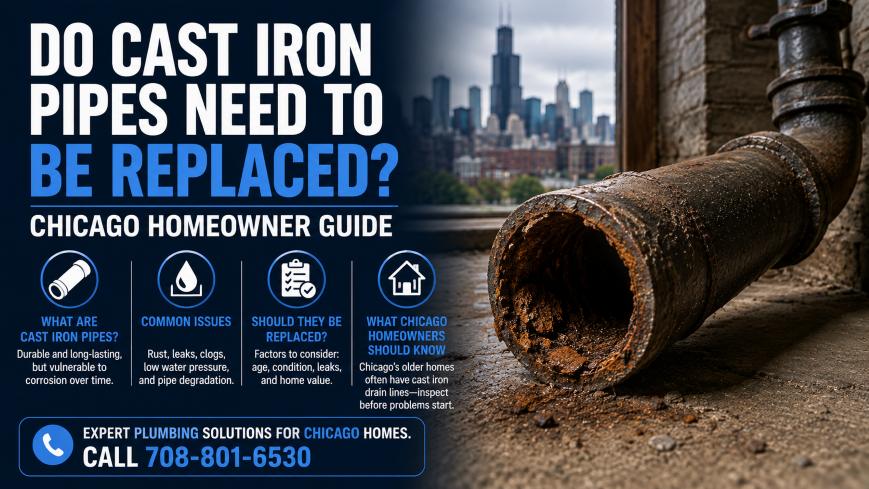
Age Alone Doesn’t Answer This Question — Condition Does. Here’s the Actual Decision Framework: When Cleaning and Maintenance Are Enough, When Targeted Repair or Lining Makes Sense, and When Full Replacement Is the Honest Recommendation.
“Do I need to replace my cast iron pipes?” is one of the most common questions we get from Chicago-area homeowners, and it’s almost always asked the wrong way. The question isn’t really about age — plenty of 70-year-old cast iron laterals are still doing their job, and plenty of 40-year-old ones are already failing. The real question is condition, and condition is something only a camera inspection can actually tell you. If you’re looking for the full picture of why Chicago’s cast iron is under so much pressure right now — the corrosion mechanics, the soil conditions, which communities are seeing the most failures — our companion piece on why Chicago’s cast iron pipes are failing right now covers that in depth. This page picks up from there and answers the decision itself: given what a camera inspection shows, what should you actually do about it?
The Short Answer, Before the Full Explanation
If you only have a minute: what a camera inspection finds determines the answer, not the pipe’s age. Here’s the condition-to-action mapping at a glance.
| What the camera finds | What it usually means |
|---|---|
| Interior roughening and scale, no cracks or offset joints | No replacement needed — maintenance and monitoring |
| One isolated crack, offset joint, or localized root intrusion | Targeted spot repair, not full replacement |
| Cracking or root intrusion across multiple sections, no collapse | Pipe lining (CIPP) is often a strong option |
| Collapsed section, severe offset joints, or corrosion-through at multiple points | Full replacement is the honest recommendation |
The sections below walk through each of these in more detail.
Age Tells You to Look. It Doesn’t Tell You What You’ll Find.
Cast iron drain pipe has a genuinely wide service life. Industry guidance from the Cast Iron Soil Pipe Institute notes that many cast iron installations exceed 100 years in service, with some underground lines lasting far longer under the right conditions — which is a useful corrective to the idea that hitting a certain birthday automatically means a pipe is failing. At the same time, real-world lifespan in a specific home depends heavily on soil chemistry, water chemistry, installation quality, and what’s gone down the drain for decades, which is exactly why Chicago’s dense clay soil and aggressive freeze-thaw cycling push some local cast iron toward failure well before the more optimistic end of that range.
The practical takeaway: a home built in 1955 doesn’t automatically need a new sewer lateral, and a home built in 1965 isn’t automatically safe because it’s “only” 60 years old. Two nearly identical houses on the same block can have cast iron in meaningfully different condition depending on tree proximity, how the joints were originally packed, and how the ground underneath has moved over the decades. Age is the reason to schedule a camera inspection. It is not, by itself, the answer to whether you need to replace anything.
When Replacement Is Not the Right Answer
A cast iron system that shows interior roughening and scale buildup but no cracking, no offset joints, and no active corrosion-through is a system that’s aging normally, not failing. In that condition, the right response is a maintenance schedule — periodic hydro jetting to keep the rougher interior surface from accumulating buildup faster than a smoother pipe would, paired with camera re-inspection every few years to track whether the condition is holding steady or progressing. Replacing a structurally sound pipe because of its age alone is money spent on a problem that doesn’t exist yet, and it’s not a recommendation we’ll make just because a pipe is old.
When Targeted Repair Makes More Sense Than Full Replacement
A single offset joint, one isolated section with a crack, or a localized area of root intrusion in an otherwise sound system is usually a spot-repair problem, not a whole-lateral problem. Excavating and repairing the specific damaged section — rather than replacing 40 or 80 feet of pipe to fix a 5-foot problem — is both less disruptive and more cost-effective when the rest of the line’s condition supports it. This is also where professional sewer tree root removal matters: clearing the roots without addressing the compromised joint they entered through just invites them back, so a spot repair that actually seals the entry point is what makes the fix last.
When Lining Can Extend the Pipe’s Life Without Full Excavation
Cured-in-place pipe lining (CIPP) — inserting a resin-saturated liner that cures into a smooth new interior surface inside the existing pipe — is a legitimate option for cast iron that’s cracked or root-infiltrated across multiple sections but hasn’t collapsed and doesn’t have severe offset joints. It’s trenchless, which means minimal excavation, and it seals the interior against future root intrusion in a way that repeated rodding never will. It is not a fix for every situation: a pipe with a collapsed section, severe grade problems, or joints so offset the sections no longer line up generally can’t be lined effectively, because the liner has to follow the existing pipe’s path. Our full breakdown of trenchless lining versus traditional excavation in Chicago goes deep into the cost comparison, the grade-correction limitation, and how to evaluate whether a contractor recommending lining is doing so because it’s right for your line or because it’s what they sell.
When Full Replacement Is the Honest Recommendation
Full replacement becomes the right call when a camera inspection shows damage that’s no longer isolated — multiple sections with active corrosion-through, joint failure recurring at several points along the line, a collapsed section, or root intrusion returning every few months because the underlying compromised joints are too numerous to spot-repair individually. At that point, continuing to rod and patch a system in that condition typically costs more over a few years than replacing it correctly does once. This is also the point where a full home repiping conversation becomes relevant if the home’s supply lines are aging on the same postwar timeline as the drain system, since coordinating both as one project is usually more efficient than two separate emergency responses years apart.
When replacement is the answer, Schedule 40 PVC is the standard material used for residential drain and sewer lateral replacement in Chicagoland today, and for good reason: it’s smooth-walled, corrosion-resistant, and doesn’t develop the interior scaling that makes cast iron accumulate buildup faster over time. The trade-off worth knowing about is sound — cast iron dampens the noise of water moving through a drain stack far better than PVC does, which is why some homeowners replacing an interior stack in occupied living space ask about sound-insulating wrap or strategic placement away from bedrooms. It’s a minor consideration next to the corrosion and maintenance benefits, but worth raising with your plumber if a stack runs near a room where drain noise would actually bother you.
The Decision Framework in One Place
Stripped down to the essentials, the decision runs in this order: first, get a camera inspection — not a rod-and-clear service call, an actual documented look at the interior condition, since a camera inspection of your sewer line is the only reliable way to know what you’re actually dealing with. Second, ask specifically what the inspection found: interior roughening only, isolated joint or crack damage, or multiple/widespread structural issues. Third, match the finding to the response — maintenance and monitoring for roughening alone, targeted spot repair of your sewer line or lining for isolated-to-moderate damage, full replacement for widespread structural failure. If a warning sign shows up between camera inspections — multiple slow drains at once, a rodding that only buys a few weeks of relief, sewage odor, or unexplained basement moisture — our complete guide to sewer line warning signs covers what each symptom actually means and how urgently it needs attention. And if the issue seems concentrated at one fixture rather than the whole system, our guide to toilet drain cleaning in Chicago walks through how to tell a fixture-level clog from a main-line problem using the same diagnostic logic.
What This Actually Costs, in Brief
Costs vary widely depending on which of the responses above actually applies to your line, and lumping them into a single number is how homeowners end up either underbudgeting or overpaying. In general terms: targeted spot repair tends to run in the low thousands, trenchless lining and full excavated replacement tend to land in a broadly similar range depending on length and access, and full home repiping is a larger project scaled to the size of the house. Our detailed cost guide linked above breaks down real Chicagoland numbers for each option, what drives cost up locally — frost-depth burial requirements, clay soil, mature tree roots, permitting — and exactly what to ask a contractor before signing anything, so it’s worth reading in full once you know which category your situation falls into.
If You’re Buying or Selling: Why the Camera Inspection Matters More Than the Age
Illinois law requires home sellers to disclose known material defects, and the Residential Real Property Disclosure Act specifically includes plumbing system condition among the items a seller must disclose if they’re aware of it — but “aware of” is doing real work in that sentence. A seller who has never had the sewer line camera-inspected genuinely may not know it has a problem, which means the disclosure form can come back clean on a system that’s actually close to failing. A standard home inspection doesn’t scope the underground lateral either, which is why a pre-purchase camera inspection is worth requesting as part of any offer on a Chicago-area home built before 1980, regardless of what the listing disclosures say. For a seller, having that same inspection done before listing turns an unknown liability into either a documented clean bill of health or a known cost that can be priced into the sale honestly — either outcome is better than a buyer’s inspector finding it first.
Getting an Honest Answer for Your Specific Pipe
The only way to actually answer “do I need to replace my cast iron pipes” for your specific home is a camera inspection that documents real condition rather than guessing from age or symptoms alone. We run the camera first on every cast iron evaluation, show you the footage, and tell you plainly which category your system falls into — maintenance, targeted repair, lining, or replacement — rather than defaulting to whichever option happens to be the most expensive.
Frequently Asked Questions
How old do cast iron pipes have to be before they need replacement?
There isn’t a fixed age that triggers replacement. Cast iron can remain structurally sound for 70, 80, or more years under favorable conditions, while a pipe half that age can already show significant deterioration in Chicago’s clay soil and freeze-thaw environment. Age is the reason to schedule a camera inspection, not the basis for a replacement decision on its own.
Can cast iron pipes be repaired instead of replaced?
Often, yes. Isolated damage — a single offset joint, one cracked section, localized root intrusion — is usually a candidate for targeted spot repair rather than full replacement. Whether repair is enough versus full replacement depends entirely on how widespread the damage is, which only a camera inspection can show.
Is pipe lining a permanent fix for cast iron problems?
Lining is a durable, long-term solution for cast iron that’s cracked or root-infiltrated but structurally intact — it isn’t a temporary patch. It isn’t appropriate for every situation, though: pipes with collapsed sections or significant grade problems generally can’t be lined effectively, since the liner follows the shape of the existing pipe rather than correcting it.
What happens if I just keep rodding a failing cast iron line instead of repairing it?
Rodding clears whatever is currently blocking the pipe but does nothing to address damaged joints, cracks, or root entry points, so the same problem tends to return — often faster each time as the underlying damage progresses. If a line needs rodding every few months, that’s usually a sign of structural damage a camera inspection should confirm, not a maintenance routine to keep repeating indefinitely.
Not Sure If Your Cast Iron Needs Replacing?
Licensed, insured, and serving Chicago and Chicagoland since 1978. We run the camera first, show you the footage, and give you an honest recommendation — maintenance, repair, lining, or replacement — for your specific pipe.
Suburbs: 708-801-6530 | Chicago: 773-570-2191 | Open 24/7
—
Suburban Plumbing Sewer Line & Drain Cleaning Experts
Licensed & Insured | Open 24 Hours | Serving Chicago & Chicagoland Since 1978
📞 Suburbs: 708-801-6530 | 📞 Chicago: 773-570-2191