
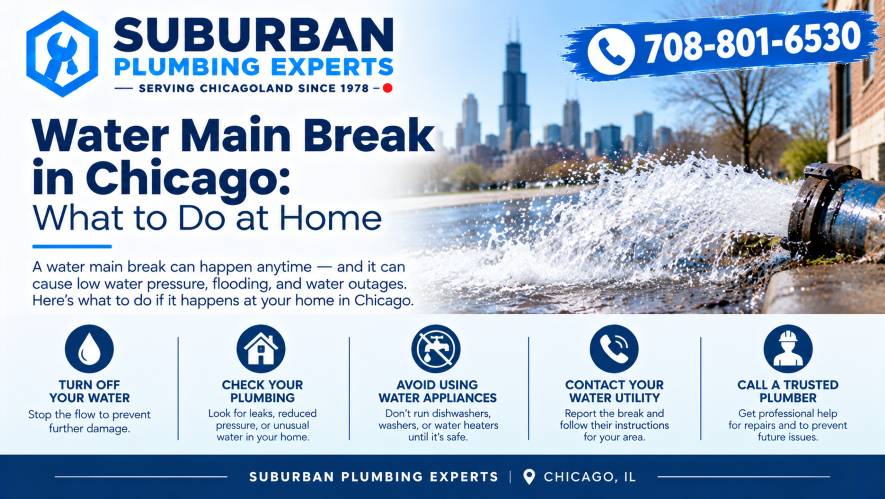
A Water Main Break on Your Street in Chicago: What Happens to Your Water and What to Do Inside Your House
When a water main breaks near your home, the city handles the pipe in the street. What happens inside your house is your problem: the pressure drops or disappears, the water comes back brown or cloudy, sediment rides into your fixtures and water heater, and in a city with an estimated 400,000 lead service lines, there’s a lead question on top of it. This guide covers how to tell whether the break is the city’s or yours, what to do in the first hour, how to protect your water heater and appliances, what Chicago and the EPA advise if you have a lead service line, and what a boil order actually requires of you.
Is It the City’s Main or Your Own Line?
Start with the phone number: 311. The City of Chicago’s Department of Water Management (DWM) says to call 311 to report a leak or a break on your water service line, and that a DWM investigator will identify whether the leak or break is on private or public property. DWM repairs the public side. The property owner is responsible for repairs on the private side.
That dividing line matters for what you do next. A break in the main in the street is the city’s to fix, and your job is to protect what’s inside the house. A leak or break on your own service line is a plumbing repair, and in Chicago it can also come with a program that’s worth knowing about before you pay for anything: DWM’s Leaks and Breaks program offers free lead service line replacement and a new water meter for properties with a leaking or broken lead service line, for any building type, and DWM’s block-level program covers properties affected by water main or sewer main replacement work. Eligibility and details change, so ask 311 before you hire anyone to replace a lead line. If you’re in a suburb rather than the city, the same steps apply, but call your village’s public works department instead of 311.
What You’ll Notice Inside Your House
- No water or low pressure. The most obvious sign, and it often affects the whole block.
- Sputtering faucets. Air in the lines as service is restored.
- Brown, yellow, or cloudy water. Sediment and rust stirred up by the change in flow when the main is shut off and refilled.
- A boil order. DWM can issue one after a break or a major repair, and it has said it does so in consultation with the Illinois EPA. Follow the city’s notice.
What to Do First
- Report it if it isn’t reported. Call 311 if you see water in the street or parkway, or if you have a leak you think is on your side of the line.
- Don’t drink or cook with discolored water. Wait until it runs clear, and follow any city advisory.
- Run cold water first, not hot. Water utilities commonly advise opening a cold tap, usually the one closest to where the water enters the house, or an outdoor spigot, and running it until it clears. Avoid running hot water until the cold is clear, so sediment isn’t pulled into the water heater.
- Hold off on laundry and the dishwasher until the water runs clear, so sediment doesn’t end up in your clothes or appliances.
- Clean the aerators and check the screens. Unscrew faucet aerators and rinse out any grit, and check the screens on the washing machine’s hose connections.
- Open faucets slowly when service returns, and look for drips at fittings once the pressure is back.
Your Water Heater After Discolored Water
The water heater is where sediment collects. If your cold water has cleared but the hot water is still discolored, the sediment is likely in the tank. Draining a few gallons from the tank’s drain valve can clear it, and our guide on what causes water heater sediment explains why it settles at the bottom and what a proper flush involves. If the hot water stays cloudy or you hear popping from the tank afterward, our water heater services team can flush it and check the unit.
If You Have a Lead Service Line
Chicago has an estimated 400,000 lead service lines, by the city’s own count as reported by WTTW, and construction near them is exactly when lead is most likely to get into the water. WTTW’s reporting on an EPA study of Chicago homes notes that higher lead levels occurred mainly after construction disrupted the lines. A main break and its repair can disturb the lines in a similar way.
The EPA’s advice to Chicago residents about lead in drinking water is specific:
- If you have a lead service line, flush the tap you’ll use, such as the kitchen tap, for 3 to 5 minutes, or longer if your water provider tells you to. To avoid wasting the water, time the flush with a shower or a load of laundry.
- Use a water filter certified to remove total lead.
- Clean faucet aerators regularly, since lead particles can get trapped in them.
- Use cold water for drinking, cooking, and baby formula. Hot water can carry more lead.
- Chicago residents can call 311 to ask about testing.
Boiling does not remove lead, according to the EPA. If you’re not sure what your service line is made of, treat it as lead until you know. Our lead service line replacement service can identify what’s in the ground and replace it, and if you’re deciding on a filter, ask for the lead-reduction certification before you buy.
If the City Issues a Boil Order
A boil order means the water could carry germs. The CDC’s guidance for drinking water advisories is to use bottled water or bring tap water to a rolling boil for one minute and let it cool before drinking or cooking with it. During an advisory, don’t use water or ice from the dispensers on your refrigerator or freezer, because they’re connected to your water line, and it’s safe to wash clothes as usual. Boiling kills germs but does not remove chemicals, so a boil order and the lead steps above are separate issues. Follow the city’s notice for when the advisory is lifted.
If Water Is Coming Into Your Basement or Yard
If water is entering from outside, keep out of standing water near electrical outlets, the panel, or appliances, and don’t wade into a flooded basement with power on. If the water is coming from your own service line, shut off the main valve inside the house. Call 311 to report the break, photograph the damage and the source, and call your insurer promptly. Our basement flooding services can help with the cleanup and with finding out how the water got in.
When the Problem Is Your Own Service Line
Not every low-pressure problem is a city main. Signs that the leak is on your side include a soggy spot or sunken area between the street and the house, a water bill that climbs with no change in use, the sound of running water with every fixture off, and low pressure in your house while your neighbors have normal pressure. Call 311 first so DWM can determine whether the break is public or private. If it’s private, our leak detection services locate the leak, and our water line repair and replacement team fixes it. If your pressure stays low after the city says service is restored, and the neighbors are back to normal, call us, because a partial blockage or a failed valve on your side are worth ruling out.
Prepare Before the Next Break
- Know where your main water shutoff is and that it turns.
- Find out what your service line is made of, and whether your property qualifies for a city replacement program.
- Keep at least a three-day supply of drinking water, one gallon per person per day.
- Our guide on protecting your plumbing in a winter power outage covers storage and the water heater as an emergency source.
- Keep a lead-certified filter or bottled water on hand if you have a lead line.
- Clean your aerators on a schedule rather than only after a problem.
- Save a plumber’s number where you can find it.
Frequently Asked Questions
Who fixes a water main break in Chicago?
The City of Chicago’s Department of Water Management repairs the public side, including the main. The property owner is responsible for repairs on the private side of the service line. Call 311 and a DWM investigator will determine which side a leak or break is on.
Is brown water after a main break safe to drink?
Discolored water is usually sediment and rust stirred up in the lines, but you shouldn’t drink or cook with it until it runs clear, and you should follow any advisory from the city. If it doesn’t clear after running cold water for a while, call 311.
Why should I run cold water instead of hot water first?
Running hot water first can pull sediment into your water heater. Water utilities commonly advise flushing the cold line until it’s clear before using any hot water.
Does boiling water remove lead?
No. The EPA says boiling does not remove lead, and the CDC says boiling does not remove chemicals. Use a filter certified to remove total lead and use cold water for drinking and cooking.
Can I wash clothes during a boil order?
The CDC says it is safe to wash clothes as usual during a boil water advisory. It also says not to use water or ice from refrigerator and freezer dispensers.
Will the city pay to replace my lead service line?
It may. The Department of Water Management’s Leaks and Breaks program offers free lead service line replacement and a new meter for properties with a leaking or broken lead service line, and its block-level program covers properties affected by water main or sewer main replacement work. Call 311 to check eligibility before you pay for private replacement.
Know Which Pipe Is Yours Before the Next Break
The main in the street is the city’s, and the lines and fixtures inside your property are yours. The people who handle a main break well are the ones who already know where their shutoff is, what their service line is made of, and what to run first when the water comes back. If you’d like your line, your water heater, and your fixtures checked, our emergency plumbing services team is available around the clock.
Water Trouble After a Main Break?
Licensed, insured, and serving Chicago and the surrounding suburbs since 1978. Call now or fill out the form below and we’ll follow up fast to get you scheduled today.
Chicago: 773-570-2191 | Suburbs: 630-749-9057 / 708-801-6530 | Emergency: 708-518-7765 | Open 24/7
—
Suburban Plumbing Sewer Line & Drain Cleaning Experts
Licensed & Insured | Open 24 Hours | Serving Chicago & the Suburbs Since 1978
📞 Chicago: 773-570-2191 | 🚨 Emergency: 708-518-7765