
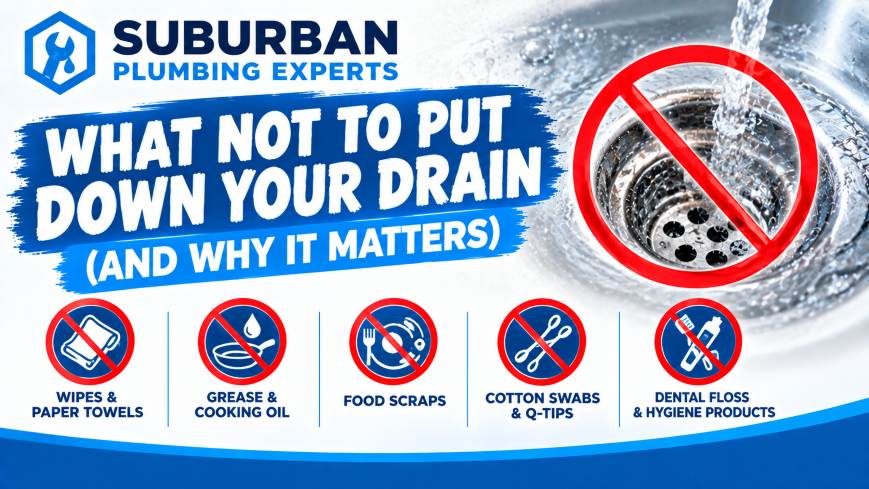
Every “Fatberg” Started the Same Way Your Kitchen Sink Does. One Ordinary Pour at a Time.
Drainage systems are built to handle water and genuinely biodegradable waste, nothing more. Most homeowners already know grease is bad for a drain, but far fewer know why specific items behave the way they do once they’re actually in the pipe, or how far the consequences reach once something leaves a single kitchen sink. This isn’t a generic list of things to avoid. It’s what actually happens to each of these once they’re in your plumbing, and why the stakes go beyond your own pipes.
Fats, Oils, and Grease: How a Kitchen Habit Becomes a City-Sized Problem
Grease that goes down warm and liquid cools and solidifies against the interior of the pipe wall, and over time it undergoes a chemical process similar to soap-making, reacting with minerals in the water and pipe to harden into a substance that’s genuinely difficult to remove, not just soft residue that a hot-water rinse will clear. Pouring hot water to temporarily liquefy grease doesn’t dissolve the underlying problem; it just moves the solidification point further down the pipe.
At scale, this is exactly how a “fatberg” forms, a mass of congealed fat, oil, and non-biodegradable material that grows in a sewer line until it partially or fully blocks it. These aren’t rare or exaggerated: reporting from a water treatment plant general manager notes that New York City spent more than $18 million in a single year clearing grease-related blockages, Baltimore spent roughly $60,000 removing one 20-foot fatberg, and Detroit spent about $100,000 on a single 100-foot blockage. Every one of those started as an individual household deciding a little grease down the drain wouldn’t matter. Collect FOG in a container instead and dispose of it with regular trash.
Kitchen Waste That Behaves Differently Than You’d Expect
Coffee grounds
Coffee grounds don’t break down the way other food waste does once wet. They compact into a dense, sediment-like mass that settles and layers inside a pipe rather than dispersing, and that layer accumulates with every pot brewed. Compost them or dispose of them in the trash instead.
Eggshells
The shell fragments themselves aren’t usually the problem, it’s the membrane lining the inside of the shell. That membrane doesn’t break down in water and instead wraps around other debris in the pipe, acting as a binding agent that turns loose particles into a more solid clog.
Starchy foods
Pasta, rice, and potato starch continue absorbing water and expanding after they go down the drain, the same gelatinization process that happens in a pot on the stove. What looks like a small amount of soft food waste can swell into a thick, paste-like mass that significantly restricts flow.
Fibrous foods
Celery, corn husks, and onion skins don’t break down quickly and instead wrap around drain components, disposal blades, and each other, forming a tangled mass rather than dispersing.
Flour
Flour reacts with water the same way it does in a mixing bowl, forming a thick, sticky paste. Inside a pipe, that paste coats the interior wall and captures other debris passing through it.
“Flushable” Is Mostly a Marketing Word
Toilet paper is engineered specifically to lose structural integrity quickly once wet, that’s the entire point of its design. Wipes marketed as “flushable” are built for the opposite property: enough structural strength to function as a wipe, which is precisely what a sewer system doesn’t need. The National Association of Clean Water Agencies runs an entire campaign, Toilets Are Not Trashcans, specifically because wipes and similar products don’t disperse the way flushable labeling implies, and they’re one of the leading contributors to the fatberg-style blockages described above when combined with grease. The EPA’s own public guidance during increased wipe use in recent years was blunt about it: flush only the three Ps, pee, poop, and toilet paper. Everything else, wipes included, belongs in the trash, a persistent myth we cover alongside several others in 10 plumbing myths Chicago homeowners still believe.
Paper Products Beyond Toilet Paper
Paper towels, napkins, and feminine hygiene products are manufactured to hold together when wet, the opposite of what toilet paper is engineered to do. They absorb water, expand, and hold their shape rather than breaking apart, creating substantial blockages even in small quantities.
Produce Stickers
Produce stickers don’t break down in water and can attach directly to pipe interiors or downstream treatment equipment. They’re small enough to seem harmless individually but accumulate the same way any non-biodegradable material does. Peel and trash them rather than rinsing them down with the produce.
Kitty Litter: The One With Consequences Beyond Your Own Pipes
Kitty litter absorbs and expands by design, which makes it an efficient clog inside a drain line regardless of clay or silica content. But the more serious issue isn’t your plumbing, it’s what happens after it leaves your house. The CDC notes that the parasite Toxoplasma gondii, commonly present in cat feces, can persist in the environment for months, and it’s known to survive standard wastewater treatment processes rather than being neutralized by them. Published wildlife research has linked flushed cat waste reaching coastal waters to toxoplasmosis infections in sea otter populations specifically because the parasite passes through treatment systems intact. Always dispose of kitty litter in the trash, regardless of what the packaging claims about flushability.
What You Pour or Flush Doesn’t Just Disappear: Medications and Household Chemicals
Flushing unused or expired medications sends pharmaceutical compounds into wastewater that standard municipal treatment isn’t designed to fully remove, and those compounds can persist into surface water afterward. The right disposal method is a pharmacy take-back program or a designated collection bin; the Illinois EPA’s medication disposal guidance lists options specific to this state.
Paint, solvents, paint thinners, and household chemicals cause damage on two fronts at once. Inside your own plumbing, many are corrosive enough to degrade pipe material over time. Further downstream, they can disrupt the biological treatment processes that wastewater plants rely on, since those processes depend on living bacteria to break down waste, bacteria that many household chemicals are specifically formulated to kill. Take these to a household hazardous waste collection site rather than a drain of any kind.
Hair
Hair is one of the most common causes of bathroom drain blockages on its own, and it becomes considerably worse combined with soap scum, which binds loose strands into a dense, pipe-clogging mass. A drain cover catches hair before it enters the pipe at all, which is a simpler fix than any of the clearing methods needed once a clump has already formed.
What Goes Down Doesn’t Just Disappear
Every item on this list shares the same underlying problem: it looks like it’s gone the moment it clears the drain, but it isn’t. It’s either building toward a blockage inside your own plumbing or moving on to a municipal system that has real limits on what it can process, and in cases like cat litter and pharmaceuticals, on to a natural environment that has even less capacity to handle it. The habits that actually prevent this are simple: a container for grease, a trash can for anything that doesn’t dissolve in water within seconds, and a proper disposal program for anything hazardous. If a blockage has already formed despite that, our drain cleaning services clear what’s already there, and our hydro jetting service handles the kind of dense, compacted buildup that a standard cleaning can’t fully reach.
—
Suburban Plumbing Sewer Line & Drain Cleaning Experts
Licensed & Insured | Serving Chicago & the Suburbs Since 1978