
Your Sump Pump Is Working Harder Than It Used to. Here’s Proof, and Here’s How to Tell When It’s Losing.
This isn’t just a feeling. According to the Illinois State Climatologist’s office, the observed number of extreme precipitation events in Illinois has increased by roughly 40 percent since the early 1900s, and the most intense rainfall events have increased by 45 percent across the Midwest in recent decades. Storms that used to be occasional are now routine, and every sump pump in Lemont is being asked to do more than the pump it replaced was ever designed for. A pump that’s quietly nearing the end of its life isn’t just a maintenance item anymore, it’s the one piece of equipment standing between a normal Tuesday storm and a flooded basement.
Why Lemont’s Sewer System Makes This Especially Important
The Village of Lemont’s Public Works Department maintains three separate systems across roughly 150 miles of pipe: a sanitary sewer system carrying wastewater to the Metropolitan Water Reclamation District, a storm sewer system that drains rainfall runoff to the I&M Canal, and, in the village’s older sections, a combined sewer system carrying both at once. That last category matters enormously for basement flood risk: in a combined sewer area, a heavy rain event can push the shared system past capacity, and that pressure can back up through a private lateral into a basement. If your home sits in one of Lemont’s older, combined-sewer neighborhoods, a sump pump alone doesn’t fully address that risk, it protects against groundwater and seepage, not sewage backing up through a floor drain during a surcharge event. Knowing which system serves your specific property is worth confirming with the Village directly.
The Warning Signs, and Why Each One Actually Happens
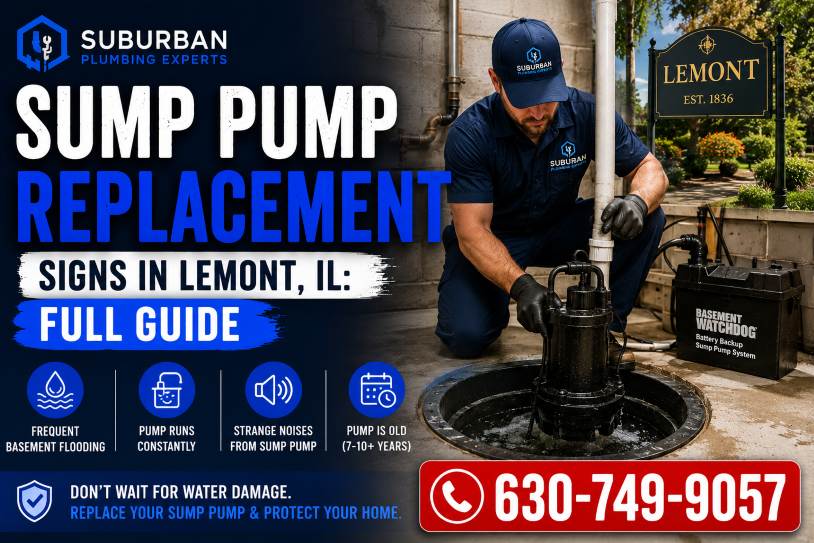
Frequent cycling. A sump pump that turns on and off far more often than it used to is under real stress, caused by an improperly adjusted float switch, a failing motor, a clogged discharge line, or a pump that was undersized from the start for the water volume it’s actually handling. Repeated starting and stopping wears components faster than continuous operation would, and it’s often the earliest sign something’s wrong, well before a complete failure.
Excessive noise or vibration. A healthy sump pump runs quietly. Grinding, rattling, or persistent vibration points to degraded internal components, the impeller or bearings in particular, and ignoring these sounds risks a sudden stoppage during the exact storm that needed the pump most.
Irregular operation during heavy rain. A pump that struggles to keep up, runs continuously without lowering the water level, or cycles unpredictably during an actual storm is showing you its real-world limits under the load that matters most. This is meaningfully different from how it might perform during a routine test with a bucket of water, and it’s the performance that actually counts.
Visible corrosion. Rust or pitting on the pump housing, discharge pipe, or float assembly signals internal deterioration that isn’t yet visible. Once corrosion starts, it tends to progress, and internal seals, switches, and bearings wear out considerably faster once the housing itself has begun breaking down.
Persistent basement moisture. Damp spots, musty odors, or minor seepage after a storm, even without a full flood, mean the pump isn’t removing water as efficiently as it should. This lingering moisture is exactly the condition that leads to mold growth and wood rot if it goes unaddressed.
Age. Most residential sump pumps last 7 to 10 years with reasonable maintenance. A pump already past that range can fail without warning even if it currently seems to run fine, since internal wear often doesn’t announce itself until the motor or switch actually gives out.
Inconsistent water removal. A pump that empties the pit fully on some cycles but not others often has a clog or a developing mechanical issue, and inconsistent performance is a reasonable signal to have it assessed before it becomes complete failure.
What Repair or Replacement Actually Costs
According to Angi’s cost data, professional sump pump replacement typically runs $309 to $755, with a broader possible range of $120 to $1,350 depending on unit type and installation complexity. Repairs on an otherwise sound pump, a clogged discharge line, a stuck float switch, a jammed impeller, generally run $400 to $550. Annual maintenance, inspection, cleaning, and minor part replacement, typically runs up to $250 a year. Set against even moderate basement water damage, that’s a modest, predictable cost rather than a discretionary one.
The Insurance Gap Almost Nobody Checks Until It’s Too Late
Standard homeowners insurance generally does not cover water damage from a failed sump pump or a sewer backup. According to Insurance.com’s coverage guide, a standard policy covers sudden, accidental damage like a burst pipe, but specifically excludes water backing up through a drain, sewer, or a failed sump pump unless a separate water backup endorsement has been added. That endorsement typically costs $50 to $250 a year for $5,000 to $25,000 in coverage per occurrence, a small premium against a basement flood that easily runs into the thousands. It’s worth noting what it doesn’t cover, too: the endorsement pays for the damage the failure causes, not the cost of repairing or replacing the pump itself. If you have a basement in Lemont and you’re not certain this coverage is on your policy, a five-minute call to your insurance agent now is far better than finding out during a claim.
Submersible vs. Pedestal: Choosing the Right Replacement
Submersible pumps sit fully inside the sump basin, sealed against moisture, and generally cost more upfront but run quieter and handle debris better over time. Pedestal pumps mount above the basin with only the intake submerged, cost less, and are easier to service, but tend to be noisier and more exposed to wear. Given the increased rainfall intensity Lemont has seen in recent years, a submersible unit is usually worth the added cost for a basement that deals with regular water intrusion or a genuinely high water table; a pedestal pump remains a reasonable choice for lighter, occasional use.
Why a Battery Backup Isn’t Optional Anymore
Heavy rain and power outages tend to arrive together, and a sump pump running only on household electricity is protecting your basement right up until the exact moment protection matters most. A battery backup system takes over automatically the instant the primary pump loses power or fails outright, running off a deep-cycle battery until utility power returns. Given the documented increase in extreme rainfall events across the region, this is no longer a nice-to-have addition, it’s the piece that closes the single biggest gap in an otherwise well-maintained system.
What a Sump Pump Doesn’t Protect Against
A sump pump manages groundwater and hydrostatic pressure, water seeping in through the floor or foundation walls. It does not stop sewage from backing up through a floor drain during a heavy rain event in a combined sewer area, that’s an entirely different mechanism, caused by pressure in the shared stormwater and sanitary system rather than rising groundwater, and it requires a backflow prevention valve to address. For homes in Lemont’s older, combined-sewer neighborhoods specifically, both systems working together provide meaningfully more complete protection than either one alone.
Upgrading to a More Energy-Efficient Model
Modern sump pumps generally run more efficiently than units from a decade or more ago, drawing less power per gallon moved while often delivering stronger, more consistent performance. For a pump that’s already due for replacement, upgrading to a current, properly sized model is a straightforward way to combine better flood protection with a modest reduction in ongoing energy cost, rather than replacing like-for-like with an equivalent to what’s failing.
A Maintenance Routine That Actually Extends the Pump’s Life
- Test it every few months by pouring water into the pit and confirming the float switch triggers the pump and it discharges cleanly within seconds.
- Clean the pit and inlet screen every three to four months, clearing debris that can jam the float switch or restrict intake flow.
- Check the discharge line seasonally for clogs or ice blockage, particularly before spring thaw, since a blocked line forces the pump to work against pressure it shouldn’t have to.
- Have a professional inspection done annually, checking the float switch, confirming the pump empties the pit fully, and catching wear before it becomes failure.
Considerations Specific to Lemont Homeowners
Beyond the sewer system distinction covered above, Lemont’s terrain along the Des Plaines River valley means water table levels and drainage conditions can vary noticeably even between neighboring properties. For a broader overview of plumbing and basement protection issues Lemont homeowners should know in 2026, see our full Lemont, IL plumbing guide, and if sewer backups specifically are a concern alongside sump pump performance, our guide to identifying sewer line problems in Lemont Township covers what to check on that side of the system. For a region-wide breakdown of current sump pump pricing, see our Chicagoland sump pump repair and replacement cost breakdown.
Frequently Asked Questions
How do I know if I need a repair or a full replacement?
Age is the biggest factor. A pump under 10 years old with a specific, isolated problem, a clogged line, a stuck switch, is usually worth repairing. A pump already past 10 years, or one showing multiple warning signs at once, is generally more cost-effective to replace outright.
Does my homeowners insurance cover sump pump failure damage?
Usually not automatically. Standard policies typically exclude water backup and sump pump failure unless a separate water backup endorsement has been added, generally $50 to $250 a year for $5,000 to $25,000 in coverage. Confirm this with your agent before you need it.
Do I need both a sump pump and a backflow valve?
If your home is in one of Lemont’s older, combined-sewer neighborhoods, quite possibly yes, since the two systems address entirely different failure modes: groundwater intrusion versus sewer backup during a surcharge event.
Why does my sump pump seem to run more than it used to?
Beyond a mechanical issue with the pump itself, documented increases in extreme rainfall intensity across Illinois mean pumps installed years ago are genuinely handling more water than they were originally sized for.
How often should I test my sump pump?
At minimum every few months, and always before spring thaw and before peak summer storm season. Pour water into the pit and confirm the pump activates and discharges within seconds.
Licensed Sump Pump Repair & Replacement for Lemont, IL
Suburban Plumbing Experts has served Lemont and the surrounding suburbs since 1978. We hold Illinois Plumbing License #055-044116 and Sewer License #2565, and every technician on our team is a trained, background-checked employee, not a subcontractor. Whether your pump needs a repair, a full replacement, or a battery backup added for real storm-season protection, we’ll tell you honestly what your system actually needs.
Is Your Lemont Home’s Sump Pump Ready for the Next Storm?
Licensed, insured, and serving Lemont and Chicagoland since 1978. We’ll tell you honestly whether your pump needs a repair, a replacement, or nothing at all.
Lemont: 630-749-9057 | Emergency: 708-518-7765 | Open 24/7
—
Suburban Plumbing Sewer Line & Drain Cleaning Experts
Licensed & Insured | Open 24 Hours | Serving Lemont & the Suburbs Since 1978
📞 Lemont: 630-749-9057 | 🚨 Emergency: 708-518-7765