
Hydro Jetting Cleans the Whole Pipe. Rodding Just Punches a Hole Through the Clog. Here’s Why That Difference Matters in La Grange.
Most sewer clogs get “fixed” the same way: a cable pushes through the blockage, water flows again, and the problem seems solved, until it comes back a few months later. That’s because cabling typically opens a path through the center of a clog without touching the buildup coating the rest of the pipe wall. Hydro jetting does something different: it uses high-pressure water to scour the entire interior diameter of the pipe, not just punch through the middle of it. For La Grange, where a meaningful share of homes still run on original sewer laterals dating to the 1920s through 1950s, that distinction is the difference between a temporary fix and one that actually lasts.
How Hydro Jetting Actually Works
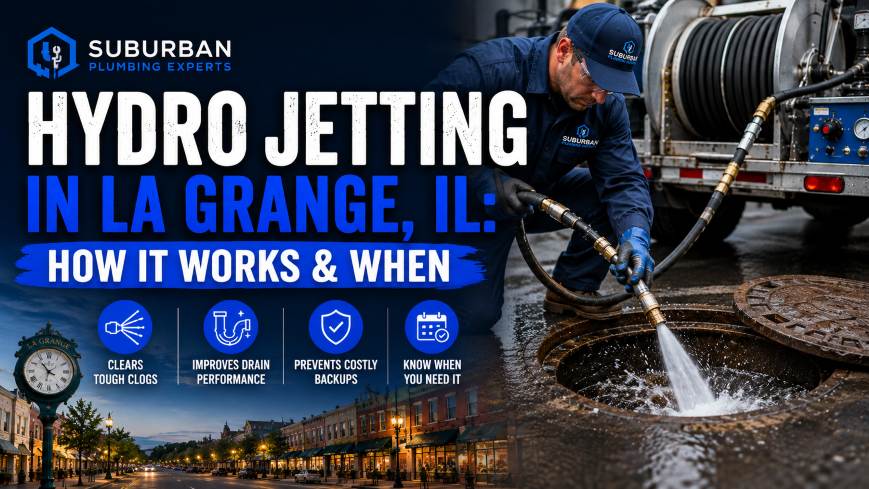
A hydro jetting unit pressurizes water and sends it through a flexible hose fitted with a specialized nozzle, fed into the sewer line through an existing cleanout. According to Cam Spray, an industrial jetter manufacturer, two separate specifications determine how a jetter performs: PSI (pounds per square inch), which delivers the cutting and blasting force needed to break buildup loose from the pipe wall, and GPM (gallons per minute), which is what actually carries that loosened debris out of the pipe rather than letting it resettle further down the line. Both numbers matter together, pressure without enough flow can leave debris behind even after it’s broken loose.
Nozzle design also plays a role: rear-facing jets propel the hose forward while scouring the pipe walls as they pass, and forward-facing jets concentrate force directly ahead to break through the toughest blockages, root masses in particular. A trained technician selects nozzle type and pressure based on the pipe’s material, diameter, and condition, rather than running one setting on every job. In practice, that means residential drain lines are typically cleaned at lower pressures, roughly 1,500 to 2,500 PSI at 4 to 8 GPM, calibrated to protect smaller-diameter interior piping, while a home’s main sewer lateral can generally handle a stronger 2,500 to 3,500 PSI at higher flow, since the larger pipe diameter and typically sturdier construction tolerate more force. Commercial and municipal lines are cleaned at the highest end of the range, up to 4,000 PSI, equipment most homeowners will never need but that matters for context on why “how much pressure” isn’t a single fixed number.
Hydro Jetting for La Grange Restaurants and Commercial Properties
Restaurants and other commercial kitchens face a version of this problem that residential homes rarely see at the same scale: continuous grease output that a grease trap only partially intercepts before it reaches the sewer lateral. Regular grease trap cleaning reduces the load, but the lateral itself still benefits from periodic jetting to clear whatever accumulates downstream of the trap over time. For multi-unit or commercial properties in La Grange, our commercial drain cleaning services apply the same camera-first, jet-second approach at the scale a business actually needs.
Why a Camera Inspection Comes Before Jetting, Not After
Pressure that’s appropriate for a sound PVC pipe can be too aggressive for a compromised clay or cast iron line. A sewer camera inspection before jetting confirms the pipe’s actual material and condition, and flags any existing cracks, offset joints, or partial collapse that would make full-pressure jetting risky rather than helpful. This sequencing matters especially in La Grange, where original clay tile laterals installed decades ago may have weakened at joints and bends in ways that aren’t visible from the surface. Our companion piece on what La Grange’s historic housing stock means for your private pipes goes deeper into exactly what a camera reveals on lines of this age.
When Hydro Jetting Is the Right Call
- Recurring clogs that keep coming back despite being cleared before, a sign that buildup coating the pipe wall, not just a single blockage, is the real problem.
- Grease and soap scum buildup, common in kitchen and shared lines, which rodding tends to punch through rather than actually remove. For the full mechanics of why grease-related clogs keep coming back after rodding, see The #1 Cause of Drain Clogs in Chicago Homes.
- Tree root intrusion, where jetting combined with a root-cutting nozzle clears root masses more completely than mechanical cutting alone.
- Routine preventive maintenance for older lines with a history of slow drainage, restoring the pipe closer to its original interior diameter before a full blockage develops.
When Hydro Jetting Isn’t the Right Tool
Jetting cleans, it doesn’t repair. A pipe with a genuine structural problem, a collapsed section, a significant crack, or a joint that’s separated, needs sewer line repair targeted at that specific damage, and jetting a compromised section can make the problem worse rather than better. This is exactly why the camera inspection step matters: it tells a technician which situation they’re actually looking at before equipment gets turned on.
Hydro Jetting vs. Sewer Rodding: What Actually Differs
Sewer rodding uses a mechanical cable to break through a clog and remains a fast, effective, less expensive option for a straightforward, isolated blockage. Hydro jetting costs more upfront but cleans the full interior surface of the pipe rather than opening a path through the center, which is why it holds up better against recurring buildup and delays the next clog considerably longer. For a line with a long history of repeat problems, jetting is often the more cost-effective choice over time even with a higher initial price, since fewer follow-up service calls offset the difference.
What Actually Drives the Cost of a Hydro Jetting Job
Pricing isn’t flat, and a few specific factors explain why one job costs meaningfully more than another: the length of the line being cleaned, how severe the buildup or root intrusion actually is, how accessible the cleanout is, and whether a camera inspection and a follow-up verification pass are included. A short, lightly clogged residential line with easy cleanout access costs considerably less than a long lateral with heavy root intrusion and limited access. For a detailed, property-type breakdown of current pricing across the region, see our complete guide to hydro jetting costs in Chicagoland. Getting a clear quote after a camera inspection, rather than a flat number over the phone before anyone has actually looked at the line, is the difference between an accurate price and a guess that changes once the technician arrives.
Why Tree Root Intrusion Comes Back, and What That Means for Scheduling
Jetting with a root-cutting nozzle clears existing root intrusion effectively, but it doesn’t kill the tree or stop new roots from growing back toward the same crack or joint that let them in the first time, since that’s exactly where moisture continues to escape the pipe. For a La Grange property with mature trees near the sewer lateral, this is why root-related jetting is often scheduled as recurring maintenance rather than a one-time fix, typically every one to two years, rather than treated as a problem that’s permanently solved after a single visit. The underlying fix for the moisture leak itself, the crack or joint the roots are exploiting, is a repair issue, not a cleaning one, and a camera inspection is what identifies whether that repair is worth pursuing alongside ongoing jetting.
What to Expect From a Professional Hydro Jetting Service
A typical visit starts with a camera inspection to confirm pipe condition and locate the problem area, followed by the jetting itself, usually completed within a few hours depending on the length and condition of the line. A second camera pass afterward confirms the line is actually clear and gives a documented before-and-after record. Homeowners generally don’t need to prepare anything beyond providing access to a cleanout; the process doesn’t require excavation and leaves no mess behind. The overall approach follows the same fundamentals covered in WinCan’s explainer on NASSCO’s Pipeline Assessment Certification Program, the recognized North American standard for how sewer condition assessment is documented and coded across the industry.
Frequently Asked Questions
Is hydro jetting safe for older sewer lines?
It depends entirely on the pipe’s actual condition, which is exactly why a camera inspection happens first. A sound clay or cast iron line generally handles jetting fine at an appropriately calibrated pressure; a line with existing cracks or separated joints may not, and a technician adjusts or recommends repair instead based on what the camera shows.
How is hydro jetting different from snaking or rodding?
Rodding and snaking use a mechanical cable to break through the center of a clog. Hydro jetting uses pressurized water to scour the entire interior wall of the pipe, removing buildup rodding leaves behind and delaying the next clog considerably longer as a result.
How often should hydro jetting be done as maintenance?
For a line with a history of recurring clogs or significant tree root exposure, every one to two years is a reasonable preventive interval. A line with no history of problems generally doesn’t need jetting on a routine schedule.
Can hydro jetting fix a cracked or collapsed pipe?
No. Jetting cleans buildup and debris; it doesn’t repair structural damage, and jetting a compromised section can worsen the problem. A camera inspection distinguishes a cleaning issue from a repair issue before any pressure is applied.
Does hydro jetting require digging up my yard?
No. The equipment feeds through an existing cleanout, and the process doesn’t disturb the yard, driveway, or landscaping.
What determines the cost of a hydro jetting job?
The length of the line, the severity of buildup or root intrusion, how accessible the cleanout is, and whether a camera inspection and follow-up verification are included all factor in. An accurate quote generally follows a camera inspection rather than preceding one.
Do restaurants and commercial properties need hydro jetting more often than homes?
Generally, yes. Continuous grease output means commercial kitchen lines accumulate buildup faster than residential lines, even with regular grease trap cleaning, which is why commercial properties often benefit from a more frequent jetting schedule.
Licensed Hydro Jetting Service for La Grange, IL
Suburban Plumbing Experts has served La Grange and the surrounding suburbs since 1978. We hold Illinois Plumbing License #055-044116 and Sewer License #2565, and every technician on our team is a trained, background-checked employee, not a subcontractor. Whether you’re dealing with a recurring clog or want a documented, thorough cleaning ahead of a problem, our hydro jetting service and La Grange, IL plumbing team can help.
Dealing With Recurring Clogs in Your La Grange Home?
Licensed, insured, and serving La Grange and Chicagoland since 1978. We run the camera first to confirm hydro jetting is the right fit before we start.
Suburbs: 708-801-6530 | Emergency: 708-518-7765 | Open 24/7
—
Suburban Plumbing Sewer Line & Drain Cleaning Experts
Licensed & Insured | Open 24 Hours | Serving La Grange & the Suburbs Since 1978
📞 Suburbs: 708-801-6530 | 🚨 Emergency: 708-518-7765