
Your Home Inspector Walked Through the Whole House, Tested Every Fixture, and Handed You a Clean Report. They Never Once Looked at the One Pipe Most Likely to Cost You Five Figures. Here’s Why, and What to Do About It.
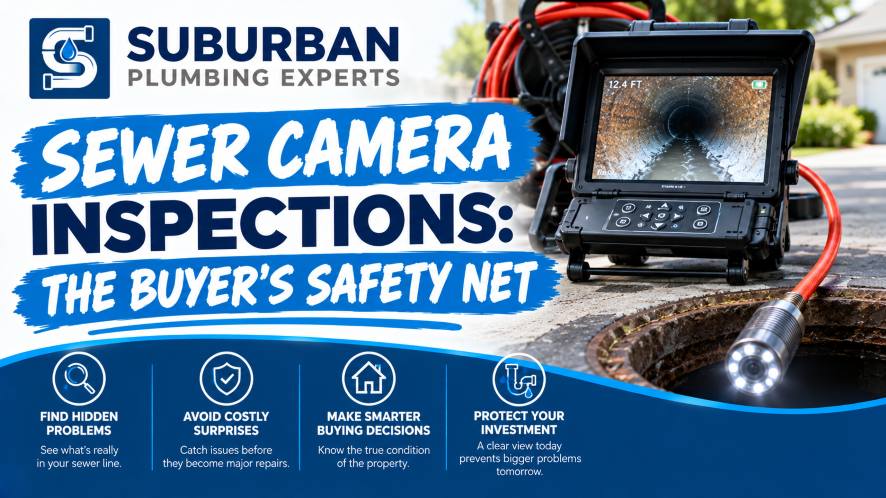
A sewer camera inspection is exactly what it sounds like: a waterproof camera on a flexible cable, fed through the sewer line from a cleanout, a roof vent, or sometimes a removed toilet, sending back live video of the pipe’s actual interior condition from the house to the city main. It’s a simple piece of technology. What it reveals is often anything but simple, especially in a region like Chicagoland, where a large share of the housing stock still runs on sewer laterals installed 60 to 100 years ago.
If you take one thing from this page, make it this: a standard home inspection does not include this. Not because your inspector is cutting corners, but because it was never part of the job description.
Why Your Home Inspector Skipped the Sewer Line
This isn’t an oversight or a judgment call individual inspectors make differently. It’s written directly into the national standard the profession works from. The American Society of Home Inspectors’ Standard of Practice lists, under the plumbing section, that an inspector is not required to inspect “septic and other sewage disposal systems” as part of a general home inspection. The sewer lateral running underground from the house to the street falls squarely into that excluded category. A general home inspector will run your faucets, flush your toilets, and check for visible leaks under sinks. What they can’t do, and aren’t required to do, is tell you what’s happening in 40 to 80 feet of buried pipe that nobody can see without threading a camera through it. The inspection you already paid for was never going to catch a collapsing lateral, because catching one was never part of what that inspection promised.
What the Camera Actually Shows
The camera head travels through the pipe while a technician watches a live monitor, looking for root intrusion, cracked or offset joints, bellied sections where the pipe sags and pools water, corrosion, grease buildup, and in older homes, deteriorated materials like Orangeburg pipe that were never meant to last this long underground. A locating transmitter on the camera head can also pinpoint the exact depth and surface position of anything significant, which matters enormously if a repair ever requires excavation.
None of this is visible, audible, or detectable from inside the house. A drain that’s draining normally today tells you almost nothing about a pipe that’s 60% blocked by root intrusion, because water is still finding its way around the obstruction. The camera is the only tool that actually answers the question “what condition is this pipe in,” rather than “does the water seem to be moving right now.”
Why This Matters So Much for a Real Estate Transaction
A home sale is one of the only moments when you have real leverage to deal with a problem that’s about to become entirely yours. Before closing, a finding on a camera report is something you can negotiate, request a credit for, or walk away from. After closing, the exact same finding is just your problem, discovered on your schedule, usually at the least convenient possible moment.
That timing is what makes a sewer camera inspection different from almost every other item on an inspection checklist. It’s not that the finding itself is unique, it’s that the window to do something about it closes the moment you sign.
If the Camera Finds Something
A finding on a camera report isn’t automatically a crisis, and it isn’t automatically nothing either. The honest answer is that it depends entirely on what’s found and how severe it is: a line with minor root intrusion that’s still flowing well is a very different conversation than a bellied section or a collapsed segment. The camera footage itself is what makes that distinction possible, since it shows the exact condition and location rather than leaving you to guess from symptoms alone.
What matters next is getting an honest read on that footage rather than a sales pitch built around it. If a finding does need to be addressed, sewer line repair can range from a targeted spot fix for a single joint to trenchless lining or full replacement for a line with more extensive damage, and which of those applies is exactly the kind of thing that should come from the same inspection, with the video in hand, rather than a second guess from a different company starting over.
Where to Go From Here, Depending on Your Situation
This page is the short version, deliberately. Depending on what you’re actually trying to do right now, one of these goes much deeper into the specifics than makes sense to repeat here:
Buying a home? Our complete guide to plumbing inspections when buying a Chicago home covers what a dedicated plumbing inspection adds beyond the standard home inspection, Chicago-specific risks like lead service lines and cast iron drain deterioration, and exactly how to use inspection findings in your negotiation before your contingency period closes.
Selling a home? Our Chicago home seller’s complete plumbing guide breaks down what buyers’ inspectors reliably find in older homes, the real math on fixing a problem before listing versus eating a credit request under contract, and a full pre-listing checklist.
Curious what’s actually down there? Our real sewer camera findings from Chicagoland homes documents, finding by finding, what root intrusion, pipe bellies, offset joints, and deteriorated materials like Orangeburg pipe actually look like on camera, and what each one means for a repair decision.
What Sellers and Buyers Both Walk Away With
A sewer camera inspection produces one of two outcomes, and both are genuinely useful. A clean report means you have documented, video-backed proof of a well-maintained system, which is real evidence either side of a transaction can point to with confidence. A report with findings means you know exactly what you’re dealing with, how severe it is, and where it’s located, before you’re locked into a decision you can’t undo.
What a camera inspection never produces is the worst outcome: finding out the hard way, after the papers are signed, that the thing nobody looked at was the thing that mattered most.
Frequently Asked Questions
Does a standard home inspection include a sewer camera inspection?
No. The national Standard of Practice that home inspectors work from specifically excludes sewage disposal systems from a general inspection. A sewer camera inspection has to be ordered separately, either from the home inspector as an add-on or directly from a licensed plumber.
Who should order a sewer camera inspection, the buyer or the seller?
Either can, and there’s a real argument for both. A buyer orders one to protect themselves before closing. A seller orders one before listing to find and address problems on their own schedule, at their own contractor’s price, rather than discovering them under contract. See the seller’s and buyer’s guides linked above for the full reasoning on each side.
What does a sewer camera inspection actually find?
Root intrusion, cracked or offset pipe joints, bellied sections where the pipe sags and traps water, corrosion, grease accumulation, and deteriorated pipe materials like Orangeburg or severely corroded cast iron. Our real findings guide, linked above, walks through each of these in detail with what they mean for repair decisions.
How long does a sewer camera inspection take?
A standard residential lateral inspection typically takes 45 minutes to 90 minutes including setup and reviewing the findings with you afterward. Homes without an accessible cleanout take a bit longer since the camera has to be run from a roof vent or through a temporarily removed toilet.
—
Suburban Plumbing Sewer Line & Drain Cleaning Experts
Licensed & Insured | Open 24 Hours | Serving Chicago & Chicagoland Since 1978