
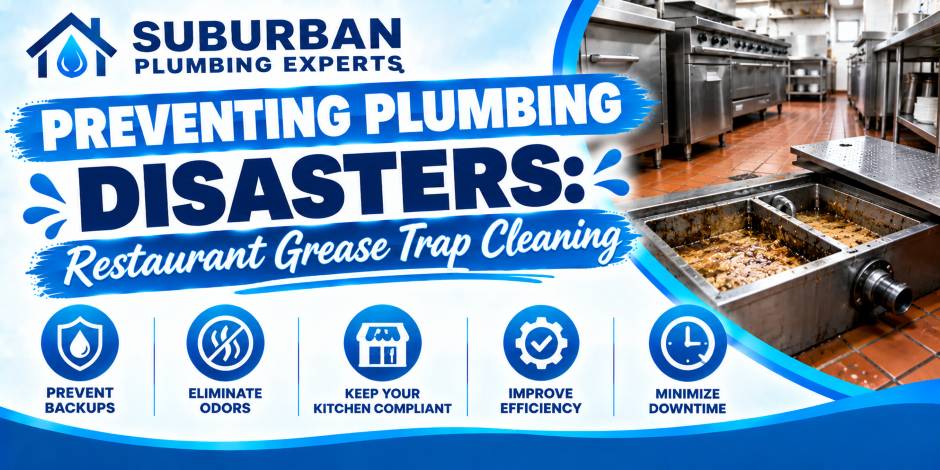
A Grease Trap Doesn’t Fail on a Random Tuesday. It Fails During Your Busiest Service, Because That’s When It’s Working Hardest
Every restaurant owner knows grease traps need to be cleaned. Fewer have actually walked through what happens when one isn’t, not the regulatory version, the real operational sequence that plays out in a working kitchen. It doesn’t happen as a single dramatic event. It’s a predictable chain, each stage quieter than the next, right up until it isn’t. Understanding that sequence is what turns “we’ll get to it next month” into “we need this handled before Friday night.”
The Sequence Nobody Notices Until It’s Obvious
Stage one: a slow drain at the three-compartment sink that staff work around rather than report, because the water still eventually goes down.
Stage two: a sewer smell near the floor drain that gets attributed to “just the kitchen” rather than recognized as sewer gas escaping past a trap that’s losing its ability to hold water back.
Stage three: a backup at the lowest fixture, usually a floor drain or the compartment sink itself, during a period of heavy water use, exactly the conditions of a dinner rush.
Stage four: standing wastewater in a working kitchen during active service, which is no longer a maintenance issue. It’s a health code violation happening in real time, with customers in the building.
Each stage is quieter and easier to dismiss than the next, which is exactly why restaurants that experience stage four almost always had stage one for weeks beforehand and never connected the two.
What a Mid-Service Backup Actually Costs
The cleanup is the smallest part of the bill. A kitchen that has to shut down mid-service loses the revenue from every table that was about to be sat, every ticket already in progress gets comped or delayed, and staff still have to be paid for a shift that just stopped generating revenue. If wastewater reaches a food prep surface, that’s not a cleaning problem, it’s a food safety event that can trigger an immediate health department response and a mandatory closure until the space is inspected and cleared, not just mopped and reopened. The restaurant that planned to make its Saturday night numbers is instead explaining to a health inspector why sewage was in the kitchen.
The Reputational Hit That Outlasts the Repair
In Chicago, food safety inspection results are public record, published on the city’s own open data portal and searchable by anyone, including the customers deciding where to eat tonight. A closure tied to a sanitary issue doesn’t stay contained to the night it happened. It becomes a line item in a public inspection history, and increasingly, a screenshot on social media before the kitchen has even finished cleaning up. A repair bill gets paid and forgotten. A public health closure shows up in search results for considerably longer, attached to your restaurant’s name specifically.
Does Insurance Actually Cover This?
Often, not the way owners assume. Commercial property and business interruption policies generally distinguish between sudden, accidental damage and damage tied to a maintenance issue the business could reasonably have prevented. A grease trap that’s gone months past its service interval and finally backs up doesn’t read as “sudden and accidental” to a claims adjuster the same way a burst pipe does, it reads as deferred maintenance, and insurers routinely push back on claims that fit that pattern. Documented, regular service records are often the difference between a claim that pays out and one that gets contested, which makes your maintenance log worth as much as the service itself.
Why Commercial Kitchens Fail Faster Than a Home Ever Would
A residential kitchen produces grease incidentally, a home’s drain line was never designed around it as a primary load. A commercial kitchen produces it as a constant byproduct of normal operation, fryers, grills, dish pits running through service after service, all discharging into the same line. That’s the entire reason a grease trap exists specifically for food service use: the volume is categorically different, and so is the speed at which a neglected line degrades. A home might go years without a real grease problem. A commercial kitchen running at volume with a trap past its service interval can go from fine to failing within weeks, which is exactly why the maintenance schedule has to be treated as an operational requirement, not a someday task.
The Line Itself, Not Just the Trap
Pumping the trap addresses what’s accumulated inside it, but grease and buildup can coat the pipe walls downstream of the trap too, narrowing the line’s effective diameter over time the same way it narrows the trap itself. This is where hydro jetting matters: high-pressure water scours the full interior wall of the line, not just the trap’s contents, clearing buildup that a standard pump-out never touches. A kitchen with a documented history of recurring slow drains despite regular trap service is usually dealing with exactly this, grease that migrated past the trap and built up in the line itself, and jetting is the tool built for that specific problem.
Catching It at Stage One
The entire sequence above is interruptible at the earliest stage, before any of the expensive consequences happen. A slow drain at the compartment sink or a persistent smell near the floor drain isn’t background noise in a commercial kitchen, it’s the system telling you where it is in the failure sequence. Training staff to report those signs immediately, rather than working around them, is free and catches the problem while it’s still a scheduling decision rather than an emergency one. If you want the full regulatory picture, how often Chicago actually requires cleaning, what the 25% rule means, and what a violation costs, our guide to Chicago grease trap requirements covers that in full. For the broader picture of what every restaurant’s plumbing needs to stay compliant beyond just the grease trap, our complete restaurant plumbing guide covers it.
What Professional Service Actually Prevents
A professional grease trap cleaning does more than pump out what’s accumulated, it confirms the trap is actually functioning at capacity, not just emptied for the moment, and gives you documentation that protects you if an insurance question or health inspection ever comes up. Scheduled service, on a documented interval, is what keeps your kitchen operating in stage zero: before any of the sequence above ever starts. Our restaurant plumbing services cover the trap, the line, and everything else a working kitchen depends on, under one relationship instead of a different call every time something different goes wrong.
Quick Answers
How do I know if my kitchen is already further into the failure sequence than I think?
Ask your kitchen staff directly whether any drain has been slower than usual or any floor drain has smelled off recently. Those reports often exist already and just never made it up the chain.
Can a single backup really trigger a health department closure?
Yes, if wastewater reaches a food prep or food storage area. That’s treated as an active food safety event, not just a cleanup task, and can mean a mandatory closure until the space passes reinspection.
Will my business interruption insurance cover lost revenue from a backup?
It depends on whether the damage is classified as sudden and accidental or as the result of deferred maintenance. A documented service history significantly strengthens your position either way.
What’s the cheapest point in this whole sequence to fix the problem?
Stage one, a slow drain nobody’s reported yet. Every stage after that gets more expensive and more disruptive, and stage four carries costs, lost revenue, a possible closure, reputational damage, that dwarf the price of routine service.
If my trap is cleaned on schedule, why do I still get slow drains?
Buildup downstream of the trap, coating the line itself, is a common cause once the trap is ruled out. Hydro jetting addresses that specifically, since a standard trap pump-out only removes what’s accumulated inside the trap, not further down the pipe.
Is my restaurant’s inspection history really visible to the public?
In Chicago, yes. Food inspection results are published on the city’s own open data portal, which means a closure or violation tied to your location is genuinely searchable, not just a private matter between you and the health department.
—
Suburban Plumbing Sewer Line & Drain Cleaning Experts
Licensed & Insured | Serving Chicago & the Suburbs Since 1978