
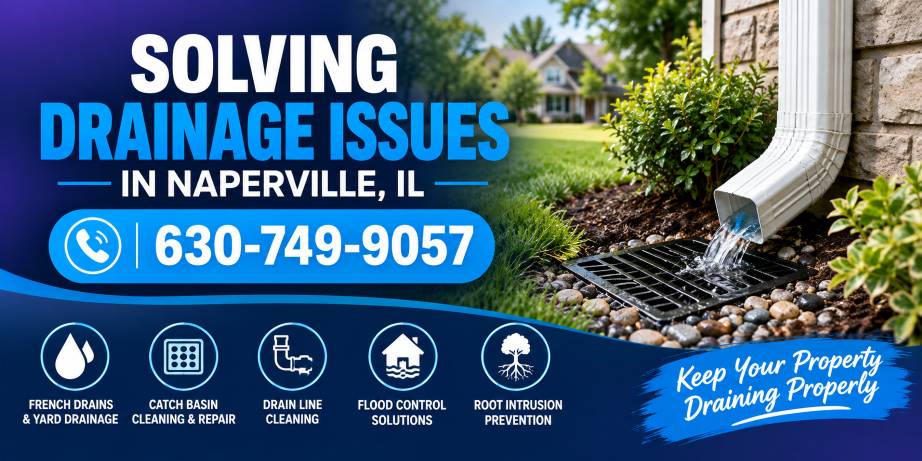
Naperville’s Own Guidance Is Direct About One Thing: A Drainage Problem Confined to Your Property Isn’t the City’s to Fix. Here’s How to Actually Diagnose What’s Wrong With Your Yard, Whose Responsibility Each Piece Is, and Which Fix Actually Matches the Cause.
A home has a drainage problem when rainwater isn’t being efficiently removed from the property, and it shows up in predictable ways: standing puddles that won’t drain, a soggy patch of lawn that never seems to dry out, plants dying from waterlogged roots, mosquitoes breeding in standing water, soil erosion along a slope, or water finding its way into a basement. What’s less predictable, and what a lot of Naperville homeowners don’t find out until they’ve already called the City, is who’s actually responsible for fixing it.
The City of Naperville’s own guidance is direct on this point: when a drainage problem is identified as localized to a single property rather than an area-wide issue affecting the City’s stormwater system, the City is not responsible for correcting it. That’s not a bureaucratic brush-off. It’s a genuinely useful piece of information, because it means most yard drainage problems are yours to diagnose and solve, and knowing that upfront saves time you’d otherwise spend waiting on a City response that isn’t coming.
Common Causes of Poor Drainage in Naperville Homes
Improper grading. Ideally, your home sits on the highest point of your lot, with the ground sloping gently away in every direction. When that slope is missing, reversed, or too flat, water has nowhere to go but toward the house. Changing your yard’s grading is also something the City expects you to think through carefully, since altering it can shift stormwater onto a neighbor’s property, and permits are required for changes that could affect how water flows off your lot.
Poor landscaping design. Planting beds that slope toward the house, or that build up too much mulch or topsoil over time, redirect water in ways that weren’t intended when the yard was originally graded.
Malfunctioning downspouts and gutters. Gutters and downspouts are supposed to move water well away from the foundation. Damaged, clogged, or poorly positioned downspouts dump water right where you don’t want it, immediately next to the house.
Dense, slow-draining soil. Much of the Naperville area sits on dense clay till left behind by glacial activity, and clay drains far more slowly than sandier soil. Water that would disperse naturally elsewhere tends to sit closer to the surface here, with fewer places to go on its own.
A high water table. Areas with a naturally high water table saturate faster during heavy rain, and if the property’s existing drainage outlets aren’t adequate for that added volume, the soil stays waterlogged long after the rain stops.
Inadequate or blocked outlets. If you have a storm sewer inlet on your own property, keeping its grate and basin clear of leaves, mulch, and debris is your responsibility, not the City’s, even though the City maintains inlets located in the street and public right-of-way. A blocked inlet on your own lot causes exactly the ponding this whole guide is about, and it’s often the easiest cause to fix once you know to look for it.
Tree root intrusion. This is worth taking seriously in Naperville specifically. The City’s own Water Utility identifies tree and shrub roots as the number one cause of sanitary sewer backups here, entering through small cracks at pipe joints and expanding steadily as the root grows, eventually restricting or blocking flow entirely.
Runoff from a neighbor’s yard. If your property sits downhill from another, water naturally flows toward you, and there’s genuinely not much a neighbor can be forced to do about it in most cases. The City’s expectation is that homeowners understand how stormwater moves through their own yard and whether adjacent properties are intended to drain onto or through it, information that’s often documented on your property’s plat if a stormwater easement has been established.
A neglected neighborhood detention pond. If your subdivision has a stormwater retention pond, it’s very likely maintained by your homeowners association, not the City. A pond that isn’t properly cared for stops functioning as designed and can contribute to drainage problems throughout the surrounding area. Checking your HOA declarations clarifies who’s actually responsible before you assume it’s a municipal issue.
When It’s Actually the City’s Problem, and When It’s Genuinely Yours
Beyond the general rule that localized property issues aren’t the City’s responsibility, a few specific situations are worth knowing where the line actually falls, and who to actually call for each. If you’re experiencing a sanitary sewer backup during or after heavy rainfall, Naperville’s Water Utility specifically asks residents to notify the City before calling a plumber, since a City representative needs to determine whether the cause is a structural defect or blockage in the main line, which is the City’s responsibility, before you assume it’s isolated to your own plumbing. If sump pump discharge is creating a wet nuisance area in your yard, the City’s Stormwater Team can be reached at (630) 420-6100, option 4. If a storm sewer inlet in the street itself is clogged with debris you can’t clear yourself, report it directly at (630) 420-6095. And if you’re considering connecting a sump pump discharge line directly to a storm sewer on your property, which is sometimes possible at the homeowner’s own cost, the City’s contact for that specific question is (630) 305-5369.
Everything else, a slow-draining yard, a wet basement with no sign of a main line problem, a downspout dumping water against your foundation, is squarely a homeowner responsibility to diagnose and address.
A Real Inspection Checklist
Before choosing a fix, walk the property with these specific questions in mind rather than guessing at the cause.
- Where does water actually pool, and how long does it take to drain? Note every low spot, and time how long standing water actually persists after a rain.
- Do your downspouts discharge at least several feet from the foundation? If a sump pump is involved, the City’s own standard is a minimum of 10 feet from the home’s exterior, directed toward a swale or storm sewer inlet, never toward the foundation or into a window well.
- What does your property’s plat show? Check for documented stormwater easements, and note whether your yard is intended to drain onto a neighbor’s property or receive drainage from one.
- Is there a storm sewer inlet on your property, and is it clear? If you have one, this is your responsibility to maintain, and it’s one of the more common overlooked causes of yard ponding.
- What’s your soil actually like? Dig a simple test hole after a dry stretch and see how quickly water added to it drains. Slow drainage confirms the dense clay conditions common throughout the area.
- Is there any sign of root intrusion in your sewer line? Recurring slow drains or backups, especially near mature trees, are worth having checked with a sewer camera inspection rather than assumed away.
Matching the Cause to the Right Fix
The right solution depends entirely on what the inspection actually reveals, not on whichever fix happens to be most familiar.
Grading problems need regrading and proper compaction, sometimes paired with replacing eroded topsoil, before any drainage system is added on top of a slope that’s still working against you.
Downspout and sump pump discharge issues are often solved simply by extending the discharge point to the proper distance and direction, following the City’s foundation clearance and window well guidance above.
A high water table or persistent surface wetness across a large area typically calls for a French drain to intercept water before it reaches the foundation. We’ve covered how these actually work, and the City’s own discharge and permitting rules that apply to installing one in Naperville, in our guide to French drains in Naperville. If a drain tile system is already in place but isn’t performing the way it used to, our breakdown of drain tile cleaning costs covers what professional cleaning involves and what it typically runs.
Root intrusion in a sewer line requires professional removal, not a drainage fix at all, since the problem sits inside the pipe rather than on the surface. Our sewer tree root removal service addresses this directly, typically alongside a camera inspection to confirm the line’s condition afterward.
A blocked storm sewer inlet or catch basin on your own property is often the simplest fix on this entire list, sometimes nothing more than clearing debris yourself. When the blockage or the structure itself needs professional attention, our catch basin cleaning service handles it.
Groundwater actively entering a basement is a sump pump problem, not a surface drainage one. Our sump pump services cover installation and repair sized to your home’s actual water volume, with discharge routed according to the City’s own requirements.
When to Actually Do This Inspection
Timing matters more than most homeowners realize. A dry-weather walkthrough tells you almost nothing about how your yard actually behaves under stress. The most useful inspection happens during or immediately after a genuinely heavy rain, when you can watch water move in real time: where it pools, how fast it drains, whether a downspout is actually discharging where you think it is, and whether a neighbor’s yard is sending water your way. Spring, when snowmelt combines with the season’s first heavy rains on ground that’s often still partially frozen underneath, is when Naperville’s clay soil is least able to absorb water and drainage problems tend to show up most dramatically. If your subdivision has a stormwater detention pond, the City’s own guidance recommends a monthly inspection, checking for shoreline erosion and clearing debris from inlet and outlet structures, which is a good general rhythm to apply to your own property’s drainage features as well.
Why Addressing This Early Actually Matters
A drainage problem rarely stays the same size. Standing water that sits against a foundation for years gradually works its way into cracks that wouldn’t otherwise exist, and what starts as a damp basement smell can become actual structural repair work if the moisture keeps finding its way in unaddressed. Soil erosion from poor grading undermines whatever’s built on top of it, whether that’s a patio, a walkway, or the foundation itself. And a sewer line with early-stage root intrusion is a routine service call. The same line left unaddressed for years, until roots have significantly narrowed or cracked the pipe, becomes a full section repair or replacement instead of a straightforward cleaning. None of these problems get cheaper by waiting, and most of them get meaningfully more expensive the longer the underlying cause stays in place.
When to Call a Professional
Diagnosing a drainage problem yourself using the checklist above is entirely reasonable. Actually correcting it usually isn’t a do-it-yourself project, since an improperly installed fix can make the underlying problem worse or simply move it somewhere else on the property. Working with a licensed Naperville plumber who understands both the City’s specific stormwater rules and the area’s clay-heavy soil conditions is what actually turns a correct diagnosis into a lasting fix rather than a repeat problem next spring.
For a broader look at how these individual causes connect to larger flooding risk, and which systems make sense together rather than in isolation, our complete flood control guide for Naperville and our Naperville basement flooding guide both go deeper into the full decision process.
Frequently Asked Questions
Will the City of Naperville fix a drainage problem in my yard?
Only if it’s an area-wide issue affecting the City’s stormwater system. The City’s own guidance is explicit that a drainage problem identified as localized to a single property is not the City’s responsibility to correct, which means most yard drainage issues fall to the homeowner to diagnose and fix.
Is the storm drain in my backyard my responsibility to maintain?
Yes. A storm sewer inlet or catch basin located on private property is the homeowner’s responsibility to keep clear of debris, even though the City maintains inlets located in the street and public right-of-way.
What’s the number one cause of sewer backups in Naperville specifically?
Tree and shrub roots. The City’s own Water Utility identifies root intrusion as the leading cause of sanitary sewer backups in Naperville, entering through small cracks in pipe joints and expanding as the root grows.
Can I direct my yard’s drainage toward my neighbor’s property?
No. The City expects homeowners to understand how stormwater drains within their own yard and to avoid altering grading in a way that creates new drainage problems for adjacent properties. Permits are required for grading changes that could affect stormwater flow.
Who maintains a neighborhood stormwater detention pond in Naperville?
In most instances, the homeowners association, not the City. Residents unsure of their pond’s maintenance responsibility should check their subdivision plat and HOA declarations.
Where should my sump pump actually discharge?
At least 10 feet away from your home’s exterior, directed toward a swale or storm sewer inlet, never toward the foundation or into a window well. Sump pumps cannot be connected to the sanitary sewer or a basement floor drain.
What should I do first if I have a sewer backup during heavy rain?
Naperville’s Water Utility asks residents to notify the City before calling a plumber when a backup happens during heavy rainfall, since a City representative needs to determine whether the cause is in the main sewer line before assuming it’s a private plumbing issue.
How do I know which drainage solution actually fixes my problem?
It depends entirely on the cause. Grading problems need regrading, a high water table calls for a properly discharging sump pump, chronic surface wetness often calls for a French drain, and root intrusion needs professional removal and a camera inspection. Diagnosing the actual cause first prevents installing the wrong fix.
What’s the best time of year to inspect my yard for drainage problems?
During or right after a heavy rain, ideally in spring, when snowmelt and the season’s first significant storms hit ground that’s often still partially frozen underneath. This is when Naperville’s clay soil is least able to absorb water, and it’s the point at which drainage problems tend to show up most clearly.
Does waiting to fix a drainage problem actually make it worse?
Generally yes. Water sitting against a foundation for years works its way into cracks that wouldn’t otherwise form, minor root intrusion in a sewer line becomes a full section repair, and erosion from poor grading undermines whatever’s built above it. Most drainage problems get more expensive to fix the longer they’re left unaddressed.
Drainage Solutions for Naperville Homes & Businesses
Licensed, insured, and serving Naperville since 1978. French drains, sump pumps, catch basin service, sewer root removal, and camera-verified diagnostics, with 24/7 emergency response.
Emergency: 708-518-7765 | Naperville: 630-749-9057 | Open 24/7
—
Suburban Plumbing Sewer Line & Drain Cleaning Experts
Licensed & Insured | Open 24 Hours | Serving Naperville & the Suburbs Since 1978
📞 Naperville: 630-749-9057 | 🚨 Emergency: 708-518-7765