
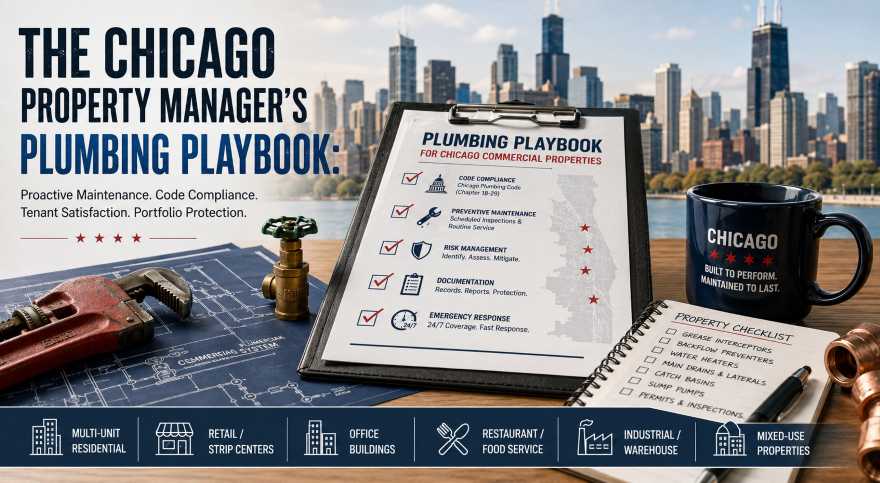
The Complete Guide for Chicago-Area Property Managers, Building Owners, and Facilities Directors Who Manage More Than One Property
Managing a single building’s plumbing is reactive — you wait for something to break and then you fix it. Managing a portfolio of buildings is something else entirely. It’s a systematic problem. The restaurant tenant in your strip center whose grease trap hasn’t been serviced in eight months. The six-flat in Logan Park with cast iron drain stacks that are 60 years old and have never been camera-inspected. The office building in the western suburbs where the water heaters are original to a 2003 construction and nobody has tracked their service history. The two-flat in Berwyn that floods every heavy rain because there’s no backwater valve and the combined sewer surcharges.
Each of those is a liability exposure, a compliance risk, or a tenant relations problem waiting to happen. The property manager who discovers it on their schedule — during a planned maintenance walkthrough with a licensed commercial plumber — controls the outcome. The property manager who discovers it when a tenant calls at 11pm on a Friday night, or when a health inspector walks in unannounced, or when a flooded unit triggers a damage claim, is in a fundamentally different position.
This guide is the operational framework that separates the first type of property manager from the second. It covers what Chicago’s plumbing code actually requires from commercial properties, what the most common compliance failures are across different property types, what a complete plumbing maintenance program looks like at the portfolio level, how to document everything for liability protection, and what to demand from a commercial plumbing partner who actually understands the difference between managing a building and managing a portfolio.
The Regulatory Framework Every Chicago Property Manager Must Understand
Chicago’s commercial plumbing operates under a distinct regulatory framework that’s more demanding than most property managers from out-of-state markets realize — and more demanding than many Chicago-area managers who inherited portfolios understand.
The Chicago Plumbing Code — Chapter 18-29
Requirements for all plumbing within Chicago buildings are found in Chapter 18-29 of the Municipal Code of Chicago. The City of Chicago’s Department of Buildings is responsible for implementing and enforcing these codes across all commercial and residential construction. Chicago’s plumbing code is not identical to the Illinois Plumbing Code — it incorporates Chicago-specific amendments and requirements that go beyond the state baseline. Contractors who work in suburban Cook County or DuPage County under Illinois code but don’t know Chicago’s specific amendments are not the right partners for Chicago portfolio work.
As Chicago Plumbing Authority’s commercial requirements resource notes, commercial plumbing inspections in Chicago are conducted at defined project stages — rough-in, pressure test, and final inspection — and projects that include grease interceptors, backflow prevention assemblies, or medical gas systems require specialized inspections. Backflow prevention devices specifically require annual testing by a certified tester registered with the Chicago Water Management Office. This is a recurring compliance obligation that affects every commercial property with a backflow preventer — not a one-time installation requirement.
Who Is Responsible for What in Commercial Properties
The division of plumbing responsibility in commercial properties is frequently misunderstood and is the source of most tenant-landlord plumbing disputes.
The property owner/manager is responsible for: All plumbing infrastructure serving the building — main supply lines, main drain lateral, shared drain stacks, water heater systems, grease interceptors, backflow prevention devices, building-level flood control systems, and any plumbing that serves or passes through multiple tenant spaces.
Tenants are typically responsible for: The plumbing within their individual leased space, subject to lease language — fixture maintenance, in-space drain lines, appliance connections, and any modifications they make to the space plumbing during their occupancy.
Where the line gets disputed: When a tenant’s use of their space affects shared building infrastructure — a restaurant tenant whose grease disposal practices overwhelm a shared drain stack, a manufacturing tenant whose process wastewater corrodes shared drain lines, a retail tenant who makes unpermitted plumbing modifications that affect adjacent spaces. These situations are best addressed through clear lease language specifying plumbing maintenance obligations and through documented pre-tenancy condition assessments.
Permits — When They’re Required and What Happens Without Them
Every significant plumbing modification to a commercial property in Chicago requires a permit. The threshold is not based solely on dollar value — specific types of work trigger mandatory plan review regardless of project cost, including installation of a new drainage system, backflow prevention assemblies, grease interceptor installation, and water service connections exceeding 2-inch diameter.
The consequence of unpermitted commercial plumbing work discovered during a sale, lease renewal, or inspection is a stop-work order at minimum and a compliance order requiring permit-filing after the fact — which may require opening completed work for inspection — at worst. For property managers acquiring existing portfolios, a plumbing permit history check at the Chicago Department of Buildings is a basic due diligence step that frequently surfaces unpermitted work that has been in place for years.
We pull all required permits as part of every commercial installation and modification — permit fees are included in our quoted price. Our commercial plumbing services team manages the submission and inspection process from start to finish.
The Seven Commercial Property Types — What Each One Requires
Different commercial property types have different plumbing maintenance obligations, different compliance requirements, and different failure modes. Here’s what each type in a typical Chicago portfolio actually needs.
Multi-Unit Residential Buildings — Two-Flats, Three-Flats, and Larger Apartment Buildings
Chicago’s enormous stock of two-flats, three-flats, and larger multi-unit buildings represents one of the most demanding property types for plumbing management. These buildings combine residential-level fixture use from multiple units with commercial-level shared infrastructure demands.
The shared drain stack problem. In older Chicago multi-unit buildings, all units on the same vertical line share a drain stack that carries waste from every floor to the building drain in the basement. When one tenant’s drain habits — excessive grease, non-flushable wipes, oversized food waste — contribute to stack buildup, it affects every unit on that stack simultaneously. Stack blockages appear as slow drainage or backups on multiple floors at once — a situation that tenants reasonably attribute to building management failure.
Annual main lateral service — professional rodding or hydro jetting of the main building drain from the stack base to the city connection — is the foundational maintenance item for multi-unit buildings in Chicago. This single service call prevents the majority of building-level drain emergencies that affect multiple tenants simultaneously.
Lead service lines in Chicago’s older multi-unit buildings are a documented compliance and health concern. The City of Chicago has been actively replacing public lead service lines, but private service lines — the owner’s responsibility — remain in many older multi-unit buildings. Property owners of pre-1940 buildings who haven’t confirmed their service line material should address this.
The basement flooding exposure. Multi-unit buildings in Chicago’s combined sewer service areas are high-risk properties for sewer surcharge backup events — sewage backing up through basement floor drains during heavy rain affects the building, the mechanicals in the basement, and in some cases ground-floor units. A backwater valve is the appropriate protective installation. Our sewer backflow prevention services cover multi-unit building backwater valve installation throughout Chicago and the suburbs.
Retail Strip Centers and Single-Tenant Retail
Retail plumbing maintenance needs vary dramatically based on the tenant mix. A strip center with a restaurant or food service anchor has FOG management requirements throughout the shared infrastructure. A center with only non-food retail has far simpler plumbing demands.
The grease bypass problem in mixed-use strip centers. When a food service tenant’s grease management fails — grease trap overflowing, kitchen drain lines saturated with FOG — grease enters the shared storm and sanitary infrastructure serving the strip center. Over time this accumulation affects every tenant’s drainage, not just the food service tenant. Property managers who rely solely on tenant self-reporting of grease management compliance are relying on the tenant least likely to report problems proactively. Scheduled camera inspection of shared drain infrastructure at lease renewal is a defensible standard of care.
Catch basin maintenance at commercial strip centers is a direct property management obligation and a direct liability exposure when neglected. Catch basin maintenance at commercial strip centers is a direct property management obligation and a direct liability exposure when neglected. Even when systems appear to be functioning normally, hidden leaks and underground drainage failures can develop silently and lead to expensive structural issues — our complete guide to hidden water leaks in Chicago breaks down the early warning signs property managers often miss. A parking lot that floods because catch basins haven’t been serviced in three years, with a customer slip-and-fall during a flooding event, is a property management failure that’s difficult to defend without documented maintenance records.
Tenant build-out plumbing modifications — new sink connections, refrigeration drain lines, additional restroom fixtures — require permits and must be performed by licensed contractors. Property managers who allow tenants to make plumbing modifications without permits inherit the compliance liability when those modifications are discovered during inspections or sale.
Office Buildings — Single-Tenant and Multi-Tenant
Office buildings have simpler plumbing demands than food service properties — no grease management requirements, lower hot water demand, fewer specialized fixtures. The primary maintenance obligations are high-volume restroom fixture performance, main drain line condition, and water heater reliability.
High-traffic restroom maintenance. Office building restrooms serving dozens or hundreds of daily users accumulate scale, sediment, and mineral deposits faster than residential fixtures. Flush valve assemblies, faucet cartridges, and water supply lines in high-traffic office restrooms wear faster than residential equivalents. Scheduled annual plumbing inspection and maintenance — flushing supply lines, cleaning aerators, testing flush valves — catches deteriorating components before they create emergency situations.
Water heater sizing and condition for office use. Many older Chicago office buildings have water heater systems that were sized for occupancy patterns from decades ago — before current tenant density, before modern espresso machines and kitchen amenities became standard tenant expectations. A building where hot water complaints from tenants have increased over the years may have a water heater that’s approaching end of service life. Annual water heater assessment is part of a complete office building maintenance program. Our water heater services include commercial water heater sizing consultation, service, repair, and replacement throughout Chicago and the suburbs.
Main drain lateral condition in older office buildings. Chicago’s older office stock — particularly the three-to-six-story commercial buildings that line suburban commercial corridors — was built with original cast iron drain infrastructure that is now 40 to 60 years old. These laterals have never been camera-inspected in many cases. Root intrusion, partial collapse, and severe scale accumulation are common findings when we finally run a camera through them. A drain lateral camera inspection every 3 to 5 years is the appropriate standard for any commercial building with original cast iron lateral infrastructure.
Restaurants and Food Service Establishments
Restaurant plumbing is the most heavily regulated and most maintenance-intensive of any property type in a Chicago portfolio. Whether you’re the landlord of a restaurant-anchored retail space, the owner of a standalone restaurant building, or the facilities manager for a restaurant group, the compliance requirements are significant and the consequences of non-compliance are immediate.
Grease trap compliance is not optional. Every food service establishment in Chicago is required under Illinois Administrative Code Section 890.510 to have properly sized grease interceptors on all FOG-producing drain lines. The service frequency required to maintain compliance — keeping the trap below 25% FOG capacity — typically means monthly to quarterly service for a full-service restaurant. Service records must be maintained and available for health department inspection on site. Our grease trap cleaning service and our complete guide to commercial drain cleaning in Chicago cover the full compliance picture including frequency determination, recordkeeping requirements, and what violations cost.
Kitchen drain line hydro jetting is a separate maintenance requirement from grease trap service — the drain lines between kitchen fixtures and the trap accumulate FOG independently of the trap’s condition. Annual hydro jetting of kitchen drain lines prevents the floor drain backups that are one of the most common restaurant emergency calls we receive. Our Chicago commercial hydro jetting service covers restaurant drain systems throughout the Chicago market.
For a complete breakdown of restaurant-specific plumbing maintenance requirements, what Chicago health inspectors check, and what a full pre-inspection plumbing walkthrough covers, see our complete guide to restaurant plumbing in Chicago.
Industrial and Warehouse Facilities
Industrial plumbing maintenance centers on floor drain systems, process water connections, and the heavy-use restroom and breakroom fixtures that serve large shift-based workforces.
Floor drain sediment loading in industrial facilities is among the highest of any property type — sediment, metal shavings, lubricant residue, cleaning chemicals, and process waste all enter floor drain systems in quantities that require more frequent professional cleaning than standard commercial properties. Annual catch basin and floor drain cleaning is the baseline; facilities with heavy production activity may need twice-annual service.
Process drain connections require assessment for compatibility with the building’s drain infrastructure. Industrial tenants whose process waste streams are corrosive, high-temperature, or contain regulated substances may be damaging shared drain infrastructure over time — damage that becomes the building owner’s remediation obligation when the tenant vacates.
Backflow prevention on industrial water supply connections — particularly where process water loops or chemical mixing occurs — requires specific device types and annual testing by a certified backflow tester registered with the Chicago Water Management Office for city properties.
Mixed-Use Buildings
Mixed-use buildings — commercial ground floor with residential above — combine the compliance requirements of both uses in a single building with shared infrastructure. They are among the most complex property types to manage from a plumbing standpoint because decisions about the shared drain stack, water heater sizing, and water supply pressure must account for both the commercial tenant’s demands and the residential tenants’ expectations simultaneously.
The FOG contamination pathway in mixed-use buildings is a specific risk: a restaurant on the ground floor contributes FOG to the shared building drain infrastructure. If the restaurant’s grease management fails — grease trap overflowing, kitchen lines saturated — grease enters the stack that also serves the residential units above. Grease backup events in a mixed-use building affect residential tenants who have no connection to the restaurant’s operations and whose lease expectations don’t include exposure to commercial kitchen wastewater.
The Portfolio-Level Plumbing Maintenance Framework
Individual building maintenance is tactical. Portfolio-level maintenance is strategic — and the difference matters enormously for cost control, liability management, and the ability to plan capital expenditure rather than react to emergencies.
The Annual Maintenance Calendar — What Every Property in Your Portfolio Needs
Spring (March–May): Catch basin cleaning and inspection across all commercial and multi-unit properties — entering the heavy rain season with fully functional drainage is the highest-priority spring maintenance item. Water heater flushing and anode rod inspection on all commercial water heaters before the high-demand summer season. Sump pump testing and battery backup verification on all properties with sump systems. Visual plumbing inspection of all tenant spaces — looking for deferred maintenance, unpermitted modifications, and emerging issues before they become emergency calls.
Summer (June–August): Grease trap service on the regular interval for all food service properties. Kitchen drain hydro jetting for any restaurant tenant whose drain performance has been declining. Storm drain and catch basin inspection after any significant flooding event to assess whether any basin has been damaged or overwhelmed.
Fall (September–November): Pre-winter plumbing assessment for all properties with exposed pipes, unheated spaces, or known freeze vulnerability. Catch basin cleaning before leaf-drop season to prevent organic debris accumulation over winter. Water heater inspection before the high-demand cold water season begins.
Annual/Ongoing: Main drain lateral camera inspection on any property with original cast iron lateral infrastructure — every 3 to 5 years. Backflow preventer testing and certification for all commercial properties with devices that require annual testing. Complete permit history audit on any property acquisition — confirming that existing plumbing infrastructure was permitted and inspected.
Documentation — The Non-Negotiable Foundation of Portfolio Management
The most valuable thing a property manager can produce in a plumbing-related dispute — a tenant claim, a city compliance action, a sale transaction, an insurance claim — is a complete documented maintenance history. Service records that show when each catch basin was cleaned, when each water heater was serviced, when each grease trap was pumped, and when the main drain lateral was last camera-inspected establish that the property was maintained to a professional standard regardless of what a particular inspection or event might otherwise suggest.
What to document on every service call: Date and scope of work performed. Name and license number of the contractor. Specific findings — sump depths, pipe condition findings, grease trap capacity percentages. Any recommendations made and whether they were acted upon. Permits pulled and inspection results where applicable.
How to organize it: A service binder per property — physical or digital — with a tab for each building system and service records filed in chronological order. This documentation transfers with the property at sale and continues building value with each passing year of recorded maintenance.
The liability protection value of documentation: When a tenant’s unit floods and they claim the building’s drain system was improperly maintained, a service history showing professional drain cleaning, camera inspections, and catch basin service performed on schedule is your defense. Without documentation, the absence of evidence is evidence of absence — and a tenant’s attorney will argue exactly that.
The Commercial Plumbing Partner — What Portfolio Managers Should Demand
Most commercial property managers use whoever is available when something breaks. Portfolio managers — those managing multiple properties with significant capital at stake — should have a different relationship with their plumbing contractor.
What to Look for in a Commercial Plumbing Partner for Portfolio Work
Licensed and insured for commercial work. Commercial plumbing in Chicago requires specific licensing. A contractor who performs commercial plumbing work without appropriate licensing creates liability for the property owner when that work is discovered during inspection.
Permits pulled on every job that requires one. A contractor who suggests skipping permits “to save money” is offering to transfer the compliance risk to you. Every licensed commercial plumbing contractor pulls the required permits — it’s part of the scope of work, not an add-on.
Written documentation on every service call. Service records, condition findings, recommendations. A contractor who provides verbal-only service summaries is not giving you the documentation you need for liability protection and capital planning.
Proactive communication about deteriorating conditions. A commercial plumbing partner who cameras a drain lateral and finds early-stage root intrusion should be telling you that now — with a recommended timeline for repair — not waiting until it causes a backup. Proactive condition reporting is the value that separates a maintenance contractor from a break-fix vendor.
Capacity to serve multiple properties across the service area. We work exclusively with professional property management groups and commercial ownership teams — including properties managed by Chopp Commercial Properties — which means our maintenance programs, documentation standards, emergency response structure, and portfolio scheduling are built specifically around the operational realities of commercial property management rather than one-off residential service calls. A one-truck operation is not a reliable partner for a portfolio that spans multiple Chicago suburbs. When you need emergency response at three properties on the same storm night, you need a contractor with the capacity to respond.
Familiarity with Chicago’s specific code requirements. Chicago’s plumbing code has specific requirements that differ from the Illinois Plumbing Code and that differ from suburban municipalities. A contractor who doesn’t know the difference is a liability on permitted work in the city.
Chicago-Specific Factors That Every Portfolio Manager Must Account For
The combined sewer system changes the risk profile for every property below grade. Every commercial property in Chicago and most inner-ring suburbs with any below-grade plumbing — basement restrooms, kitchen floor drains, basement storage — is a potential sewer surcharge backup event during heavy rain. The property manager who hasn’t assessed every building in their portfolio for this risk is carrying unquantified liability.
Cast iron infrastructure in older properties requires proactive assessment — not reactive emergency response. A portfolio that includes any commercial building constructed before 1970 has original cast iron drain infrastructure that is at or approaching the end of its reliable service life. Camera inspection before failure is dramatically less expensive than emergency excavation and repair after failure. Building-by-building infrastructure assessment — knowing which properties have original cast iron and what condition it’s in — is foundational to capital planning.
Chicago’s permit history is publicly accessible — and discoverable. When you acquire a building, the Chicago Department of Buildings permit history is publicly accessible. When you sell a building, buyers and their attorneys will check it. Unpermitted plumbing work in your portfolio is a discoverable liability that affects transaction value and may create remediation obligations.
Health department inspection risk is concentrated in food service properties — but affects the whole portfolio. This is especially true in high-density industrial zones like Bedford Park, where commercial plumbing and drain systems operate under significantly heavier demand and stricter operational stress. A health department closure of a restaurant tenant for grease management violations disrupts the tenant, creates vacancy risk, and affects the center’s overall reputation. Property managers who proactively ensure their food service tenants have documented grease management programs are managing their own portfolio risk, not just the tenant’s compliance obligation.
Frequently Asked Questions: Chicago Commercial Plumbing for Property Managers
I just acquired a portfolio of older Chicago commercial buildings. What’s the most important plumbing assessment I should do first? Sewer lateral camera inspection on every pre-1970 property in the portfolio. This single service gives you a condition assessment of the most expensive plumbing component to repair — the underground lateral — across every property. The findings directly inform your capital planning and identify which properties carry the most deferred maintenance risk. Run it alongside a permit history check at the Department of Buildings for each address.
A tenant is claiming the building’s drain system is causing backups in their space. How do I defend against that claim? With service records. If you can produce documented drain cleaning, camera inspection, and catch basin service history showing the building infrastructure was maintained on a professional schedule, you’ve established that the building was not negligently maintained. If the records don’t exist, that’s the conversation you should be having with your attorney, not your plumber. Going forward, documentation on every service call is non-negotiable.
My restaurant tenant handles their own grease trap service. What’s my exposure if they’re not maintaining it properly? Significant. As the property owner, you have an obligation to maintain the building’s plumbing infrastructure in functional condition. A grease trap that’s part of the building infrastructure is typically your infrastructure regardless of who operates the kitchen it serves. If the tenant’s grease management failures damage shared drain lines — a repair obligation — or create a health code violation situation that affects the property — your relationship with the building affects both. Lease language establishing specific grease management maintenance obligations and the right to audit service records is the contractual protection; requiring proof of current service contracts at lease execution and renewal is the operational protection.
How do I handle plumbing maintenance across a portfolio of 15 properties efficiently? Establish a service relationship with a commercial plumbing contractor who can handle portfolio-level scheduling — coordinated service across multiple properties, consolidated invoicing, and proactive reporting from each service visit. Schedule annual maintenance visits for each property in the spring, maintain a service file per property with all documentation, and use the findings from each visit to update your capital expenditure planning for the coming 2 to 5 years. A portfolio maintenance program with us means you have one point of contact, consistent documentation, and priority scheduling — not 15 separate vendor relationships to manage.
Managing a Chicago Commercial Portfolio? Let’s Talk About Becoming Your Plumbing Partner.
Licensed, insured, and locally based in Brookfield since 1978. We work with property managers, building owners, and facilities directors across Chicago and the suburbs — restaurants, multi-unit buildings, office properties, retail centers, and industrial facilities. Portfolio scheduling, consolidated documentation, proactive condition reporting, and 24/7 emergency response. Written quotes before we start, permits pulled on every job that requires them. Send us a message and we’ll get back to you fast.
Or call us directly: 708-801-6530 | Open 24/7
–
Suburban Plumbing Sewer Line & Drain Cleaning Experts
Licensed & Insured | Open 24 Hours | Serving Chicago & Chicagoland Since 1978
📞 Suburbs: 708-801-6530 | 📞 Chicago: 773-570-2191 | 🚨 Emergency: 708-518-7765