
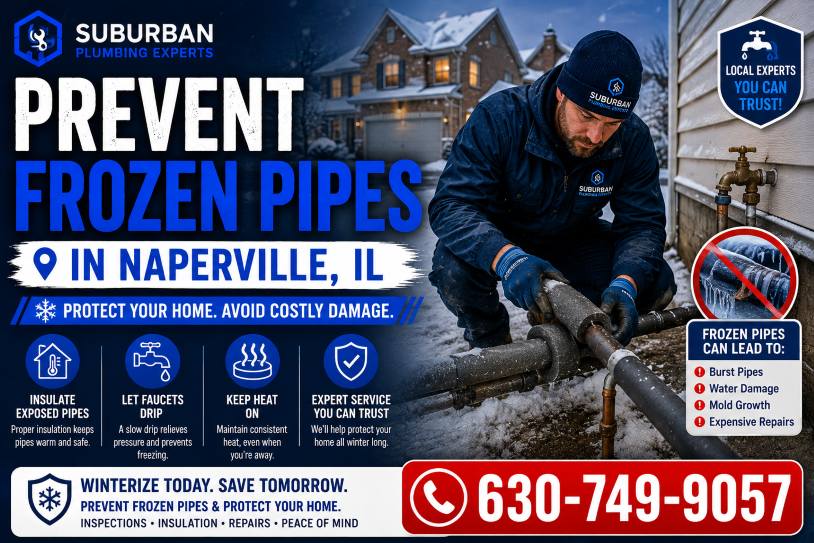
It’s Not the Cold That Bursts a Pipe. It’s What Happens the Moment It Thaws.
Water expands by about 9 percent as it freezes, and that expansion is what cracks or splits a pipe, copper, PVC, or galvanized steel alike. The dangerous part isn’t actually the freeze itself, plenty of frozen pipes never burst while they’re still frozen, it’s the moment they thaw and pressurized water finds the crack that formed during the cold snap. That’s why a frozen pipe is still an emergency even before any water is visibly leaking: the damage may already be done, waiting for the thaw to reveal it. According to the National Weather Service’s climate normals for the Chicago area, average January lows sit around 19°F, with subzero readings a routine occurrence most winters, which means Naperville homes face this risk repeatedly each season, not as a rare event.
What This Actually Costs When It’s Not Prevented
Water damage and freezing accounted for 27.6 percent of all homeowners insurance claims in 2022, according to the Insurance Information Institute’s claims data, second only to wind and hail, with an average claim severity of $13,954 between 2018 and 2022. Set against that, basic frozen or burst pipe repair typically runs $200 to $3,000 according to Angi’s cost data, averaging around $500, with roughly 80 percent of that going to labor rather than materials. The gap between those two numbers, a few hundred dollars for prevention and repair versus nearly $14,000 for an average claim, is the entire argument for taking prevention seriously before the first hard freeze rather than after.
Where Pipes Actually Freeze, and Why
According to the American Red Cross’s guidance on frozen pipes, the pipes most at risk are those exposed to severe cold, outdoor hose bibs and sprinkler lines, those running through unheated interior spaces, basements, crawl spaces, attics, and garages, and any pipe running against an exterior wall with little or no insulation. Naperville homes with additions, finished basements, or garages converted to living space often have supply lines that were never rerouted away from these exact conditions, which is worth checking specifically rather than assuming your home’s layout is immune.
Insulate the Pipes That Are Actually at Risk
Foam pipe sleeves or UL-listed heat tape on exposed runs in unheated spaces, exterior walls, attics, crawl spaces, and garages, address the specific locations identified above rather than treating every pipe in the house equally. For a full seasonal checklist beyond pipes specifically, our guide to winterizing your home in Illinois covers the complete preparation list. Pay particular attention to any pipe running through an exterior wall, since that placement combines two risk factors, direct cold exposure and typically the least insulation, at once.
Disconnect and Drain Outdoor Hoses Before the First Hard Freeze
A hose left connected traps water in the bib itself, and that trapped water is exactly what freezes and splits it. Disconnect and fully drain every outdoor hose, close the interior shutoff valve supplying outdoor bibs where one exists, and open the outside bib briefly afterward to let any remaining water drain and expand safely rather than inside a closed fitting. This single step prevents a surprisingly large share of the outdoor plumbing damage we see every winter, covered in more depth on our outdoor plumbing services page.
Keep the House Consistently Warm, Even When You’re Not There
A consistent interior temperature matters more than most homeowners expect. Keep the thermostat set no lower than roughly 55°F even overnight or while away, since the cost difference in heating bills is minor compared to the cost of a burst pipe. If you travel during winter, a smart thermostat that lets you monitor and adjust remotely is a worthwhile safeguard, and never turn heat off entirely in a vacant property during cold months.
Let Faucets Drip During Extreme Cold
Moving water is meaningfully less likely to freeze than standing water. During a genuine cold snap, particularly on nights well below normal, let faucets served by exposed or at-risk pipes drip slightly. It’s a small increase in your water usage against a real reduction in freeze risk for the specific pipes most exposed to cold.
Open Cabinet Doors Under Sinks Near Exterior Walls
Kitchen and bathroom cabinets against exterior walls block warm household air from reaching the supply lines inside them. Opening those cabinet doors during a cold snap lets ambient heat reach pipes that would otherwise sit in a sealed, unheated pocket of space, a small habit that meaningfully reduces risk at exactly the locations most prone to freezing.
Seal the Drafts Feeding Cold Air to Your Pipes
Gaps around utility penetrations, dryer vents, cable and pipe entry points, and around windows and doors near plumbing runs let cold air reach pipes directly. Caulk and weatherstripping close these gaps cheaply, and it’s worth an annual check specifically around any area where a pipe runs near an exterior wall.
If a Pipe Freezes Before You Catch It
Keep the affected faucet open, even a trickle helps melt the ice from the inside, and apply gentle heat with a hair dryer, an electric heating pad, or towels soaked in hot water. Never use an open flame or a propane or kerosene heater directly on a pipe, that’s a fire risk that turns a plumbing problem into something considerably worse. If you can’t locate or reach the frozen section, or can’t get it to thaw, stop and call a professional rather than continuing to improvise. Our companion guide on frozen and burst pipe situations specific to Naperville homes covers exactly what to watch for and how to respond once a pipe has actually failed, including what changes once it’s an active leak rather than just a freeze. For the region-wide pattern of how winter plumbing emergencies tend to unfold, our complete guide to winter plumbing emergencies in Chicagoland is worth a read as well.
Frequently Asked Questions
What temperature should I keep my house at to prevent frozen pipes?
No lower than about 55°F, even overnight or while traveling. Never let a home sit with the heat off entirely during winter, even briefly.
Does letting a faucet drip actually help?
Yes. Moving water is considerably less likely to freeze than standing water, which is why this is recommended specifically for pipes served by exposed or at-risk runs during a genuine cold snap.
How much does it cost to fix a burst pipe versus prevent one?
Basic burst pipe repair typically runs $200 to $3,000, averaging around $500. That’s a small fraction of the nearly $14,000 average cost of a water damage insurance claim, which is the core argument for prevention over reaction.
Can I thaw a frozen pipe myself?
Often yes, with gentle heat from a hair dryer, heating pad, or hot towels while keeping the faucet open. Never use an open flame. If you can’t locate or reach the frozen section, call a professional rather than continuing to try.
Which pipes in my Naperville home are actually at the highest risk?
Pipes in unheated spaces, basements, crawl spaces, attics, garages, those running against exterior walls, and any outdoor hose bib or sprinkler line. Homes with additions or converted garage space often have supply lines in these exact conditions without homeowners realizing it.
24/7 Frozen & Burst Pipe Service for Naperville, IL
Suburban Plumbing Experts has served Naperville and the surrounding suburbs since 1978. We hold Illinois Plumbing License #055-044116 and Sewer License #2565, and every technician on our team is a trained, background-checked employee, not a subcontractor. If a pipe does freeze or burst this winter, our Naperville, IL plumbers are available around the clock, and our pipe thawing and burst pipe repair teams handle both the emergency and, if it’s already gone that far, any resulting basement flooding.
Protect Your Naperville Home Before the Next Cold Snap
Licensed, insured, and serving Naperville and Chicagoland since 1978. A pre-winter inspection catches vulnerable pipes while they’re still cheap to fix.
Naperville: 630-749-9057 | Emergency: 708-518-7765 | Open 24/7
—
Suburban Plumbing Sewer Line & Drain Cleaning Experts
Licensed & Insured | Open 24 Hours | Serving Naperville & the West Suburbs Since 1978
📞 Naperville: 630-749-9057 | 🚨 Emergency: 708-518-7765