
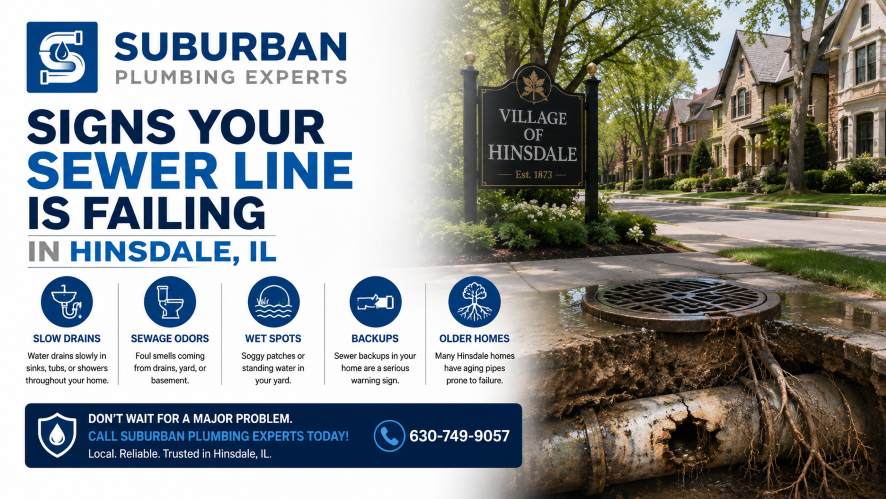
Hinsdale’s Large Lots, Aging Stone and Clay Laterals, and Salt Creek Proximity Combine to Put Real Money on the Line When a Sewer Problem Develops. Here’s What Actually Elevates the Risk Here, the Signs Worth Acting on Immediately, and What to Do Next.
A sewer line rarely fails all at once. It fails slowly, underground, for months or years before a homeowner notices anything at all, and by the time the signs are obvious, the problem has usually been developing for a while. That’s true everywhere. In Hinsdale specifically, a few local factors make it worth paying closer attention than the average Chicagoland suburb, and they have less to do with bad luck and more to do with the physical realities of the village itself.
Hinsdale’s older homes tend to sit on larger, deeper lots than a typical Chicagoland subdivision, which means longer lateral runs between the house and the street connection, more buried pipe, and more joints along the way for something to go wrong at. Many of these properties, particularly in the historic core, still run on original stone or clay sewer laterals that predate modern PVC by decades. And a meaningful stretch of the village sits close enough to Salt Creek that groundwater and drainage conditions add a layer of stress to underground infrastructure that drier, higher ground doesn’t deal with in the same way.
Why Hinsdale’s Sewer Lines Carry Elevated Risk
Three factors compound here in a way that’s worth understanding before symptoms show up.
Lateral length and age. A longer lateral simply has more linear feet of aging pipe and more joints than a shorter one, and on Hinsdale’s larger historic lots, that difference is meaningful. A lateral on a deep, wide lot might run considerably farther from the foundation to the street connection than one on a standard suburban parcel, and every additional joint along that run is another point where root intrusion, settling soil, or simple age can eventually cause a problem. Stone and clay pipe, common in homes built before the mid twentieth century, was never designed with the flexibility or joint sealing that modern PVC has, which makes every joint along that longer run a potential entry point for roots or a spot where settling soil can eventually cause separation. A homeowner who’s never had the line inspected has no real way of knowing how many of those joints have already started to fail versus how many are still sound.
Proximity to Salt Creek. Parts of Hinsdale, particularly the Graue Mill neighborhood along the creek, have a documented flooding history serious enough that DuPage County, the Village of Hinsdale, the Graue Mill Homeowners Association, and the Forest Preserve District of DuPage County partnered on a multi year flood protection project completed in 2018, following major flood events in 2010 and 2013. The project added floodgates, floodwalls, pump stations, and berms specifically because of how directly Salt Creek’s water levels affect the surrounding ground. Elevated groundwater in low lying areas near the creek puts additional pressure on buried sewer laterals and increases the odds of infiltration at any joint that’s already showing wear, even on properties outside the immediate flood protection zone.
What’s actually at stake financially. Hinsdale home values run well above the regional average, and a hidden sewer problem discovered after closing is a genuinely expensive surprise on a property in that price range. That’s exactly the situation our companion piece on plumbing inspection before buying a home in Hinsdale walks through in detail, and it’s worth reading before closing on any Hinsdale property, not just older ones.
The Signs Worth Acting On
The underlying mechanics of how a sewer line actually fails, root intrusion, joint separation, grease and mineral buildup, are the same across Chicagoland, and we’ve covered that in full depth in our guide to warning signs your Chicago sewer line is failing. Rather than repeat that explanation here, this is the condensed version worth knowing specifically as a Hinsdale homeowner.
- Chronic clogs that come back after clearing. A drain that clogs once is a drain. One that clogs repeatedly despite being cleared points to a problem further down the line, not at the fixture itself.
- Multiple drains backing up around the same time. A single slow drain is usually isolated. Several fixtures acting up together, especially the lowest ones in the house, points toward the main line.
- Sewer odor inside or outside the home. A properly sealed system shouldn’t smell. Odor, especially outdoors above where the lateral runs, often means sewage is escaping into the surrounding soil.
- Backed up drains or a toilet that won’t flush properly. On the lowest level of the house, this is one of the more urgent signs and often means the line is close to a full blockage.
- Gurgling sounds when running water elsewhere in the house. That sound is trapped air being forced through a partial obstruction, and it often shows up before a full backup does.
- A soggy or unusually green patch of yard. Wastewater leaking slowly from a compromised joint acts as fertilizer for whatever’s growing directly above it, which is why this sign so often traces the exact path of the lateral.
- An increase in pest activity around the property. Roaches, and in some cases rodents, are drawn to the moisture and organic material a leaking line provides, even before the leak is otherwise visible.
One or two of these in isolation aren’t necessarily a crisis. Several showing up together, or any of them persisting after a standard drain clearing, is a strong enough signal to schedule a professional look rather than wait for the situation to escalate on its own.
What to Do Once You Notice the Signs
A sewer camera inspection is the right first step in almost every case. It shows exactly where a problem sits in the line and what’s actually causing it, root intrusion, a separated joint, general deterioration, or something more serious, before any repair decision gets made. That distinction matters because the fix is genuinely different depending on the cause.
A blocked but otherwise structurally intact sewer line typically just needs clearing, either through sewer rodding or hydro jetting depending on what the camera shows and how established the obstruction is. For a line with recurring root intrusion at a joint, hydro jetting tends to hold longer than rodding since it strips root material back to the pipe wall rather than cutting a temporary path through it.
A cracked, offset, or collapsed section is a different category of problem entirely, and clearing alone won’t solve it. Depending on how localized the damage is, that typically means one of three paths. A spot repair addresses a single damaged section without disturbing the rest of the line, and it’s often the most cost effective option when the camera inspection shows the problem is contained. Pipe relining installs a new interior surface inside the existing pipe without full excavation, which is particularly useful on Hinsdale’s larger, more heavily landscaped lots where digging up a long lateral run would mean tearing out mature trees, hardscaping, or driveways to reach it. A full section replacement becomes the right call when deterioration is widespread along the line rather than isolated to one or two points, which is more common on original stone or clay laterals that have never had a full inspection or repair.
Timing matters here too. On properties near Salt Creek, symptoms often become noticeably worse after heavy rain, when elevated groundwater adds pressure to an already compromised joint and pushes more infiltration into the line. If chronic issues seem to track with weather rather than showing up randomly, that pattern itself is useful diagnostic information worth mentioning to whoever performs the camera inspection.
For Hinsdale properties that deal with recurring backups tied to the home’s elevation relative to the street sewer, particularly in the lower lying areas nearer Salt Creek, an overhead sewer conversion is worth discussing as a permanent fix rather than repeatedly addressing the same backup after every heavy rain.
Not every sign here means a full sewer replacement is imminent. A licensed Hinsdale plumber starts with an accurate diagnosis, not an assumption, and that’s what determines whether the fix is a routine cleaning or something more involved.
Frequently Asked Questions
Why do Hinsdale homes seem to have more sewer line problems than newer subdivisions nearby?
Longer lateral runs on larger historic lots, older stone and clay pipe material, and elevated groundwater conditions near Salt Creek all combine to put more stress on Hinsdale’s underground sewer infrastructure than a typical newer subdivision experiences.
How much does a sewer camera inspection cost, and is it really necessary?
Cost varies by property and access, but it’s a small fraction of what a misdiagnosed repair or an emergency excavation ends up costing. Given how different the right fix is depending on the actual cause, a camera inspection is the step that keeps the rest of the repair from being a guess.
Is my sewer lateral my responsibility, or the Village’s?
As is typical across Chicagoland municipalities, the sewer lateral running from your home to the public sewer main is generally the homeowner’s responsibility, while the Village maintains the main line itself. A licensed plumber familiar with Hinsdale’s specific infrastructure can confirm exactly where that line falls for a given property.
Can a sewer line problem really affect my home’s resale value?
Yes, particularly in a market with home values as high as Hinsdale’s. An undisclosed or undiagnosed sewer issue found during a buyer’s inspection can delay or derail a sale, which is exactly why a proactive camera inspection before listing is worth the modest cost.
How often should an older Hinsdale home get its sewer line inspected?
Every one to two years for a property with a documented history of root intrusion or recurring clogs, and every few years as routine maintenance for an older home that hasn’t had a documented issue yet. Homes near Salt Creek with elevated groundwater exposure benefit from staying on the more frequent end of that range.
What’s the difference between clearing a line and repairing it?
Clearing removes an obstruction, roots, grease, debris, from an otherwise structurally sound pipe. Repair addresses actual damage to the pipe itself, a crack, a separated joint, or a collapsed section, and clearing alone won’t fix that kind of structural problem even temporarily.
Sewer Line Service for Hinsdale Homes & Businesses
Licensed, insured, and serving Hinsdale and the surrounding suburbs since 1978. Camera-verified sewer inspections, hydro jetting, sewer rodding, and repair for aging laterals, available 24/7.
Emergency: 708-518-7765 | Suburbs: 630-749-9057 | Open 24/7
—
Suburban Plumbing Sewer Line & Drain Cleaning Experts
Licensed & Insured | Open 24 Hours | Serving Hinsdale & the Suburbs Since 1978
📞 Hinsdale: 630-749-9057 | 🚨 Emergency: 708-518-7765