
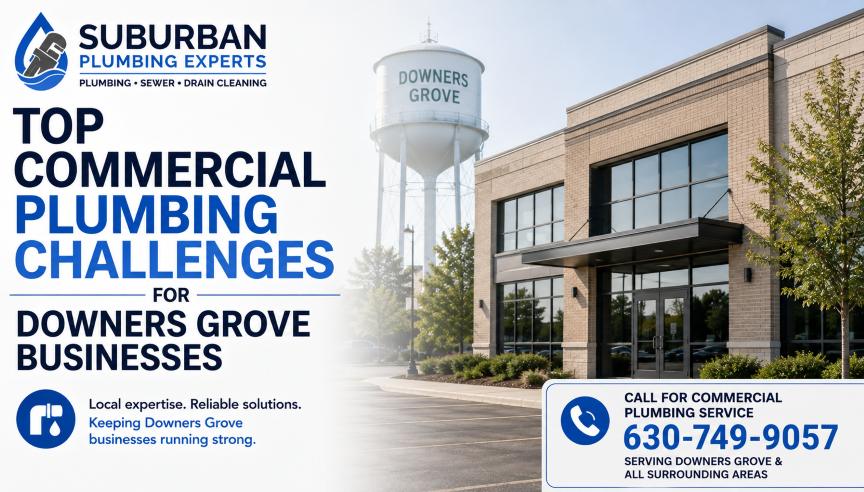
The Longer a Business Operates in One Location, the More Likely an Underlying Plumbing Issue Is Already Developing. Here’s What Actually Goes Wrong in Downers Grove Commercial Properties, Why, and What Keeps It From Becoming an Unplanned Closure.
Commercial properties in Downers Grove face a fairly consistent set of plumbing challenges, and the longer a business operates in one location, the more likely it is that an underlying issue is already beginning to develop. Knowing what typically goes wrong helps property owners and managers act quickly and make informed decisions about maintenance and repair, rather than reacting to a failure that a little foresight could have caught.
Downers Grove’s mix of older commercial buildings along its major corridors and newer developments throughout the village means plumbing conditions vary widely property to property. Older structures often carry aging infrastructure — cast iron drain lines, galvanized piping, grease systems that have seen years of limited maintenance. Newer buildings face a different strain: usage demand that outpaces what the original system was designed for. In both cases, the most common issues are predictable, largely preventable, and significantly less costly addressed early.
The Real Cost of Neglecting Maintenance
A regularly maintained commercial plumbing system runs in the background where it belongs, supporting operations without interrupting them. A neglected one has a way of announcing itself at the worst possible moment — during a busy service, a full office, or the one day you least have time for a plumbing emergency.
Periodic inspections catch what daily operations mask: a slow drain building toward a full blockage, a water heater approaching the end of its reliable life, a grease line accumulating exactly the kind of buildup that shuts down a kitchen. Addressing these findings while they’re still minor repairs — not urgent failures — keeps downtime minimal and repair costs predictable. The financial math backs this up directly: a backed-up drain that shuts down a kitchen mid-service, a burst pipe that closes an office for the day, or a water heater failure that takes a hospitality business offline all stack lost revenue and emergency-service premiums on top of the repair bill itself, usually adding up to several times what routine maintenance would have cost.
Common Blockages and Clogs
Blocked and slow drains are the single most frequent complaint we hear from Downers Grove commercial properties — and also the most preventable. In restaurant and food service environments, grease is the primary culprit, coating pipe walls until flow is severely restricted or a line backs up entirely during service. In offices and retail spaces, it’s typically foreign objects, paper products, and the accumulated buildup of high-volume daily use without adequate upkeep.
The pattern is consistent across property types: a drain that’s slightly slower than usual gets ignored until it becomes a backup that can’t wait. Regular professional commercial drain cleaning breaks that cycle before it reaches the critical point. In commercial kitchens specifically, what actually goes down the drain is the single biggest factor in blockage frequency — our guide to drain cleaning in Downers Grove’s restaurant industry covers exactly what that means for grease trap compliance and DuPage County’s food service code.
Pipe Replacement Strategy for Older Buildings
Commercial pipes handle significantly more daily demand than residential systems, and in Downers Grove’s older commercial buildings, many of those pipes have been doing that job for decades without replacement. Corrosion develops gradually inside aging galvanized and cast iron lines, joints deteriorate, and small leaks that start as a minor concern become structural and water damage issues if left long enough.
Material choice matters as much as the decision to replace. Copper remains a reliable standard for supply lines; PEX offers flexibility and corrosion resistance well suited to retrofit work where access is limited. For drain lines, replacing cast iron with PVC or ABS reduces corrosion risk and simplifies future maintenance. A licensed commercial plumber who assesses the full system before recommending an approach — rather than patching only the visibly failing section — is the difference between a repair that actually solves the problem and one that just delays it.
Why Hydro Jetting Outperforms Snaking for Commercial Lines
For commercial properties dealing with persistent drain issues or lines that haven’t been properly cleaned in years, hydro jetting delivers results snaking can’t match. Where a snake punches a hole through a blockage and leaves the buildup on the pipe walls intact, hydro jetting uses pressurized water to scour the entire interior of the pipe clean — removing grease, sediment, and debris that’s been accumulating since the line was last properly serviced.
For Downers Grove restaurants and food service operations, where grease buildup is a constant reality, the difference between a snaked drain and a hydro-jetted one shows up immediately in flow performance. For offices, retail, and larger facilities under consistent high-volume demand, the thorough cleaning extends the interval between service calls and reduces the odds of an emergency blockage disrupting operations — which, for a property where downtime has a direct dollar cost, makes it the more economical choice over time, not just the more thorough one.
Commercial Water Heater Issues
A water heater failure in a commercial setting creates problems well beyond inconvenience. A restaurant without hot water fails health code requirements and can’t operate. An office building or fitness facility without consistent hot water has an immediate tenant and customer relations problem. A unit that’s underperforming or showing wear isn’t something to monitor — it’s something to address before it forces the issue at the worst possible time.
The most common commercial water heater problems in Downers Grove properties: inadequate heating output as demand outpaces an aging unit’s capacity, sediment buildup that reduces efficiency and accelerates wear on heating elements, and slow leaks at connections or the tank itself that go unnoticed until real water damage has occurred. Regular servicing — flushing sediment, inspecting elements and connections, testing pressure relief valves — extends the unit’s lifespan and maintains the performance a commercial operation actually depends on.
Sewer Line Maintenance and Compliance
A sewer line problem in a commercial property doesn’t stay contained for long. Backups reaching floor drains, restrooms, or kitchen areas create unsanitary conditions that can trigger a real health code violation, force a closure, and generate the kind of customer experience that’s difficult to recover from. Under the DuPage County Health Department’s own food service regulations — which govern every restaurant and food-handling business in the village — sewer and drain compliance isn’t a suggestion; it’s an inspected part of maintaining your operating permit.
Downers Grove’s mature tree canopy is one of the most consistent contributors to commercial sewer line problems in the area. Root systems from established oaks, maples, and elms work into aging sewer lines over time, and by the time flow restriction or a backup makes the intrusion obvious, the roots have typically been developing inside the pipe for months. Regular sewer rodding and hydro jetting keep lines clear, and periodic sewer camera assessments catch root intrusion and deterioration early — when a targeted repair is still straightforward rather than an emergency excavation.
How Seasonal Changes Affect Commercial Plumbing
Illinois seasons put commercial plumbing through a demanding annual cycle, and Downers Grove properties unprepared for what each season brings tend to find out the hard way.
Winter is the most immediately damaging. Pipes running through exterior walls, loading dock areas, unheated storage, and poorly insulated utility rooms are all vulnerable when temperatures drop, and a burst pipe in a commercial building can release a significant volume of water before anyone notices. Insulating exposed pipes and having a commercial plumber assess freeze risk before the first hard freeze of the season keeps January from producing an emergency.
Spring brings heavy rainfall and rapid snowmelt that test drainage systems across the board — catch basins unserviced since the previous year, sewer lines carrying winter’s accumulated debris, and sump systems facing their biggest annual demand in a short window. Testing these systems before peak rain season, not after the first flood event, is consistently the smarter approach. Summer heat accelerates grease decomposition in kitchen drain lines. Fall’s leaf drop is the fastest driver of catch basin and storm drain clogging all year — for properties with significant nearby tree coverage, scheduling a fall cleaning before the ground freezes is one of the most practical decisions a property manager can make.
Handling a Plumbing Emergency
Commercial plumbing emergencies follow a consistent pattern: they happen at the worst time, they escalate faster than expected, and the businesses that respond quickly and correctly always come out better than those that don’t. Know where your main water shut-off is, and make sure everyone responsible for opening and closing the building knows too. Have your plumber’s number accessible to whoever might need it — not buried in a filing cabinet. When something goes wrong, call a licensed emergency commercial plumber immediately rather than attempting a repair that could worsen the situation or create a liability. For a full breakdown of how to prepare for and minimize downtime during a commercial plumbing emergency, our Reliable Emergency Plumbing Services for Downers Grove Commercial Properties guide covers it directly, including real jobs we’ve completed at Downers Grove commercial properties.
Partnering With the Right Plumber
The difference between a commercial property that rarely has plumbing problems and one that deals with them constantly usually comes down to the relationship behind the maintenance. A plumber who knows your building — its infrastructure age, your operation’s specific demands, and the history of what’s been repaired versus deferred — brings accuracy and efficiency to every call that a contractor seeing the property for the first time can’t match.
Finding that plumber starts with verifying they understand commercial plumbing specifically, not just residential work at a larger scale. Confirm they hold a valid Illinois plumbing license through the Illinois Department of Public Health, check reviews from other commercial clients in the area, and look for itemized quotes and proper permit pulling on every job — not a verbal estimate and a handshake.
Frequently Asked Questions
How often should a Downers Grove commercial property schedule preventive plumbing inspections?
Most commercial properties benefit from at least an annual comprehensive inspection, with more frequent checks — often quarterly — for high-volume operations like restaurants where grease and drain load accumulate faster than in a typical office.
Can a failed drain or sewer line really result in a health code violation for my business?
Yes, particularly for food service operations. DuPage County Health Department inspections cover drain and sewer compliance as part of the food service code, and a documented backup or sanitation issue can result in a violation requiring correction and re-inspection — in serious cases, a suspended permit.
Is hydro jetting worth the extra cost over snaking for a commercial line?
For a line with a recurring blockage history — especially grease-heavy restaurant lines — yes. Snaking clears the immediate obstruction but leaves the buildup that caused it; hydro jetting removes that buildup entirely, which is what actually reduces how often you need service in the first place.
What’s the single most cost-effective thing a Downers Grove business can do to avoid a plumbing emergency?
A documented, scheduled maintenance program — inspection, drain cleaning, and water heater servicing on a real calendar rather than reactive calls only after something fails. The cost of routine maintenance is consistently a fraction of the lost revenue and emergency premium tied to an unplanned closure.
Commercial Plumbing Service for Downers Grove Businesses
Licensed, insured, and serving commercial properties throughout Downers Grove — restaurants, offices, retail, and industrial facilities. Preventive maintenance programs, drain cleaning, hydro jetting, water heater service, and 24/7 emergency response.
Emergency: 708-518-7765 | Downers Grove: 630-749-9057 | Open 24/7
—
Suburban Plumbing Sewer Line & Drain Cleaning Experts
Licensed & Insured | Open 24 Hours | Serving Downers Grove & the Suburbs Since 1978
📞 Downers Grove: 630-749-9057 | 🚨 Emergency: 708-518-7765