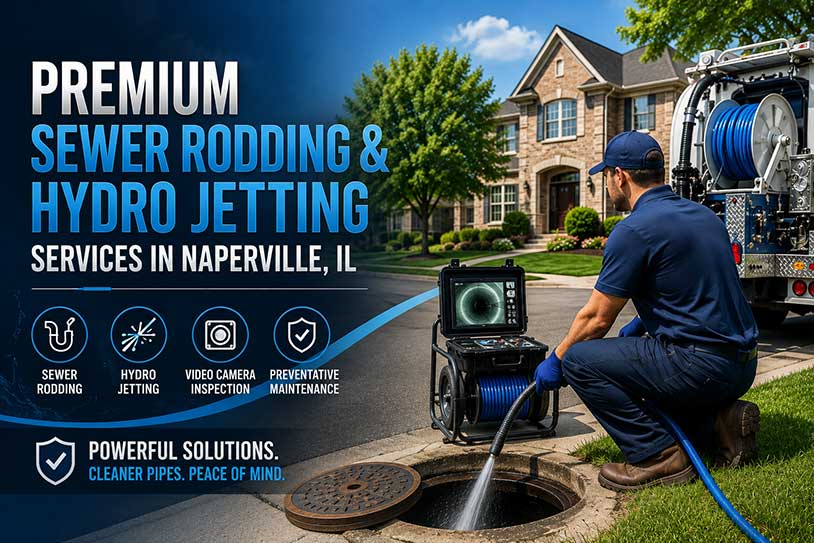
Sewer Rodding and Hydro Jetting in Naperville: Two Different Tools for Two Different Problems
The most common mistake in sewer line service isn’t picking the wrong company, it’s picking the wrong method before anyone’s actually looked at the line. Rodding and hydro jetting solve different problems in fundamentally different ways, and using the wrong one either wastes money on a fix that won’t hold or, in a genuinely compromised pipe, applies force the line isn’t ready to handle. Here’s exactly how each method works, when a Naperville plumber should actually recommend one over the other, and what a proper service visit looks like from start to finish.
Sewer Rodding: How It Actually Works
A rodding machine feeds a flexible steel cable through the line via an existing cleanout, with a cutting head at the tip designed to break through whatever’s blocking the pipe, a solid clog, a mass of tree roots, or compacted debris. The cable rotates as it advances, and the cutting head grinds a path through the obstruction rather than pushing it intact further down the line. For a straightforward, isolated blockage, this is fast, effective, and considerably less expensive than jetting. The limitation is inherent to how it works: rodding opens a path through the center of whatever’s blocking the pipe. It doesn’t scour the interior walls, which means buildup coating the rest of the pipe stays exactly where it was.
Equipment matters more than most homeowners realize here. According to the City of Naperville’s own published guidance for residents hiring sewer contractors, a service line running 100 feet or longer requires a larger rodding machine than what handles a shorter line, since underpowered equipment simply can’t maintain adequate cutting force across that distance. The City also specifies that legitimate contractors guarantee, in writing, that any blockage is pushed all the way through to the municipal mainline rather than just relocated a few feet down your own line, debris left short of the mainline tends to cause the same backup again within weeks. We cover the full detail of the City’s technical standards in our guide to sewer line rules every Naperville homeowner should know.
Hydro Jetting: How It Actually Works
A hydro jetting unit pressurizes water and sends it through a flexible hose fitted with a specialized nozzle, fed into the line the same way, through an existing cleanout. According to Cam Spray, an industrial jetter manufacturer, two separate measurements determine how effectively a jetter performs: PSI, the pressure that cuts through buildup and breaks it loose from the pipe wall, and GPM, the flow rate that actually carries that loosened material out of the line rather than letting it resettle further down. Both have to work together, pressure without adequate flow can leave debris behind even after it’s broken loose. Nozzle selection matters too: rear-facing jets propel the hose forward while scouring the walls as they pass, and forward-facing jets concentrate force directly ahead, particularly effective against dense root masses.
The practical result is a pipe that’s clean along its entire interior circumference, not just a path through the center. That’s why a jetted line typically goes considerably longer before needing service again than a rodded one, and it’s why jetting is the right call for a line with a genuine buildup problem rather than a single, isolated obstruction.
How We Decide Which One Your Line Actually Needs
- A single clog with no history of recurrence almost always calls for rodding, faster, less expensive, and entirely adequate for the job.
- A line that keeps clogging in the same spot despite being cleared before is a buildup problem, not a clog problem, and jetting addresses the actual cause instead of buying a few more weeks.
- Grease-heavy lines, common behind kitchens and in commercial settings, respond to jetting far better than rodding, since grease coats the full pipe wall rather than sitting as a discrete obstruction.
- Significant tree root intrusion often calls for a combination: mechanical root cutting to clear the mass, followed by jetting to remove what the roots left behind.
- A pipe with known structural damage, a crack, a significant offset, or a deteriorated section, may not be a candidate for jetting at all. Applying full pressure to a compromised pipe can make the damage worse rather than better, which is exactly why we don’t skip the next step.
What Actually Happens During a Service Visit
- We ask what you’ve noticed. Recurring pattern, timing, which fixtures are affected, this narrows the likely cause before any equipment comes out of the truck.
- We inspect before we clean. For anything beyond an obvious, isolated clog, a sewer camera inspection confirms the pipe’s actual material and condition, and shows us exactly what we’re dealing with and where. Professional inspections follow the framework established by NASSCO’s Pipeline Assessment Certification Program, the recognized standard for documenting pipe condition consistently rather than relying on one technician’s subjective read.
- We recommend the method that actually fits. Rodding, jetting, root cutting, or a combination, based on what the camera showed, not on what’s fastest to run that day.
- We do the work. Access through an existing cleanout in nearly all cases, no excavation required for either method.
- We verify it’s actually clear. A follow-up camera pass confirms the line is genuinely open along its full length, not just flowing again temporarily.
- You get a straight answer. What we found, what we did, and whether anything else is worth watching, before we leave, not buried in a follow-up call.
Residential and Commercial Naperville Properties Need Different Approaches
A kitchen line behind a restaurant accumulates grease at a volume no residential drain comes close to, and a commercial property’s grease trap condition directly affects how often the lateral downstream needs jetting versus simple maintenance rodding. A single-family home’s main lateral, especially an older one on clay tile or cast iron, faces a different set of problems: root intrusion, joint separation, and decades of gradual settling that a newer commercial building’s PVC piping doesn’t carry in the same way. We run commercial drain cleaning on a different equipment and scheduling logic than residential service for exactly this reason, treating each property type according to what actually clogs it rather than a one-size approach.
What This Costs, and Why the Range Is Wide
Pricing depends on the length of the line, how accessible the cleanout is, and how severe the buildup or intrusion actually turns out to be, a short, lightly clogged residential line costs considerably less than a long lateral with heavy root intrusion and limited access. For a full breakdown of current pricing by property type and job scope across the region, see our complete guide to hydro jetting costs in Chicagoland. An accurate quote follows a look at the actual line, not a flat number given over the phone before anyone’s assessed the job.
A Maintenance Rhythm Worth Keeping
For an older Naperville home on original clay tile or cast iron, a camera inspection every one to two years catches root intrusion or a shifting joint while it’s still a cleaning job rather than a repair. For a kitchen line, residential or commercial, keeping fats, oils, and grease out of the drain in the first place slows how fast buildup returns after a jetting visit. We cover exactly why grease is the single biggest driver of recurring clogs, and why rodding alone often can’t break that cycle, in The #1 Cause of Drain Clogs in Chicago Homes. If drains beyond just the sewer lateral are part of the pattern, our broader guide to drain cleaning for Naperville homeowners covers kitchen, bathroom, and floor drains specifically.
When It’s Not a Cleaning Problem Anymore
Neither rodding nor jetting fixes a structurally failed pipe, a collapsed section, a significant crack, or a joint separated beyond what cleaning addresses. If a camera inspection turns up damage rather than buildup, targeted sewer line repair is the honest recommendation, and we’ll tell you that directly rather than jetting a pipe that needs an entirely different fix.
Frequently Asked Questions
How do I know if I need rodding or hydro jetting?
A single, isolated clog with no history of recurrence usually needs rodding. A line that keeps clogging in the same place, or shows grease buildup on camera, needs jetting to address the buildup itself rather than just clearing a path through it.
Is hydro jetting safe for an older Naperville home’s clay tile or cast iron line?
It depends entirely on the pipe’s actual condition, which is exactly why a camera inspection happens first. A sound line generally handles properly calibrated jetting fine; a line with existing structural damage may not, and we adjust the plan based on what the camera shows.
Does either method require digging up my yard?
No. Both rodding and hydro jetting are performed through an existing cleanout, and neither disturbs your yard, driveway, or landscaping.
How often should a Naperville home get its sewer line jetted?
There’s no universal answer, it depends on pipe age, material, and whether the property has a history of grease buildup or root intrusion. A camera inspection is the most reliable way to determine your specific line’s actual maintenance interval.
Can a commercial kitchen’s grease trap reduce how often the sewer line needs jetting?
Yes. A well-maintained grease trap intercepts a meaningful share of the FOG that would otherwise reach the lateral, which directly reduces how quickly buildup accumulates downstream.
Licensed Sewer Rodding & Hydro Jetting for Naperville, IL
Suburban Plumbing Experts has served Naperville and the surrounding suburbs since 1978. We hold Illinois Plumbing License #055-044116 and Sewer License #2565, and every technician on our team is a trained, background-checked employee, not a subcontractor, equipped with both rodding and jetting capability on every service vehicle. Sewer backups and burst pipes don’t wait for business hours, and neither do we: our 24/7 emergency plumbing service and our Naperville, IL plumbing team are ready whether your situation is urgent or you’re scheduling routine maintenance.
Dealing With a Stubborn Drain or Sewer Line in Naperville?
Licensed, insured, and serving Naperville and Chicagoland since 1978. We inspect first and recommend rodding, jetting, or repair based on what your line actually needs, not what’s fastest to run.
Naperville: 630-749-9057 | Emergency: 708-518-7765 | Open 24/7
—
Suburban Plumbing Sewer Line & Drain Cleaning Experts
Licensed & Insured | Open 24 Hours | Serving Naperville & the West Suburbs Since 1978
📞 Naperville: 630-749-9057 | 🚨 Emergency: 708-518-7765