
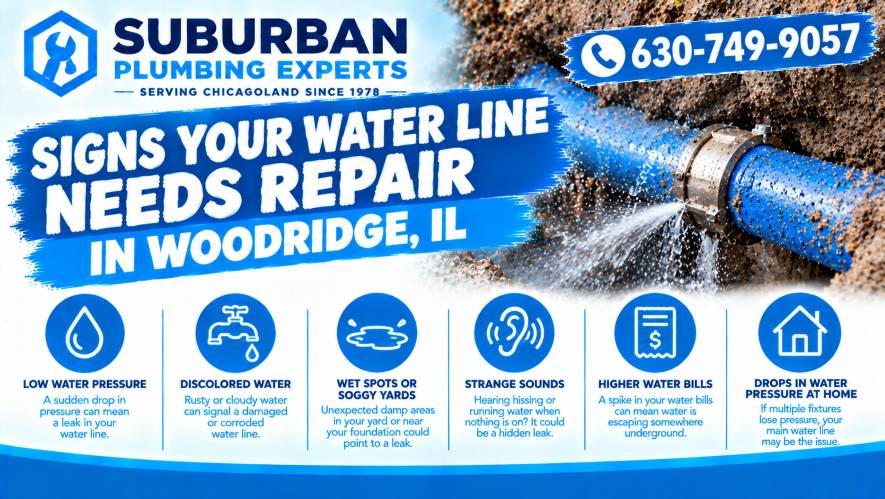
Your Water Line Is the One Pipe You Can’t See, Can’t Hear, and Probably Can’t Find on a Map of Your Own Yard. It Also Feeds Every Fixture in the House, So When It Starts to Fail, the Signs Show Up Everywhere Except the Place the Problem Actually Is.
Most homeowners never think about their water service line until something goes wrong with it. It runs underground from the water main or meter to your house, usually out of sight for its entire length, and it quietly delivers every drop of water you use. When it starts to fail, the symptoms rarely point at the pipe. They show up as weak showers, a higher bill, a wet patch in the yard, or water that suddenly looks the wrong color, and each of those has other possible explanations that send people looking in the wrong place.
This guide covers the signs that most reliably point to the water line itself, how to tell them apart from look-alike problems, and what to do the moment you suspect one. It also explains why Woodridge homes have a few specific things worth knowing that a generic checklist won’t mention. If you’d rather skip straight to a diagnosis, our Woodridge plumbing team and our water line repair and replacement service handle exactly this.
First, Which Pipe Are We Talking About?
A home has three separate pipe systems that get confused with each other constantly. The water service line is the pressurized supply pipe that brings clean water in from the main. The sewer lateral is the gravity-fed pipe that carries wastewater out. The interior plumbing is everything inside the walls and floors. A failing water service line is a supply-side problem: water is leaking out under pressure, or the pipe is corroding and restricting what gets through. A failing sewer lateral is a drainage-side problem, with slow drains, gurgling, and odors instead. If your symptoms involve drains and smells, our sewer camera inspection is the better first step, and our guide to gurgling drains explains one of the most common warning signs. If they involve pressure, water quality, or your meter, keep reading.
Ownership matters too. In most municipalities, the utility owns the water main in the street and the homeowner owns the service line from the curb stop or meter to the house, which means a leak on that stretch is the homeowner’s repair. Rules differ by village, so it’s worth confirming where responsibility changes hands for your specific property before you call anyone.
Why Woodridge Homes Have Their Own Version of This Problem
Woodridge is a relatively young community. It was incorporated in 1959, on wooded high ground overlooking the East Branch of the DuPage River, and most of its housing was built in the decades after. That’s a different story than an old Chicago neighborhood with 100-year-old pipes. Woodridge’s water line concerns tend to come from two other places.
The first is construction-era materials. Homes built in the postwar and 1960s-1970s building boom were plumbed in the materials of the time, and some water lines and interior supply pipes from that era were galvanized steel, which corrodes from the inside over decades, narrowing the pipe and eventually flaking or leaking. A house that’s 50 or 60 years old with its original water line has reached the age where that kind of internal corrosion becomes a real possibility. This is general plumbing history rather than a Woodridge-specific survey, so the only way to know what your own line is made of is to look at it where it enters the house or have a plumber confirm it.
The second is the terrain. The village sits on rolling ground rather than flat prairie, part of the broader glacial landscape that shapes much of DuPage County. As a general rule of physics, water pressure drops roughly 0.43 psi for every foot you climb in elevation, so properties higher on a grade can see lower static pressure than ones lower down, and a line that’s marginal on the high side of a slope shows its weakness sooner. That’s not a defect, it’s just a reason to measure your actual pressure rather than assume it matches your neighbor’s.
The Signs That Actually Point to the Water Line
1. Your Water Meter Moves When Everything Is Off
This is the single most reliable test, and it costs nothing. Turn off every faucet, appliance, and ice maker in the house. Find your water meter, note the reading or watch the small leak-indicator dial, wait 15 to 20 minutes without using any water, and check again. If the meter has moved, water is going somewhere you aren’t using it. If the toilets and fixtures check out, the leak is likely in the service line or in a wall or slab. Our leak detection services use specialized equipment to locate a hidden leak without digging up the whole yard to find it.
2. Water Pressure Dropped Throughout the House
One weak faucet is usually a clogged aerator. Weak pressure at every fixture at once points upstream, toward the service line or the pressure regulator. A leak in the line diverts water before it reaches the house, and internal corrosion physically narrows the pipe, and both reduce what comes out of your taps. An inexpensive pressure gauge threaded onto an outdoor spigot gives you an actual number instead of a guess, and our plumbing system guide explains what healthy pressure looks like and how to test it. Mineral buildup can also narrow a pipe over time, which our guide to hard water in Chicago-area homes covers in full.
3. A Wet, Soft, or Unusually Green Patch in the Yard
Pressurized water that escapes underground has to go somewhere, and it often surfaces as a soggy spot, a patch of grass that stays green and lush while the rest of the lawn dries out, or in severe cases a small depression where the soil has washed away. Because the line is pressurized, these spots can appear and stay wet in dry weather, which is what distinguishes them from ordinary drainage problems after rain. If the wet area also smells like sewage, you may be looking at the sewer lateral instead, which is where a camera inspection comes in.
4. A Sudden Jump in Your Water Bill
A bill that climbs without any change in how your household uses water is a classic sign of a hidden leak. Compare your usage to the same month last year rather than the previous month, since seasonal use varies, and use the meter test above to confirm before assuming it’s a billing error.
5. Discolored, Metallic-Tasting, or Cloudy Water
Brown or rust-colored water, especially when it first runs after the water has been sitting, can indicate corrosion in an iron or galvanized pipe. Discoloration that appears suddenly and clears after running the tap for a minute is common after nearby main work and isn’t necessarily your line, but water that’s consistently off-color points back toward your own pipes.
Pipe material also matters for a more serious reason. According to the EPA, there is no safe level of lead exposure, and pipes are the primary source of lead in drinking water. Its Lead and Copper Rule Improvements require water systems to identify and replace lead service lines within 10 years. Lead service lines are far less likely in a community built mostly after the 1950s than in an older city, but if your home is on the older end of Woodridge’s housing stock and you don’t know your pipe material, it’s reasonable to ask your water utility or a plumber to confirm it rather than assume. Our lead service line replacement page has more on this.
6. Hissing, Running Water, or Banging When Nothing Is On
A hissing or running-water sound near where the line enters the house, with every fixture off, suggests water escaping under pressure. Banging or thudding right after a fixture shuts off is different. That’s water hammer, a pressure shockwave, and it’s a separate issue from a leak even though it can accompany pressure problems.
7. Dampness, Cracks, or Mold Near Where the Line Enters the House
A leak close to the foundation can show up as persistent dampness on a basement wall or floor near the entry point, efflorescence (a white mineral crust) on masonry, or a musty smell with no obvious source. Because several things cause basement moisture, including groundwater and sump pump issues, a pressurized leak is worth ruling in or out with the meter test rather than assuming it’s the usual suspect.
8. No Water at All After a Hard Freeze
If your water stops completely during a deep freeze, a frozen service line is a likely cause, especially if the line is shallow or runs through an unprotected area. Our hard freeze countdown guide covers how to prepare before the cold arrives, and our burst pipe services handle the repair if a line has actually split.
What to Do the Moment You Suspect a Water Line Problem
Start by confirming it’s a leak with the meter test. If it is, locate your main shutoff valve, usually where the line enters the house near the meter, and close it if water is actively flooding or the leak is severe. Take photos of any wet areas, the meter readings, and anything unusual, since documentation helps both the repair and any later conversation with your utility or insurer. Avoid digging in the yard yourself. Underground utilities, including gas, electric, and communications lines, can be dangerous to hit, and Illinois requires a utility locate before excavation.
Then get the line diagnosed rather than guessed at. Pinpointing the exact location of a leak is the difference between a targeted repair and a much larger excavation. Call our Woodridge plumbers and we’ll start with that diagnosis.
What Repair Actually Involves
The right fix depends on what’s wrong and how much of the line is affected. A single failed joint or a short damaged section can often be repaired in place with a targeted excavation. A line that’s corroded along its length, has failed repeatedly, or is made of a material that’s reached the end of its life is usually better replaced than patched, since repeated spot repairs on a deteriorating pipe tend to cost more over time than a single replacement. Depending on the situation and the property, replacement can sometimes be done with less disruption to landscaping than a full open trench, though that depends on the line, the soil, and the access. Galvanized interior supply pipes from the same era may need attention at the same time, which is where home repiping comes in. Our water line repair and replacement service covers both repair and replacement, and a diagnosis first, then a repair plan matched to what’s actually found, is the sequence that avoids paying for the wrong fix.
Frequently Asked Questions
How can I tell if a leak is in my water line or my sewer line?
The water line is pressurized supply, so leaks show up as a moving water meter with everything off, lower pressure, or a wet spot that appears even in dry weather. A sewer line problem shows up on the drainage side: slow drains, gurgling, and odors. A camera inspection is the definitive way to check the sewer side.
Is the water line my responsibility or the village’s?
In most municipalities, the utility owns the main in the street and the homeowner owns the service line from the curb stop or meter to the house. Rules vary, so confirm where responsibility changes for your specific property before assuming either way.
How do I check my water meter for a leak?
Turn off all water use in the house, note the meter reading or watch the leak-indicator dial, wait 15 to 20 minutes, and check again. Any movement means water is going somewhere. If toilets and fixtures check out, the service line or a hidden pipe is the likely cause.
Why is my water pressure low in the whole house?
Low pressure at every fixture, not just one, points upstream toward the service line or pressure regulator. Causes include a leak, internal corrosion narrowing the pipe, mineral buildup, or a partly closed or failing valve. Measuring your actual pressure with a gauge is the first step.
Could my water line contain lead?
It’s less likely in a community built mostly after the 1950s than in an older city, but it isn’t impossible for homes on the older end. The EPA’s Lead and Copper Rule Improvements require water systems to identify and replace lead service lines, so your water utility is a good source of information about your specific line, and a plumber can confirm the material. See our lead service line replacement page for more.
Should I repair or replace a failing water line?
A single isolated failure is often repairable in place. A line that’s corroded along its length or has failed repeatedly is usually better replaced, since repeated patches on a deteriorating pipe tend to cost more over time than one replacement. A proper diagnosis tells you which situation you’re in.
Think Your Water Line Is Failing in Woodridge, IL?
Licensed, insured, and serving Woodridge and the surrounding west suburbs since 1978. Leak detection, diagnosis, and repair, matched to what your specific line actually needs.
Woodridge: 630-749-9057 | Emergency: 708-518-7765 | Open 24/7
—
Suburban Plumbing Sewer Line & Drain Cleaning Experts
Licensed & Insured | Open 24 Hours | Serving Chicago & Chicagoland Since 1978
📞 Woodridge: 630-749-9057 | 🚨 Emergency Hotline: 708-518-7765