For a Naperville Business, a Clogged Drain Isn’t Just a Maintenance Item. It’s a Liability, a Compliance Risk, and a Customer Experience Problem All at Once.
A residential clog is an inconvenience. A commercial clog behind a customer-facing business is a different category of problem entirely, one that can show up on a health inspection report, create a slip hazard in a public space, or shut down a kitchen mid-service. The right maintenance approach depends on what type of business you’re running and what’s actually going through your drains, and getting that match right is the difference between routine upkeep and a recurring emergency. For the full technical picture, including real PSI and GPM ranges for commercial-grade equipment and a property-type breakdown across restaurants, offices, retail, and industrial facilities, our complete guide to commercial hydro jetting in Chicago covers the subject in full depth. What follows here focuses on what actually matters for a Naperville business specifically.
What Hydro Jetting Actually Does, in Plain Terms
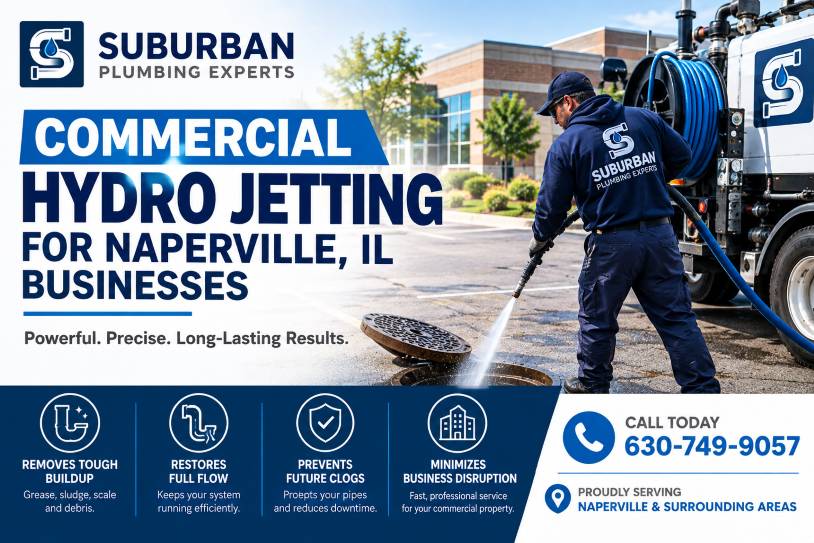
A hydro jetting unit sends pressurized water through a flexible hose and specialized nozzle, fed into the line through an existing cleanout. According to Cam Spray’s guide to sewer jetter flow rate and pressure, two measurements determine how effective this is: PSI, the pressure that breaks buildup loose from the pipe wall, and GPM, the flow rate that actually carries that loosened material out of the line rather than letting it resettle downstream. That’s the mechanical reason jetting outperforms a standard cable snake for commercial volume: a snake opens a path through the center of a clog, while jetting scours the entire interior surface, addressing the coating that causes commercial lines to clog repeatedly in the first place.
Why Commercial Kitchens Face Real Regulatory Stakes, Not Just Inconvenience
For any Naperville business operating a food service kitchen, plumbing maintenance isn’t purely an operational choice, it intersects directly with health code compliance. According to DuPage County Health Department’s Food Service Construction and Design Manual, grease interceptors have to remain genuinely accessible for maintenance, and indirect waste connections throughout a commercial kitchen, dishwashers, prep sinks, floor drains, are subject to specific code requirements. A backed-up floor drain or an overflowing grease interceptor during an inspection isn’t just embarrassing, it’s a documented sanitation finding that can trigger a follow-up inspection or worse. Scheduled hydro jetting keeps the lines behind that equipment clear well before an inspector ever has a reason to look twice.
The Liability Angle That Applies to Every Business Type, Not Just Restaurants
Standing water from a slow or backed-up drain is a slip hazard, and that risk doesn’t discriminate by industry. According to the National Safety Council’s own injury cost data, drawn from National Council on Compensation Insurance claims figures, falls and slips averaged $54,499 per lost-time workers’ compensation claim in 2022 and 2023, well above the $47,316 average across all injury causes. A customer slip-and-fall carries its own separate liability exposure on top of that. Whether you run a retail floor, a medical office, or a restaurant dining room, water on a floor that didn’t need to be there is an expensive, entirely preventable risk.
What Different Naperville Business Types Actually Need
Restaurants and food service face the highest-frequency need given continuous grease exposure, and jetting paired with regular commercial grease trap cleaning addresses both the interceptor and the line downstream of it, since grease that gets past an overloaded trap accumulates in the lateral regardless of how well-maintained the trap itself is.
Retail and office spaces see lower volume than food service, but restroom and break room lines in an older building still benefit from periodic professional attention, particularly buildings that have never had a baseline camera inspection to establish actual line condition.
Medical and dental offices combine general drain maintenance needs with backflow prevention concerns specific to the equipment involved, worth addressing as a package rather than two separate maintenance conversations.
Multi-tenant and mixed-use buildings share lines across units, meaning one tenant’s habits can create a backup that affects everyone downstream. Scheduled maintenance here is a property management decision, not something that should wait for an individual tenant to report a problem.
How We Actually Decide What Your Business Needs
The honest answer is that we don’t recommend jetting on every visit regardless of what we find. A commercial sewer camera inspection comes first for anything beyond an obvious, isolated clog, confirming whether the issue is buildup that jetting addresses, an isolated blockage that professional sewer rodding clears just as effectively for less cost, or structural damage that needs commercial sewer line repair rather than cleaning of any kind. Applying full jetting pressure to a line that’s already structurally compromised can make the problem worse, which is exactly why the inspection step isn’t optional.
What This Looks Like as an Ongoing Maintenance Relationship
A single jetting visit solves the immediate problem. A scheduled maintenance relationship prevents the next one from happening during business hours, during a health inspection, or during your busiest week of the year. For businesses that have dealt with recurring clogs, we typically recommend establishing a baseline camera inspection first, then setting a jetting interval based on what that inspection actually shows about your specific lines rather than a generic calendar schedule that may not match your business’s real usage pattern.
Frequently Asked Questions
Is hydro jetting overkill for a small retail or office space?
Not necessarily, but it’s not always the right first step either. A camera inspection determines whether your specific situation calls for jetting, simple rodding, or nothing beyond routine monitoring, rather than assuming every commercial property needs the same treatment.
Can hydro jetting help us pass a health inspection?
Indirectly, yes. Keeping grease interceptors and the lines behind them clear reduces the chance of a backup or overflow being documented as a sanitation finding during an inspection, though jetting itself isn’t a direct code requirement.
Does hydro jetting disrupt business operations?
Generally no. Access is typically through an existing cleanout, without excavation, and most commercial jobs are scheduled around business hours specifically to minimize disruption.
How is jetting different for a multi-tenant building versus a single business?
The mechanics are the same, but a shared line means one tenant’s habits can affect the whole building’s drainage. Property managers often benefit from scheduling maintenance at the building level rather than waiting for individual tenant complaints.
How often should a commercial kitchen get its lines jetted?
It depends on kitchen volume and grease output more than a fixed calendar, which is why a baseline camera inspection is worth establishing before committing to a specific interval.
Commercial Hydro Jetting & Drain Maintenance for Naperville, IL
Suburban Plumbing Experts has served Naperville and the surrounding suburbs since 1978. We hold Illinois Plumbing License #055-044116 and Sewer License #2565, and every technician on our team is a trained, background-checked employee, not a subcontractor. Our commercial drain cleaning service inspects first and recommends the method that actually fits your business, and if something goes wrong outside business hours, our 24/7 emergency plumbing service and Naperville, IL commercial plumbing team are ready to respond.
Set Up Commercial Drain Maintenance for Your Naperville Business
Licensed, insured, and serving Naperville’s business community since 1978. We’ll assess your actual usage and line condition before recommending a maintenance schedule, not a one-size-fits-all plan.
West Suburbs: 630-749-9057 | Emergency: 708-518-7765 | Open 24/7
—
Suburban Plumbing Sewer Line & Drain Cleaning Experts
Licensed & Insured | Open 24 Hours | Serving Naperville & the West Suburbs Since 1978
📞 West Suburbs: 630-749-9057 | 🚨 Emergency: 708-518-7765