
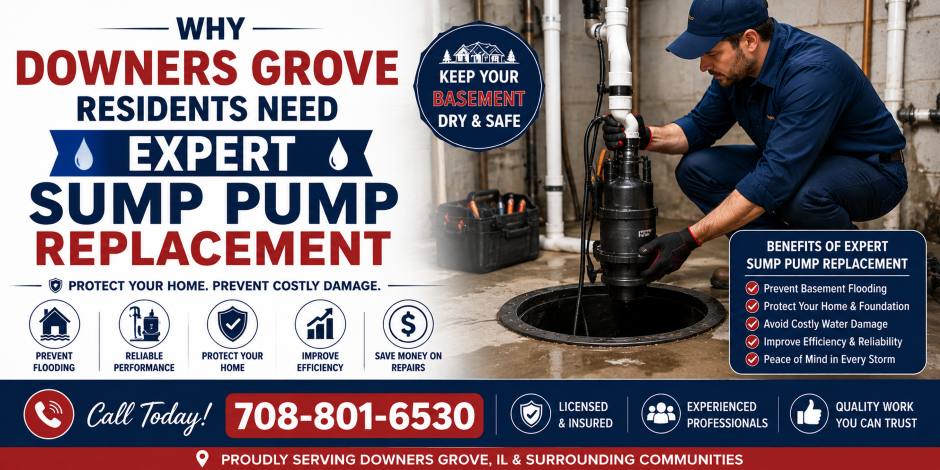
A Sump Pump Doesn’t Fail All at Once — It Tells You First, Through Noise, Constant Cycling, or Visible Rust. The Real Question Isn’t Whether to Eventually Replace It. It’s Whether You Catch the Signs in Time to Do It on Your Own Schedule, Not During the Next Storm.
Downers Grove, with its distinctive geographical and climatic characteristics, presents unique challenges for homeowners, particularly around basement flooding. The role of a sump pump here can’t be overstated — it’s the last line of defense against water accumulating in a basement, which left unchecked can lead to serious property damage and health issues from mold and mildew growth.
Understanding why sump pump issues are so common in Downers Grove basement flooding means looking at the local conditions actually driving it — creek overflow areas, aging infrastructure in older neighborhoods, and how heavy storms can overwhelm even a well-maintained protection system in this part of DuPage County.
A note on scope: This guide is about the replacement decision — recognizing when a pump has reached the end of its useful life and choosing the right one to replace it with. If your pump has already failed and you’re dealing with an active storm right now, our Downers Grove Basement Protection Quick Fix Checklist walks through the immediate troubleshooting steps instead.
Understanding How a Sump Pump Actually Works
A sump pump sits in the lowest part of a basement or crawlspace, in a basin designed to collect groundwater before it can spread across the floor. When water in the basin rises to a set level, a float switch triggers the pump, which removes the water and directs it away from the home to a location where it can drain safely.
Understanding this mechanism is what actually makes the case for timely replacement clear: every part of that system — the float switch, the impeller, the check valve, the motor itself — wears down over years of cycling, and a pump that’s still technically running isn’t the same as a pump that’s still reliable.
Recognizing the Signs Your Sump Pump Needs Replacement
Homeowners should watch for a specific set of warning signs: unusual noises during operation, the pump running continuously rather than cycling normally, visible rust or physical damage, and an inability to start or stop properly. If your pump is over seven years old, it’s worth planning for replacement even without an active symptom — the average lifespan of these units is around a decade, and waiting until year ten to start thinking about it means you’re already on borrowed time.
Catching these signs early is what prevents an actual flooding event, not just an inconvenient repair. If your pump suddenly stops working mid-storm despite your best efforts at maintenance, our quick fix checklist covers exactly what to do in that moment while you arrange for professional service.
Why Professional Replacement Is Worth It
Professional replacement offers real advantages over a DIY approach. A licensed plumber has the training to install the pump correctly the first time, ensuring it runs efficiently rather than working against a subtly wrong installation from day one. They can also identify problems with your existing drainage setup that aren’t obvious to an untrained eye — a discharge line that’s improperly pitched, a check valve installed backward, or a basin that’s undersized for your home’s actual water volume.
Professional installation also typically comes with a real warranty — protection against future problems that a DIY install simply doesn’t carry, and genuine peace of mind against unexpected expense down the road.
The Real Risks of Improper Installation
An improperly installed sump pump can mean inadequate water removal, a higher flooding risk, and premature failure of the unit itself. Incorrect installation can also void manufacturer warranties outright, leaving you responsible for the full cost of any resulting repair or replacement. Relying on an expert Downers Grove, IL plumber for replacement is what actually protects against all of this — getting the job done right the first time, rather than discovering the installation was wrong the hard way, during the storm it was supposed to protect against.
Choosing the Right Sump Pump for Your Home
Several types of sump pumps exist, each with real tradeoffs. Submersible pumps sit directly in the basin and run quietly; pedestal pumps sit above the basin and are generally easier to service but louder in operation; battery backup systems provide protection specifically during a power outage, which is exactly when you need the pump working most. An experienced plumber can help determine the right type — and the right capacity — for your specific home based on basement size, typical water volume, and budget.
Getting the sizing right matters more in Downers Grove than in a lot of suburbs specifically because the village has documented Localized Poor Drainage Areas (LPDAs) — properties where bowl-shaped topography creates standing water risk independent of a home’s individual flooding history. If your property falls within one of the village’s identified LPDAs or floodplain zones — checkable through the Village of Downers Grove’s own stormwater management resources — that’s a real factor your plumber should weigh when sizing your replacement pump, not an afterthought.
Why Expert Replacement Is a Genuinely Cost-Effective Investment
Professional replacement might look like an added expense next to a DIY unit swap, but it’s typically the more cost-effective choice over time. Correct installation means the pump runs efficiently, which reduces energy costs and extends its working life. It also heads off the frequent repairs or premature second replacement that often follow a marginal DIY install — the kind of hidden cost that only shows up after the fact.
A Reliable Sump Pump Protects More Than Your Basement
A properly functioning sump pump protects your home’s safety and its value simultaneously. Homes with a documented, reliable sump pump system are more attractive to buyers specifically because they offer real assurance against basement flooding — a genuine selling point in a market where buyers increasingly ask about flood history upfront.
It’s also worth being direct about what a sump pump doesn’t cover: it protects against groundwater and seepage, not sewer backups, which are a separate problem entirely and one that affects a real number of Downers Grove homeowners. Our Downers Grove homeowner’s guide to sewer backups covers what causes those specifically, who’s actually responsible, and how to prevent them — a genuinely different fix than a sump pump replacement.
Frequently Asked Questions
My sump pump is only 4 years old but making noise. Does it need replacement already?
Not necessarily — noise well before the typical decade-long lifespan is often a specific, repairable issue (a worn bearing, a misaligned impeller) rather than a sign of full failure. That said, don’t ignore it either; have it assessed rather than assuming it will resolve on its own.
How do I find out if my property is in one of Downers Grove’s LPDAs?
The Village of Downers Grove’s stormwater management resources include mapping tools that show floodplain and LPDA boundaries for specific addresses. This is worth checking before assuming your risk level based only on your basement’s past behavior, since LPDA status is based on topography, not just history.
Is a battery backup pump really necessary, or is a standard pump enough?
A battery backup matters most because power outages and heavy storms tend to happen together — exactly when a standard pump is most needed and least likely to have power. For a Downers Grove home in a flood-prone area, a backup system is a genuinely reasonable investment, not an upsell.
Should I replace my sump pump proactively at 7-10 years, or wait until it actually fails?
Proactive replacement around that window is generally the smarter call. Waiting for outright failure means you’re choosing a new pump and arranging installation during an active emergency — with less time to compare options and a real risk of flooding in the gap. Replacing on your own schedule avoids both problems.
Sump Pump Replacement & Installation in Downers Grove, IL
Licensed, insured, and familiar with Downers Grove’s floodplain and LPDA structure. Proper sizing, professional installation, and a real warranty — not a DIY swap.
Emergency: 708-518-7765 | Downers Grove: 630-749-9057 | Open 24/7
—
Suburban Plumbing Sewer Line & Drain Cleaning Experts
Licensed & Insured | Open 24 Hours | Serving Downers Grove & the Suburbs Since 1978
📞 Downers Grove: 630-749-9057 | 🚨 Emergency: 708-518-7765