
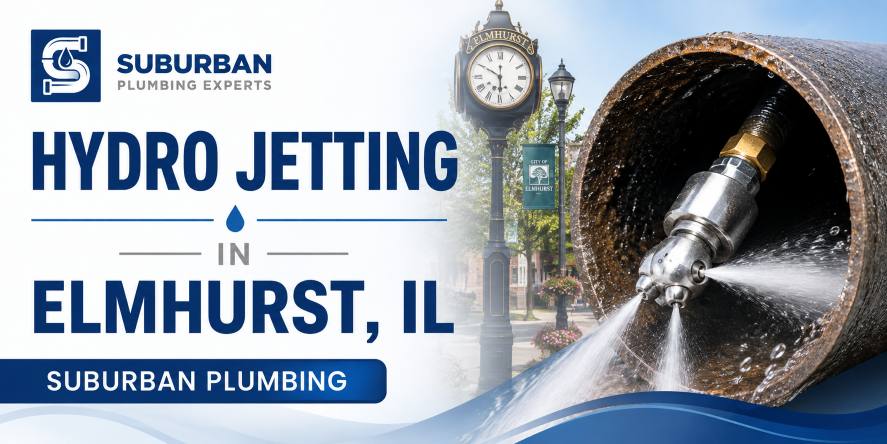
Elmhurst’s Tree City USA Canopy Is One of Its Best Features and One of Its Most Common Sewer Line Problems. Here’s Why Root Intrusion Hits This Village Specifically, Why Hydro Jetting Solves It Better Than Rodding, and What the City’s Own Cost-Sharing Program Means for the Repair Bill.
Elmhurst’s tree-lined streets are one of the things people specifically choose the city for, and they’re also the reason so many Elmhurst homeowners eventually deal with a sewer line problem that has nothing to do with anything they did wrong. Elmhurst has held Tree City USA status from the Arbor Day Foundation for decades running, and the City’s own Forestry Division actively maintains tens of thousands of parkway trees across the community as part of that commitment. That’s a genuine civic asset. It’s also, underground, a slow and steady source of root intrusion into the sanitary sewer laterals running beneath nearly every older lot in the city.
This isn’t a defect specific to any one neighborhood or housing era. It’s simply what happens when mature trees and buried clay tile or cast iron sewer lines share the same ground for fifty or more years. What varies is how a homeowner finds out about it, and what they do once they know.
Why Root Intrusion Is Elmhurst’s Most Common Sewer Problem
Tree roots grow toward moisture, and a sewer lateral carrying wastewater is a reliable, constant moisture source sitting a few feet underground. Older sewer pipe, particularly the clay tile common in homes built before the 1960s, has joints every few feet where sections of pipe connect. Those joints are exactly where a root finds its way in first, through a hairline gap that widens as the root thickens over years. Once inside, the root doesn’t stop growing, and it catches paper, grease, and debris as they pass, gradually narrowing the pipe until flow slows or stops entirely.
This is the same underlying mechanism behind most Chicago area drain clogs generally, not something unique to Elmhurst’s plumbing. We’ve laid out the fuller version of that mechanism, including how hard water and grease interact with aging pipe material, in our guide to the number one cause of drain clogs in Chicago homes. What makes Elmhurst specifically worth a closer look is the density of mature parkway and private property trees sitting directly above a housing stock old enough for most of its original sewer laterals to still be clay tile. That combination shows up in service calls more often here than it does in newer, less densely planted subdivisions elsewhere in DuPage County.
Why Hydro Jetting Handles Root Intrusion Better Than Rodding
Mechanical rodding, the traditional method of clearing a blocked line, works by pushing a rotating cutting head through the obstruction. Against a root mass, that means cutting a path through the middle of it and restoring flow, at least for a while. What rodding doesn’t do is remove the root remnants still attached to the pipe wall at the joint, which means the same root mass typically regrows into that path within months, and the homeowner ends up scheduling the same service again on a repeating cycle.
Hydro jetting works differently. High pressure water, adjusted to the pipe’s material and condition, scours the entire interior surface of the pipe clean rather than just clearing a channel through the middle. Against root intrusion specifically, that means stripping root material back to the pipe wall at the joint rather than leaving a stump behind to regrow. It’s also gentler on aging clay tile and cast iron than repeated aggressive rodding, which over years can wear at already brittle joints. A sewer camera inspection beforehand confirms exactly where the intrusion is and how significant it’s become, which matters on an older Elmhurst lateral where the difference between “roots need clearing” and “the joint itself has separated” changes the entire recommendation.
The City of Elmhurst’s Sewer Cost-Sharing Program
Here’s something a lot of Elmhurst homeowners don’t know until they’re already dealing with a root intrusion problem: the City itself offers a Sanitary Sewer Cost-Sharing Program designed to help offset the cost of repairing or replacing the private sanitary sewer connection running from a home to the City’s main line. There’s a related program covering driveway approach damage specifically caused by parkway tree roots, where the City covers a portion of the repair cost when root damage from a City owned parkway tree has created a genuine safety hazard.
These programs exist precisely because the City recognizes that its own parkway trees, the same trees that make Elmhurst’s streets what they are, contribute directly to this kind of underground damage on private property. Eligibility and reimbursement details are specific enough that it’s worth reviewing the City’s own program page directly, or asking your plumber whether a given repair is likely to qualify before assuming the full cost falls on the homeowner alone. It’s a detail that changes the math on a repair that might otherwise feel like an unplanned, unassisted expense.
What Else Elmhurst’s Older Housing Stock Adds to the Picture
Root intrusion rarely shows up in isolation on a home old enough to have it. The same clay tile and cast iron pipe that’s vulnerable to roots is also the pipe most likely to be dealing with general age related deterioration, corrosion, and joint settling, independent of any tree nearby. We’ve covered what that broader picture looks like for Elmhurst specifically, including what a full camera inspection tends to reveal on a property that’s never had one, in our Elmhurst aging pipes and sewer inspection guide, which is worth reading alongside this one for anyone dealing with a home built before the 1970s.
For homeowners weighing hydro jetting against other options and wanting a fuller breakdown of pricing and when each method actually applies, our complete guide to hydro jetting in Chicagoland covers cost ranges by service type and property category in more depth than makes sense to repeat here.
Signs Your Elmhurst Sewer Line Has Root Intrusion
- Slow drains throughout the house, not just one fixture. A single slow drain usually points to a localized clog. Multiple slow drains, especially the lowest fixtures in the house, point toward a main line issue further down, which is where root intrusion typically develops.
- Gurgling sounds from toilets or drains when other fixtures run. That gurgle is air being forced back up the line by a partial obstruction, a common early sign of a developing root mass.
- Recurring backups on a predictable cycle. If a line gets cleared and backs up again on a fairly consistent schedule, rodding is likely cutting a path through a root that keeps regrowing rather than actually removing it.
- Unusually lush or fast growing grass along the sewer line’s path. Wastewater leaking slowly from a compromised joint acts as fertilizer, and a visibly greener strip of lawn tracing a straight line toward the street is a classic, easy to miss sign.
Frequently Asked Questions
Is hydro jetting safe for Elmhurst’s older clay tile sewer lines?
Yes, when pressure is calibrated to the pipe’s material and condition by a licensed plumber. A camera inspection beforehand confirms the pipe’s actual condition, which is what allows pressure to be set appropriately rather than guessed at.
How do I know if my Elmhurst property qualifies for the City’s sewer cost-sharing program?
Eligibility depends on the specifics of the repair and whether it involves the private sanitary sewer connection or driveway damage tied to a City owned parkway tree. Reviewing the City’s program page directly, or asking your plumber to flag it during an inspection, is the most reliable way to find out before assuming the repair is entirely out of pocket.
How often should hydro jetting be scheduled for a property with mature trees nearby?
Most homes with significant tree coverage near the sewer line benefit from service every one to two years, with a camera inspection in between to monitor how quickly intrusion is redeveloping. Homes with a documented history of recurring root problems sometimes need more frequent attention until the underlying joint issue is addressed directly.
Will hydro jetting damage an already fragile older pipe?
Properly calibrated hydro jetting is generally safer for aging pipe than repeated aggressive rodding, which can wear at already brittle joints over time. The camera inspection that precedes jetting is what allows a plumber to adjust pressure and technique to the pipe’s actual condition rather than applying a one size fits all approach.
What’s the difference between root intrusion and a fully collapsed sewer line?
Root intrusion is typically confined to individual joints and can usually be cleared with jetting, sometimes repeated over a couple of service visits for a heavily established root mass. A collapsed line is a structural failure of the pipe itself and requires repair or replacement rather than cleaning. A camera inspection is what distinguishes between the two before any work begins.
Hydro Jetting Service for Elmhurst Homes & Businesses
Licensed, insured, and serving Elmhurst and the surrounding suburbs since 1978. Camera-verified hydro jetting and sewer line service for root intrusion, grease buildup, and recurring blockages, with 24/7 emergency response.
Emergency: 708-518-7765 | Suburbs: 630-749-9057 | Open 24/7
—
Suburban Plumbing Sewer Line & Drain Cleaning Experts
Licensed & Insured | Open 24 Hours | Serving Elmhurst & the Suburbs Since 1978
📞 Elmhurst: 630-749-9057 | 🚨 Emergency: 708-518-7765