
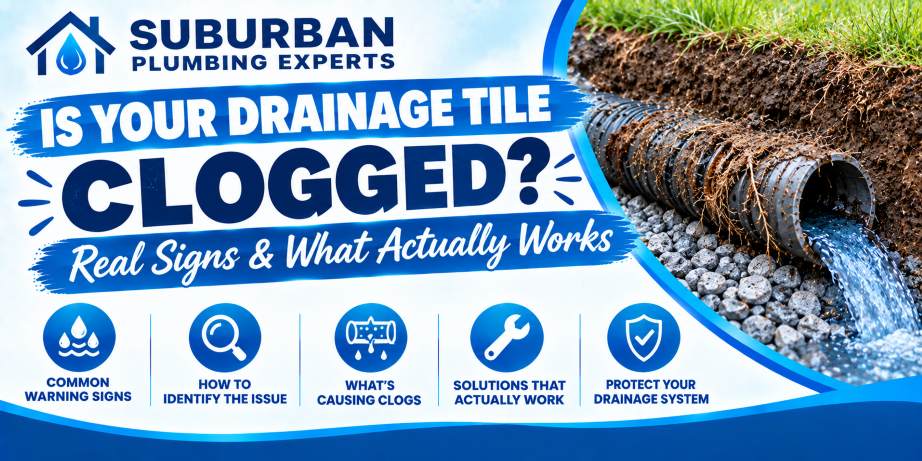
Is Your Drainage Tile Clogged? Real Signs & What Actually Works
Most Advice on This Topic Tells You to Plunge or Snake a System That, in Most Homes, Has No Accessible Opening at All
Drainage tile, also called weeping tile, a French drain, or a perimeter drain, is the buried, perforated pipe that runs along a foundation’s footing to intercept groundwater before it can pressure its way into a basement. It’s a different system entirely from your sanitary drains, and that distinction matters, because a lot of common advice treats a clogged drain tile like a slow kitchen sink: grab a plunger, run a snake down it, pour in some baking soda and vinegar. In most homes, there’s no drain opening to plunge or snake in the first place. The system is buried under the floor slab or outside the footing with no accessible fitting unless one was specifically installed, and even where access exists, treating an old, compromised system with aggressive flushing can do more harm than good. Here’s what actually works instead.
How the System Actually Works
An interior system runs beneath the basement floor slab around the perimeter, collecting groundwater and channeling it to a sump pit, where a sump pump discharges it away from the house. An exterior system, more specifically called a French drain, sits outside the foundation at footing depth and either drains by gravity to daylight, a storm connection, or its own dry well. Both versions exist to do the same job: relieve hydrostatic pressure against the foundation before that pressure finds its way through a crack or joint on its own.
Why It’s Called “Tile” When It’s Usually Just Pipe
The name is a holdover from how these systems were actually built for most of the 20th century: short, unglazed clay segments, literally tiles, laid end to end with open gaps between them so groundwater could seep in from all directions. Homes built before roughly the 1980s often still have the genuine article, jointed clay or concrete tile, while newer installations use continuous perforated PVC or corrugated pipe instead. The material matters for more than trivia. Every joint in an old clay tile system is a potential entry point for fine roots and soil infiltration, which is exactly why older systems tend to develop root intrusion and siltation problems that a continuous, sealed PVC line mostly avoids. If you know roughly when your home was built, you already have a reasonable guess at which kind of system you’re dealing with, and how much more scrutiny an older one deserves.
The Real Test: Run a Hose and Watch the Pit
This is the actual diagnostic homeowners can do themselves, and it’s more reliable than guessing from symptoms alone. Run a garden hose at a slow, steady trickle against the exterior foundation wall, ideally in a spot you suspect might be affected, for ten to fifteen minutes. If you have an interior system, watch the sump pit: water should start arriving and the level should rise. If the pit stays dry while you know water is soaking into the ground right outside, that’s a strong sign the tile isn’t moving water the way it should, either from a clog or a failure somewhere in the line.
Signs You’re Actually Dealing With a Problem
Water at the floor-wall joint, the seam where your basement floor meets the wall, rather than water rising through the floor itself, is one of the more specific signs of a struggling perimeter drain, since that joint is exactly where pressure finds its way in once the tile can’t keep up.
Efflorescence, a white, chalky mineral residue low on basement walls, forms as moisture wicks through concrete and evaporates, leaving mineral deposits behind. It’s a sign of ongoing moisture pressure even without visible standing water.
A musty odor along baseboards often shows up before any visible water does, as damp conditions behind a wall support mold and mildew growth you can smell before you can see.
A sump pump running constantly can mean the tile is delivering more water than usual because grading or gutter issues are overwhelming the system, while a pump that barely runs despite clearly wet conditions outside suggests the opposite problem, water isn’t reaching the pit at all.
Soggy soil or pooling water around the foundation after rain that used to drain fine is the clearest exterior sign something’s changed in how the system is handling water.
Why You Probably Can’t DIY This
Most residential drain tile systems, especially interior ones installed under a finished basement floor, were never given a dedicated cleanout. Contractors can install one during construction, but many homeowners skip it since it means an exposed fitting in an otherwise finished space. Without that access point, there’s simply nowhere to insert a snake or run a hose directly into the pipe, which is why so much generic advice about plunging or chemically treating a drain tile doesn’t actually apply to most real installations. Where access does exist, there’s a second caution worth taking seriously: aggressively flushing or jetting an older system that’s already compromised, cracked pipe, collapsed sections, deteriorated fabric, can push the problem further rather than solve it. Assessment has to come before treatment, not after.
What Actually Works: Assess First, Then Treat
A camera inspection, run through the sump pit or an existing cleanout if one is present, is the only reliable way to see what’s actually happening inside the line before deciding on a fix. It shows whether you’re dealing with sediment and mineral buildup a cleaning can resolve, root intrusion, a collapsed or offset section, or simple age-related deterioration that cleaning won’t fix regardless of method. If the pipe itself is structurally sound, hydro jetting through accessible points clears sediment and buildup without the physical force a rigid auger applies, which matters on an older or more fragile line. If the camera reveals a genuinely failed section, targeted excavation and replacement of that specific section, rather than treating the whole system as unclogged and hoping, is the actual fix. Our drainage tile installation and repair service covers both scenarios, from clearing a sound system to replacing a compromised one.
What a Professional Visit Actually Involves
A technician starts by identifying access, your sump pit, an existing cleanout, or occasionally a section that needs to be exposed if neither exists. A waterproof camera goes in and is fed along the line while the technician watches the footage in real time, noting where sediment builds up, where a joint has separated, and how far any root intrusion actually extends rather than guessing at its severity from the surface. On an interior system, this often means working from inside the sump pit itself; on an exterior French drain, access sometimes requires locating and exposing the line at a specific point rather than running the full length from one opening. Once the footage shows what’s actually there, you get a straight answer: this section cleans up fine, this section needs targeted repair, or this system has reached the point where a cleaning would be treating a symptom of something more serious. That clarity is the entire value of inspecting first, you’re paying for an accurate diagnosis, not a guess dressed up as a service.
The Most Common Root Cause Isn’t the Tile at All
Before assuming a clog, rule out the simpler explanation: grading and downspouts. If soil slopes toward the foundation instead of away from it, or downspouts dump roof runoff right at the foundation wall instead of several feet away, the drain tile system can be overwhelmed by volume it was never sized to handle, producing symptoms that look identical to an actual clog. The Department of Energy’s Building America Solution Center is specific that final grade should slope away from the foundation and that downspouts need their own dedicated discharge path. One mistake worth checking for directly: downspouts tied straight into the same buried perforated pipe as the drain tile itself, rather than into their own separate solid line. That setup dumps every roof storm directly onto the one system meant to relieve pressure on the foundation, not add to it, and it’s a surprisingly common installation shortcut. Regrading soil to slope away from the house and extending downspouts at least four to six feet from the foundation, on their own line, often resolves what looks like a drainage tile problem without touching the tile itself. It’s worth checking before assuming the buried pipe is the culprit.
When to Call a Professional
If the hose test shows the pit isn’t filling, if you’re seeing floor-wall joint moisture or efflorescence, or if your sump pump’s behavior has changed noticeably, that’s the point to bring in a professional rather than keep watching it. A sump pump that’s failing alongside a struggling drain tile compounds the problem fast, and a basement that’s already taking on water needs basement flooding services addressing the immediate water before anyone can properly assess the drain tile itself.
Quick Answers
Can I just pour drain cleaner or vinegar and baking soda into my sump pit to help?
No. Neither addresses sediment, root intrusion, or structural issues inside a buried perimeter drain, and a sump pit isn’t a direct treatment point for the tile itself the way a household drain opening is for a sink.
My home doesn’t have a cleanout. Does that mean I can’t have my drain tile serviced?
No, it means service happens through the sump pit or via a cleanout installed as part of the repair itself, rather than through an opening that was never there to begin with. A professional assessment determines the right access point for your specific system.
Is it normal for my sump pump to run every time it rains?
It depends on your soil and grading, but a sudden change from occasional to constant running is worth investigating, whether that’s a drain tile issue, a grading problem, or a downspout dumping water too close to the foundation.
How do I know if it’s a clog or a totally failed system?
Symptoms alone can’t tell you that reliably. A camera inspection is what actually distinguishes a resolvable clog from a structural failure that needs replacement, and guessing wrong means paying for a cleaning that was never going to fix the real problem.
Is my home more likely to have problems if it’s older?
Often, yes. Homes built before roughly the 1980s frequently have jointed clay or concrete tile with open gaps at every joint, which is far more susceptible to root intrusion and silt infiltration than the continuous perforated PVC used in newer construction.
Will a camera inspection tell me for sure whether I need a repair?
Yes, that’s specifically what it’s for. It replaces guesswork with a direct look at the pipe’s actual condition, so any repair recommendation is based on what’s really there rather than an assumption based on symptoms alone.
—
Suburban Plumbing Sewer Line & Drain Cleaning Experts
Licensed & Insured | Serving Chicago & the Suburbs Since 1978