
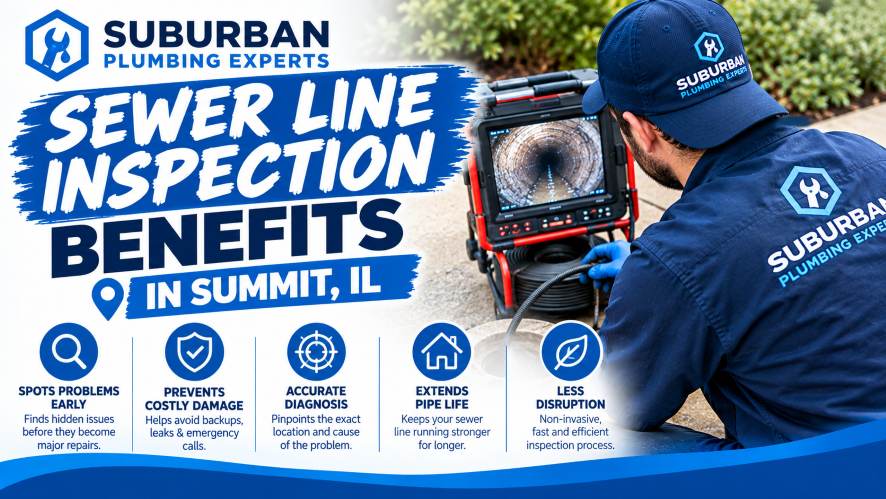
The Village Is Named for a High Point, But Most of It Sits in a Floodplain, and That Contradiction Is Exactly Why Inspections Matter Here
Summit gets its name from sitting on the historic high ground of the old Chicago Portage, the narrow divide where the Chicago River and Des Plaines River watersheds meet. It’s a fitting name for the 1600s, less fitting for what came after. Most of the village today sits within the Des Plaines River floodplain, and that combination, high ground in name, low ground in practice, is exactly why a sewer camera inspection does more here than it would in a typical suburb. A hidden crack in a Summit lateral isn’t just a path for wastewater to leak out. In a floodplain community, it’s just as often a path for groundwater and floodwater to get in. Our licensed Summit plumbers see this pattern regularly.
Signs Your Lateral Might Already Be Letting Water In
A sewer smell or slow drains that show up worse after heavy rain, not randomly. That pattern specifically, symptoms that track with wet weather rather than everyday use, is one of the clearest signs of infiltration rather than a simple blockage.
A basement floor drain that backs up during storms but is fine the rest of the time. In a floodplain community, this is often the system telling you it’s taking on more water than it should be, some of it through your own lateral.
A water bill or sump pump cycle that’s crept up without an obvious cause. Chronic low-level groundwater intrusion doesn’t always announce itself loudly. Sometimes it just shows up as a pump running more than it used to.
Visible settling or a soft spot in the yard along the lateral’s path. Water escaping a cracked pipe, in either direction, erodes the soil around it over time.
What a Camera Inspection Actually Catches Here: Infiltration, Not Just Blockages
Most homeowners think of a sewer inspection as a way to find clogs and root intrusion, and it is. But in a floodplain village, a camera also reveals something else: infiltration and inflow, groundwater or storm runoff working its way into the sanitary line through cracked joints, deteriorated pipe, or a failing connection. Because Summit’s sanitary sewers ultimately feed into the regional system overseen by the Metropolitan Water Reclamation District’s Infiltration/Inflow Control Program, excess groundwater entering through a cracked private lateral doesn’t just risk a backup at your house, it adds volume to a system that’s already working harder during wet weather in a low-lying community. A camera inspection often shows this directly: water actively seeping in at a joint, or unusual moisture along a pipe wall during a dry spell, both signs the line is letting more than wastewater through.
Why Summit’s Housing Age Makes This More Than a Theoretical Risk
Summit’s population exploded from 949 in 1910 to over 6,500 by 1930, driven almost entirely by the Corn Products Refining Company’s Argo plant, once the largest corn-milling operation in the world, and the flood of workers who moved here for it. Public records from that era note that water and sewer infrastructure struggled to keep pace with how fast the village grew. A meaningful share of Summit’s housing dates to exactly that boom, which means a meaningful share of the sewer laterals underneath it are now more than a century old, installed in a hurry during a period when the village itself admitted its public services were stretched thin.
What We Typically Find, By Home Vintage
Homes from the 1910s through 1930s boom era most often have clay tile laterals, sometimes cast iron closer to the house. These are the lines most likely to show root intrusion at the joints and the ones where infiltration is most common, simply because clay tile joints were never designed to be watertight the way modern connections are.
Postwar homes from the 1940s through 1960s typically have cast iron or early copper laterals. Cast iron holds up structurally longer than clay but corrodes from the inside over decades, narrowing the pipe’s effective diameter well before it fails outright, often showing up as slow drainage that gradually worsens rather than a sudden break.
Homes from the 1970s on are more likely to have PVC laterals, which hold up better against both root intrusion and infiltration, though a PVC line is not automatically problem-free, a bad joint or a section installed poorly can still let water in either direction. Knowing which category your home likely falls into before the camera goes in gives you a realistic idea of what to expect, though the inspection is what actually confirms it rather than the home’s age alone.
The Real Advantages of Getting Ahead of It
It catches infiltration before it compounds. A hairline crack lets in a little groundwater. Left alone, that same crack widens, lets in more, and eventually contributes to the kind of basement backup that shows up during exactly the storms a floodplain community sees most often.
It replaces guesswork with an exact location. A camera with a locating sonde traces the precise path and depth of a fault, so if a repair is needed, digging happens in the right spot the first time instead of an exploratory trench.
It gives you documentation, not just an opinion. Recorded footage is something you can show an insurer, a buyer, or a second opinion. “The plumber says it needs work” and “here’s the footage of exactly what’s wrong” are very different conversations.
It’s dramatically cheaper than the alternative. Our breakdown of Chicago-area sewer line repair costs puts a standard camera inspection at roughly $200 to $400. An emergency backup that reaches a finished basement costs far more once you add cleanup, the repair you’ll still need, and whatever the water damaged on the way in.
What Happens If Infiltration Goes Unaddressed
Individual homeowners aren’t typically the direct target of MWRD’s infiltration and inflow enforcement, that program is primarily aimed at municipalities and the sewer systems they operate. But the pressure runs downhill. When MWRD identifies a community with excessive I/I contributing to overflows or basement backups, the local municipality is the one on the hook to find and reduce it, and private laterals are consistently one of the largest sources utilities find once they start looking. That sometimes leads to municipal sewer lateral inspection or repair mandates, cost-share programs, or stricter point-of-sale requirements down the line, all of which are considerably easier to deal with if you’ve already had your own line inspected and know where you stand, rather than finding out when the village comes asking. Getting ahead of it on your own timeline beats responding to someone else’s.
Choosing a Provider Who Understands Floodplain Plumbing
Not every plumber reads infiltration signs the same way. Someone who’s only worked on higher, drier ground might diagnose water inside a lateral as a plumbing leak and miss that it’s actually groundwater working its way in from outside the pipe, which calls for a different fix entirely. A technician with real Summit experience knows to check for that specifically, not just clear whatever’s blocking the line and call it done. Ask directly whether the company has worked in floodplain communities before, and ask to see actual footage from past jobs, not just a verbal summary of what they typically find.
What This Looks Like in Practice
Our team has done exactly this kind of work in Summit directly: a combined sewer camera inspection and hydro jetting service that identified active root intrusion, cleared it with targeted root removal, and confirmed the line was flowing properly afterward. That’s the sequence that should happen every time, see what’s actually there, fix what needs fixing, confirm it worked, rather than rodding a line blind and hoping the problem doesn’t come back next season. For anything beyond a single service, our full range of Summit sewer services covers sewer line repair and replacement too.
Quick Answers
Can a sewer inspection actually help with flooding, not just backups?
Yes. Identifying and sealing a lateral that’s letting groundwater infiltrate reduces the volume your line, and the system it feeds into, has to handle during heavy rain, which is a real factor in a floodplain community.
Does Summit’s floodplain location mean my sewer line is automatically at risk?
Not automatically, but it does mean age and condition matter more here than in a community on higher, drier ground. A line in good shape is a line in good shape anywhere. The difference is how much worse a bad one can get during the kind of weather Summit sees regularly.
How often should I get one done?
Every 18 to 24 months for most homes, more often if your house dates to Summit’s early-1900s growth era or you’ve had prior root or backup issues.
What’s the actual difference between infiltration and a regular clog?
A clog blocks flow with something inside the pipe, roots, grease, debris. Infiltration is water getting into the pipe from the outside through a crack or failed joint. Both show up on camera, but they call for different fixes: clearing a clog versus sealing or repairing the pipe itself.
Will fixing infiltration on my line actually make a difference regionwide?
Your own repair mainly protects your own home. But it’s worth knowing that infiltration and inflow reduction is a real regional priority, not just a sales pitch, MWRD actively tracks and works to reduce it across every community tributary to its system, Summit included.
Licensed Sewer Camera Inspection for Summit Homes
Licensed, insured, and serving Summit since 1978. Non-invasive camera inspection with recorded footage you can actually see. Call now or fill out the form for fast service.
Emergency: 708-518-7765 | Summit: 708-801-6530 | Open 24/7
—
Suburban Plumbing Sewer Line & Drain Cleaning Experts
Licensed & Insured | Open 24 Hours | Serving Summit & the Suburbs Since 1978📞 Summit: 708-801-6530 | 🚨 Emergency: 708-518-7765