
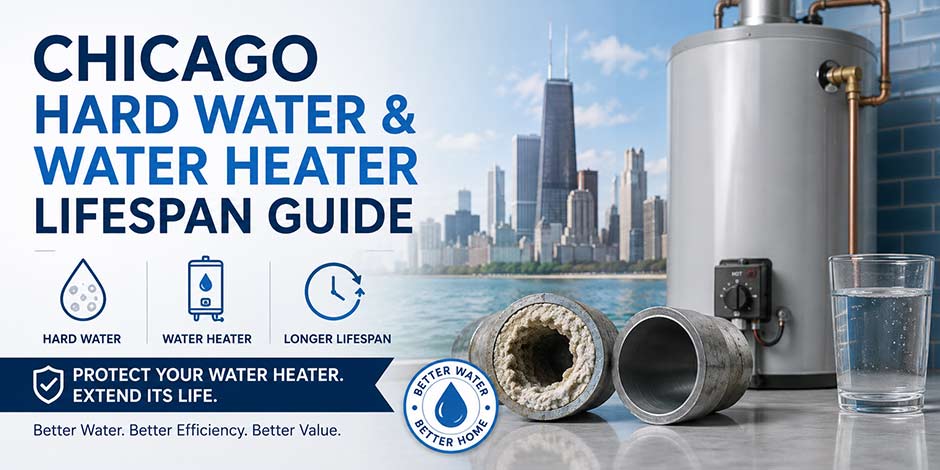
Lake Michigan Water Runs 8 to 10 Grains Per Gallon. Here’s What That Does to a Water Heater in 6 Years — and What It’s Costing Every Chicago and Suburb Homeowner Who Hasn’t Done the Math.
The water coming out of your Chicago-area tap is among the hardest in any major American city. Not slightly above average. Not worth mentioning. Measurably, verifiably, consequentially hard — at 8 to 10 grains per gallon depending on your specific suburb and the time of year, well above the 7 GPG threshold the Water Quality Association uses to define “very hard” water. The Illinois State Water Survey has documented Chicagoland’s hardness extensively. The MWRD tracks it. Water utility consumer confidence reports across the suburban corridor list it plainly.
What almost nobody has written — until now — is the actual math on what 8 to 10 GPG does to a standard 50-gallon water heater over time, what it does to a tankless unit without a softener, what it does to the appliances and fixtures throughout your home, what hard water scale actually looks like inside a 10-year-old Chicago water heater, and whether a water softener pays for itself in this specific market. Not general guidance. Actual numbers, actual timelines, actual cost comparisons for Chicago and suburbs specifically.
That is what this guide covers. The existing article on our site, How Hard Water in Chicago Suburbs Can Damage Your Plumbing, covers the basics of what hard water is and how it affects pipes, fixtures, water heaters, and appliances. This guide focuses on the actual costs and long-term impact for Chicago-area homeowners.
Chicago’s Hard Water: The Actual Numbers
Where the Hardness Comes From
Chicago’s water supply comes primarily from Lake Michigan. Lake Michigan draws its water from surface runoff and groundwater that passes through the dolomite and limestone geology of the upper Midwest before reaching the lake. Limestone and dolomite dissolve calcium and magnesium ions into the water as it moves through them — and those ions are what make water hard.
The City of Chicago’s water supply tests consistently at approximately 8 to 8.5 grains per gallon at the treatment plant. By the time water reaches suburban communities — particularly those served by their own well systems drawing from the Cambrian-Ordovician aquifer rather than Lake Michigan — hardness levels can be significantly higher. Communities like Naperville, Aurora, and parts of DuPage County drawing from deep limestone aquifers regularly test at 15 to 25 GPG — conditions the WQA classifies as “extremely hard.” For Lake Michigan-sourced communities throughout Cook County, 8 to 10 GPG is the consistent baseline.
Water hardness is only one characteristic of Chicagoland’s drinking water. If you’d like a broader look at where your tap water comes from, what’s in it, how it compares across local communities, and what homeowners should know about filtration and water quality, read our Complete Guide to Chicagoland Tap Water.
To put 8 to 10 GPG in context: the national average household water hardness is approximately 7.9 GPG. Chicago is above average — but the more meaningful comparison is to what those specific grains do inside the specific plumbing systems and appliances in a Chicago home over a 10-to-15-year ownership period. That is where the real story is.
What “Grains Per Gallon” Actually Means Physically
One grain of hardness per gallon represents approximately 17.1 milligrams of calcium carbonate dissolved in one gallon of water. At 8.5 GPG — Chicago’s Lake Michigan baseline — every gallon of water flowing through your plumbing system carries approximately 145 milligrams of dissolved calcium carbonate. A standard Chicago household uses between 50 and 100 gallons of water per day. At 75 gallons per day, that is approximately 10,875 milligrams — nearly 11 grams — of calcium carbonate flowing through your plumbing and appliances every single day.
Over a year: roughly 4 kilograms of calcium carbonate passing through your water heater, dishwasher, washing machine, coffee maker, ice maker, and every supply line and fixture in your home. Over a decade: 40 kilograms. Not all of it deposits — most passes through. But a meaningful fraction of it precipitates out of solution when water is heated, when water sits in contact with a surface for an extended period, and when water evaporates. And it deposits in specific, predictable locations: the bottom of your water heater tank, the heating elements of your appliances, the aerators on your faucets, and the interior walls of your supply lines.
What Hard Water Does to a Water Heater — The Real Lifespan Math
The Sediment Accumulation Process
Water hardness scale deposits most aggressively inside a water heater tank for a simple reason: the tank heats water. Calcium carbonate’s solubility in water decreases as temperature increases — the opposite of most dissolved substances. When cold 8.5 GPG water enters your water heater and is heated to 120°F, calcium carbonate precipitates out of solution and sinks to the bottom of the tank. This process happens on every heating cycle, every day, for the entire lifespan of the tank.
In a Chicago home without water treatment, a standard 50-gallon gas water heater accumulates a meaningful layer of sediment at the bottom of the tank within the first 2 to 3 years of operation. By year 5 to 7, that sediment layer is thick enough to create a measurable insulation effect between the burner and the water — the water heater has to run longer on each cycle to achieve the same temperature rise. By year 8 to 10, the sediment layer can be 2 to 4 inches deep, the tank bottom is subject to accelerated corrosion from the mineral layer trapping moisture and heat against the steel, and the efficiency loss is significant enough to show on energy bills.
The sound of a Chicago water heater working hard against heavy sediment buildup is distinctive — a rumbling or popping noise as water trapped beneath the sediment layer boils and bubbles through it. If your water heater makes this sound, it is not a minor quirk. It is the tank telling you that sediment accumulation has reached the stage where it is actively degrading performance and accelerating the tank’s end-of-life trajectory.
The Lifespan Difference: Treated vs. Untreated Water in Chicago
The manufacturer’s rated lifespan for a standard residential tank water heater is 10 to 15 years, based on testing in average water conditions — approximately 7 to 8 GPG nationally. In Chicago’s 8 to 10 GPG water without any water treatment or regular tank flushing, real-world lifespan consistently falls at the low end of that range or below it — 7 to 10 years being the more realistic expectation based on the service patterns we see across our territory.
In homes with a water softener installed on the supply side, water heater lifespan reliably reaches 12 to 15 years — sometimes longer — because the calcium carbonate that would otherwise precipitate inside the tank stays dissolved in softened water and passes through rather than accumulating. The lifespan difference between a water heater in treated versus untreated Chicago water is realistically 4 to 6 years. On a water heater that costs $1,200 to $2,500 installed, that lifespan difference represents $480 to $1,250 in annualized capital cost — just from the water heater alone, before any energy efficiency consideration.
The Energy Cost of Scale — Numbers That Actually Matter
The U.S. Department of Energy’s research on hard water and water heater efficiency has documented consistent findings: a water heater operating with just 1/4 inch of scale buildup loses approximately 7 to 10% of its heating efficiency. At 1/2 inch of scale — which a Chicago water heater without treatment reaches by year 5 to 7 — efficiency losses of 15 to 20% are typical.
What does 15 to 20% efficiency loss mean on a real energy bill? A standard gas water heater in a Chicago home costs approximately $250 to $350 per year to operate at baseline efficiency. A 15% efficiency loss adds $37 to $52 per year. A 20% loss adds $50 to $70. Over a 10-year water heater lifespan without treatment, that cumulative energy waste totals $370 to $700 — before accounting for the 2 to 4 years of shortened lifespan. The total 10-year cost of hard water on a single water heater in a Chicago home — energy waste plus accelerated replacement — is realistically $800 to $2,000 compared to a treated-water scenario.
That is one appliance. Add the dishwasher, the washing machine, and the coffee maker, and the total 10-year cost of untreated hard water in a Chicago home reaches $1,500 to $4,000 in accelerated appliance replacement and energy waste — before touching the pipe scale and fixture issues.
What Hard Water Does to a Tankless Water Heater — A Specific Warning
Tankless water heaters — on-demand units that heat water as it flows through rather than storing it in a tank — are increasingly common in Chicago-area homes and are an excellent technology in the right application. In Chicago’s hard water environment without a water softener, however, a tankless water heater is the single most vulnerable appliance in the home. If you’re trying to decide whether a traditional or tankless unit is the better investment for your home, our comparison of tankless vs. tank water heaters in Chicago breaks down the costs, lifespan, maintenance, and which homes benefit most from each option.
A tankless unit’s heat exchanger — the component where cold water is rapidly heated to output temperature — is a compact assembly of small-diameter tubes and fins designed to maximize surface area for heat transfer. That compact, high-surface-area design is also maximally efficient at accumulating calcium carbonate scale. In untreated Chicago water, a tankless heat exchanger accumulates scale at a rate that can reduce flow and efficiency within 2 to 3 years and cause premature failure within 5 to 7 years — well before the 15 to 20 year lifespan that makes tankless units financially justified.
Every major tankless water heater manufacturer — Rinnai, Navien, Noritz, Rheem — explicitly states in their installation documentation that water softening or descaling treatment is required in hard water environments to maintain warranty coverage and rated lifespan. In Chicago’s 8 to 10 GPG environment, installing a tankless water heater without a water softener is not just inadvisable — it may void the manufacturer’s warranty. Our water heater replacement service covers both tank and tankless installations throughout Chicago and the suburbs, and every tankless recommendation we make includes an honest assessment of the water treatment requirement before installation.
What Hard Water Does to the Rest of Your Home’s Plumbing — Fixture by Fixture
Supply Lines and Pipe Interior Scale
Copper supply lines in Chicago homes accumulate calcium carbonate scale on their interior walls over time — the same process that affects the water heater tank, but slower and more distributed. In a 30-year-old Chicago home with original copper supply lines and no water treatment history, the interior diameter of those lines has measurably reduced from original dimensions. The reduction is typically modest — not enough to cause significant pressure loss on its own — but it contributes to the overall supply system pressure drop alongside any other restrictions.
The more significant pipe-related hard water issue in Chicago is the combination of scale buildup and galvanized steel supply lines in older homes. Galvanized steel corrodes from the inside out as its zinc coating depletes — a process that hard water accelerates by creating an electrochemical environment that promotes zinc depletion. In a Chicago home with original galvanized supply lines — common in homes built before 1960 — hard water is actively participating in the corrosion process that produces rust-colored water, reduced pressure, and eventual pipe failure. Our home repiping service addresses galvanized line replacement throughout the Chicago area — and in homes where galvanized and hard water have been interacting for 50 to 80 years, the interior of those pipes is rarely what the outside suggests.
Showerheads and Faucet Aerators
Showerheads and faucet aerators are the most visible hard water casualty in any Chicago home. The small orifices in a showerhead face plate — typically 1 to 2 millimeters in diameter — accumulate calcium carbonate deposits that progressively restrict flow and redirect the spray pattern. A showerhead that starts with 12 to 20 evenly distributed spray openings and has never been descaled in a Chicago home will have 3 to 8 functioning openings within 3 to 5 years, with the remainder partially or fully blocked. The spray pattern becomes uneven, pressure feels lower (because it is), and the fixture that cost $80 to $300 is functionally degraded without any mechanical failure.
Faucet aerators — the small screen assemblies at the tip of every faucet — accumulate both calcium carbonate scale and small particles of pipe scale dislodged from supply lines. In Chicago homes, aerators should be removed and cleaned or replaced every 6 to 12 months as routine maintenance. A clogged aerator that restricts flow at a single fixture is often misdiagnosed as a pressure problem in the supply line — an expensive diagnostic path when a $3 aerator replacement and a vinegar soak would have identified the actual issue in 10 minutes.
Dishwashers and Washing Machines
Dishwashers in hard water environments accumulate scale on their heating elements — the component that heats water for the wash cycle and powers the drying cycle. Scale on a dishwasher heating element produces the same efficiency loss as scale in a water heater: the element works harder to achieve the same temperature, runs longer, uses more energy, and fails sooner. The white film on dishes and glassware that many Chicago homeowners treat as a normal characteristic of their dishwasher is calcium carbonate — the same mineral that is simultaneously scaling the machine’s internal components.
Washing machines accumulate scale in their water inlet valves, in the drum where water contacts the heating element in heated-wash models, and in the detergent dispensers where hard water interacts with soap to form soap scum. Hard water also reduces the cleaning effectiveness of laundry detergent — calcium and magnesium ions bond with surfactant molecules in detergent, reducing the amount of active cleaning agent available. The standard recommendation to use more detergent in hard water areas is a real phenomenon: Chicago homeowners use measurably more detergent per load than soft-water households, adding $50 to $150 per year in detergent costs on top of the appliance wear.
The Toilet Tank — The Overlooked Hard Water Problem
Toilet flush valves, fill valves, and flappers in Chicago homes fail more frequently than manufacturer specifications project — and hard water is a primary reason. The small rubber seating surfaces and plastic components inside toilet tank fill mechanisms are subject to calcium carbonate deposits that prevent proper sealing. A fill valve that closes incompletely because scale has built up on its seating surface produces a running toilet — one of the most common Chicago plumbing service calls — that is attributable to hard water rather than a failed component. Replacing the fill valve without addressing the hard water deposits that caused the failure restores function temporarily, but the same mechanism fails again on the same accelerated timeline.
Our toilet repair service covers fill valve and flush mechanism replacement throughout Chicago and the suburbs. A running toilet that has been repaired twice in three years in a Chicago home is almost always a hard water problem in addition to a component problem — addressing only the component is treating the symptom rather than the cause.
The Water Softener Question — Does It Actually Pay Off in Chicago?
What a Water Softener Does — and What It Doesn’t
A water softener uses an ion exchange process — sodium or potassium ions on a resin bed replace calcium and magnesium ions in the incoming water supply — to produce softened water with a hardness measurement at or near zero GPG throughout the home’s supply system. Softened water does not accumulate calcium carbonate scale on water heater tanks, heating elements, showerhead orifices, or pipe interiors. The appliance lifespan differences described above — the 4 to 6 additional years of water heater life, the protected tankless heat exchanger, the fully functional dishwasher element — are the direct result of removing the calcium and magnesium from the water before it enters the home’s plumbing system.
What a water softener does not do: it does not filter other contaminants from the water supply (that requires a separate filtration system), it does not address lead in water from a lead service line (see our Chicago lead pipe guide for that issue specifically), and it does not improve water pressure or address drainage issues. It addresses the calcium and magnesium hardness problem specifically and nothing else.
The Chicago ROI Calculation — Actual Numbers
A whole-home water softener installed in a Chicago suburban home costs between $800 and $2,500 for the unit and installation depending on capacity, brand, and whether any supply line modifications are required. Annual operating cost — primarily salt or potassium for the regeneration cycle — runs $60 to $150 per year in a typical household. A properly sized and maintained softener has a service life of 15 to 25 years.
Against that cost, the financial case in Chicago’s water environment:
Water heater lifespan extension of 4 to 6 years on a $1,200 to $2,500 installed unit represents $320 to $1,250 in deferred replacement cost. Energy efficiency preservation on the water heater — the 15 to 20% efficiency loss that scale produces — saves $37 to $70 per year, or $555 to $1,050 over a 15-year softener lifespan. Dishwasher and washing machine lifespan extension — typical hard water reduction in appliance lifespan is 30 to 50% in high-hardness environments — represents $400 to $1,200 in deferred appliance replacement cost across both units. Detergent savings — reduced soap and detergent usage in softened water — saves $100 to $300 per year, or $1,500 to $4,500 over 15 years.
Total 15-year financial benefit of a water softener in Chicago’s water environment: conservatively $2,500 to $8,000. Against a softener cost of $800 to $2,500 plus $900 to $2,250 in salt over 15 years, the net financial return on investment in Chicago’s hard water market is positive in essentially every realistic scenario — with the payback period ranging from 2 to 5 years depending on household size and appliance replacement timing.
This is not a universal statement for every market. In areas with 3 to 5 GPG water hardness, the ROI case for a water softener is marginal. In Chicago’s 8 to 10 GPG environment — and dramatically more so in DuPage County communities with 15 to 25 GPG well water — the math is not close.
What to Know Before Buying a Water Softener in Chicago
Sizing matters more than brand. A water softener sized for a single-person household installed in a 4-person Chicago home will regenerate too frequently, use more salt than necessary, and wear faster. Proper sizing is based on household size, water usage, and incoming hardness level — not just the softener’s rated capacity on the box. Have the incoming water hardness tested before purchasing a unit (many water treatment companies offer free testing, and the IDNR maintains hardness data by municipality).
Salt-based versus salt-free: Salt-based ion exchange softeners are the only technology that produces true soft water — zero or near-zero GPG hardness. Salt-free “conditioners” or “descalers” use template-assisted crystallization or other physical processes that change the form of calcium carbonate to reduce scale adhesion without removing calcium and magnesium from the water. They reduce scale in pipes and appliances to a degree — but they do not produce the same appliance lifespan results as true softened water. For Chicago homeowners protecting a tankless water heater specifically, a salt-based softener is the required solution; the manufacturer’s warranty requirement is for softened water, not conditioned water.
Installation: A whole-home water softener is installed on the main supply line after the water meter, before any distribution to fixtures. It requires a drain connection for the regeneration cycle brine discharge. In Chicago and suburban municipalities, brine discharge to the sanitary sewer is permitted — check your specific municipality’s requirements. Installation is a plumbing job requiring connection to the main supply line; it is not a DIY project in a Chicago home where the supply system is galvanized or copper in a finished basement.
What Chicago Homeowners Should Do Right Now — In Order of Priority
Step 1: Know your water heater’s age and listen to it. If your tank water heater is 8 or more years old and has never been flushed — or if it rumbles or pops during heating cycles — sediment accumulation has reached the stage where it is actively shortening lifespan. Annual flushing can extend life when scale buildup is still manageable. If you’re unsure what professional flushing actually involves or when cleaning is worthwhile, our complete guide to water heater cleaning, why it matters, how it’s done, and when Chicago homeowners need it explains what the process can and cannot accomplish. In a Chicago home with 8+ GPG water and a 10-year-old tank that has never been flushed, the honest answer is often that the tank is approaching end of life and flushing provides minimal remaining benefit. Our water heater services cover inspection, maintenance, and replacement throughout Chicago and the suburbs with a straight assessment of where your specific unit is in its lifespan before any replacement is proposed.
Step 2: If you have or are considering a tankless water heater — assess your water treatment first. Do not install a tankless unit in Chicago water without either a water softener or a scale inhibitor system in place. The heat exchanger will be measurably impacted within 2 to 3 years and the warranty protection that justifies the higher upfront cost of a tankless unit depends on water treatment. This sequence matters: water treatment assessment first, tankless installation second.
Step 3: Test your incoming water hardness. The City of Chicago’s consumer confidence report lists average hardness. Your suburb’s utility report lists theirs. If you’re on a private well in DuPage County, have the water tested — well water hardness varies significantly by depth and location and may be substantially higher than the Lake Michigan baseline. Knowing your actual hardness number is the foundation of every treatment decision. If you’re curious how your community compares, see our Chicago Suburbs’ Hard Water: The Real Data guide, which breaks down measured hardness levels across Chicago and many surrounding suburbs.
Step 4: Run the ROI math for a water softener. Use the framework above — water heater lifespan, energy waste, appliance lifespan, detergent savings — with your actual incoming hardness and household size. In Chicago’s 8 to 10 GPG environment, the math almost always favors installation. In DuPage County well water at 15 to 25 GPG, the math is not even close.
Step 5: Clean or replace your showerheads and aerators now. This costs almost nothing and immediately improves the pressure and spray pattern of every affected fixture. Remove aerators from all faucets, soak them in white vinegar for 30 minutes, rinse and reinstall. Soak showerhead faces in a bag of white vinegar for 1 to 2 hours. This is the hardest working $0 plumbing maintenance task available to a Chicago homeowner.
Frequently Asked Questions: Hard Water and Water Heaters in Chicago
My water heater is 9 years old and makes a rumbling noise. Is that the hard water scale you’re describing?
Almost certainly yes. The rumbling sound is water trapped beneath accumulated sediment at the bottom of the tank boiling and bubbling through as the burner fires. In Chicago’s water environment, a 9-year-old tank that has never been flushed will have substantial sediment. The sound indicates you are in the accelerated efficiency loss and end-of-life phase. Have the tank inspected — the inspection will tell you whether flushing extends the life meaningfully or whether the sediment and the anode rod condition indicate replacement is the better financial decision at this point.
I just bought a Rinnai tankless water heater. Do I really need a water softener in Chicago?
Yes — and Rinnai says so in their installation documentation. Rinnai’s installation requirements for their condensing tankless units in hard water areas specify that water hardness above 11 GPG requires a water softener or scale inhibitor to maintain warranty coverage. Chicago’s baseline of 8 to 10 GPG is below that threshold — but it is close, seasonal variation exists, and your specific suburb’s water may test higher than the city average. More importantly, even below the warranty threshold, operating a Rinnai tankless in Chicago water without any treatment will produce measurable heat exchanger scale within 3 to 5 years. Rinnai recommends annual descaling service in hard water environments. A water softener eliminates that annual service need and protects the investment over the unit’s full rated lifespan.
My dishes come out of the dishwasher with a white film. Is that hard water?
Yes. The white film on dishes and glassware is calcium carbonate — the same mineral causing scale inside the dishwasher’s components. It is also an indicator that your dishwasher’s rinse aid dispenser may be empty or set too low. Rinse aid works specifically to counteract hard water spotting on dishes. For ongoing maintenance, use a dishwasher cleaner product (such as Affresh) monthly to address internal scale buildup. For a permanent solution, a water softener eliminates both the film on dishes and the scale accumulation inside the appliance simultaneously.
Is Chicago’s water safe to drink? Is the hardness a health concern?
Hard water is not a health concern — calcium and magnesium are essential dietary minerals and the levels present in Chicago’s water supply are not harmful. The concerns with Chicago’s water quality are separate from hardness. The lead service line issue affects homes with lead supply connections (learn more in our Chicago Lead Pipes by Neighborhood guide), while treatment byproducts from chlorination are a separate filtration question. Hard water is a plumbing and appliance concern, not a health concern. Hard water is a plumbing and appliance concern, not a health concern. The reverse osmosis and whole-home filtration market in Chicago sometimes conflates these issues — a water softener addresses hardness, a filter addresses contaminants, and they are different systems for different purposes.
How much does a water heater flush cost in Chicago and is it worth doing?
A professional water heater flush in Chicago typically costs $75 to $150. On a water heater under 7 years old in moderate scale accumulation, annual flushing extends the service life and maintains efficiency — it is worth doing. On a water heater 10 or more years old with visible sediment symptoms (the rumbling sound, reduced hot water output, longer recovery times), flushing provides diminishing returns and should be paired with an honest assessment of remaining service life before the cost is committed. We never recommend flushing as a standalone service without also assessing the anode rod condition — the anode rod is the sacrificial element that protects the tank wall from corrosion, and a depleted anode rod on a scale-loaded older tank is a combination that accelerates end of life regardless of how well the flush is executed.
Water Heater Making Noise? Appliances Scaling Up? Let’s Give You a Straight Answer.
Licensed, insured, and serving Chicago and the suburbs since 1978. We service, repair, and replace tank and tankless water heaters throughout the Chicago area — and we give you an honest assessment of where your unit is in its lifespan before any replacement is proposed. We also install and service whole-home water softener systems sized for Chicago’s specific water hardness. Written quotes before we start. Our own licensed plumbers on every call. Send us a message and we’ll get back to you fast.
Or call us directly: 708-801-6530 | Chicago: 773-570-2191 | Open 24/7
—
Suburban Plumbing Sewer Line & Drain Cleaning Experts
Licensed & Insured | Open 24 Hours | Serving Chicago & the Suburbs Since 1978
📞 Suburbs: 708-801-6530 | 📞 Chicago: 773-570-2191 | 🚨 Emergency: 708-518-7765