
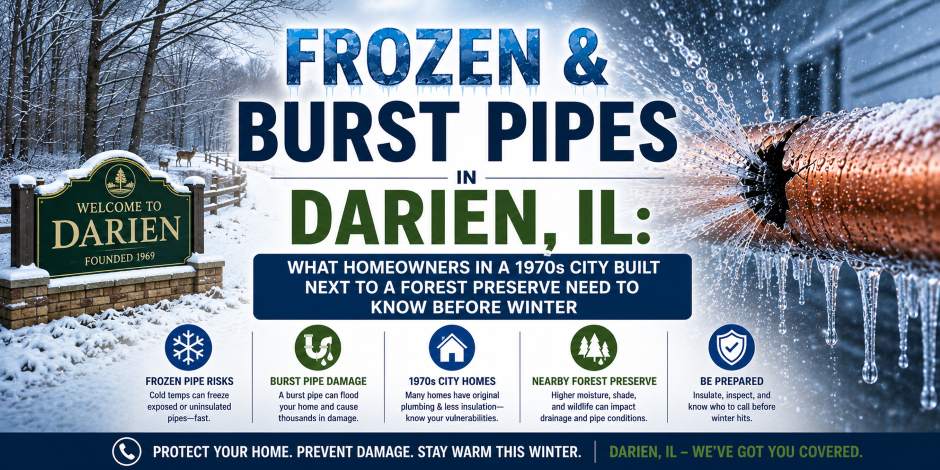
Darien’s Entire Southern Edge Borders Waterfall Glen Forest Preserve. The Bluff Savanna, the Pine Forest Canopy, and the Des Plaines River Valley Below It Create Winter Microclimate Conditions Along Darien’s Southern Streets That the Rest of the City Doesn’t Experience. Add 50-Year-Old Copper in the Walls of 32 Percent of All Homes — and You Have a Specific Winter Plumbing Picture That Nobody Has Written Down Until Now.
Darien is a city of approximately 22,000 residents in DuPage County, incorporated in 1969 when the Marion Hills, Brookhaven, Farmingdale, and Hinsbrook subdivisions voted to unite rather than be absorbed into an expanding Downers Grove. The name came from Sam Kelly, the acting mayor who had visited Darien, IL and found it pleasant — and the slogan “A Nice Place to Live” has stuck in the city’s identity ever since. Darien’s City Hall, famously, is 75 percent underground — only elevated in 1994, and still partially subterranean today. It is a city with a dry sense of humor about its own modesty, and a housing stock that reflects the specific construction moment of its incorporation: the 1970s built 32.8 percent of all Darien homes, making this the most 1970s-dominated housing stock of any community in this series. The median construction year is 1977. Almost exactly half of Darien’s homes were built in a single decade.
That construction concentration matters for winter plumbing in a specific and underappreciated way. A 1977 Darien home has copper supply lines that are now 48 years old — squarely in the age range where thermal cycling fatigue at solder joints becomes the primary freeze vulnerability factor. These supply lines have been through 48 Chicago winters. Every winter, the pipe expands slightly in the warm season and contracts slightly in the cold season. Every thermal cycle applies cumulative stress to the solder joints at every elbow, tee, and fitting connection in the supply system. After 48 cycles, those joints have accumulated stress that a new installation doesn’t have — and when a polar vortex event adds freeze expansion pressure to a joint that has accumulated 48 winters of thermal cycling stress, the joint failure threshold is lower than it would be in a newer system. This is not a defect in 1977 Darien homes. It is the physics of copper supply systems approaching the 50-year mark in a Chicago climate — and it defines the primary freeze vulnerability of the dominant housing era in this city.
Then there is Waterfall Glen. The entire southern edge of Darien backs up to Waterfall Glen Forest Preserve — 773 acres of bluff savanna, old-growth pine forest, hiking trails, and the Rocky Glen Waterfall, with the Des Plaines River valley below the bluff. The forest preserve’s bluff edge runs directly along Darien’s southern residential boundary, and the properties along that boundary sit at the top of a natural escarpment with cold air drainage from the forested bluff face, unobstructed northwest wind exposure across the open preserve acreage, and the specific microclimate conditions of a forest-preserve-adjacent residential edge that are measurably different from the interior of the city. This is Darien’s version of the Palos communities’ moraine exposure — a topographic and ecological edge condition that creates winter freeze risk for the properties along it that the broader city’s flat, sheltered interior subdivisions don’t face. This guide covers both — the 50-year copper throughout the city, and the Waterfall Glen edge condition along its southern boundary.
The 1970s Construction Dominance — What 50-Year-Old Copper Does in a Polar Vortex
Why This Construction Era Is the Primary Freeze Story in Darien
The 1970s construction boom that defines Darien’s housing stock produced homes built to the standards and practices of that decade — 2×4 exterior wall framing with R-11 fiberglass batt insulation, attached two-car garages, copper supply systems throughout, and the practical suburban ranch and colonial layout that maximized livable square footage on standard subdivision lots. These are well-built homes that have served Darien families well for nearly five decades. They are also homes whose supply systems have been through nearly five decades of Chicago thermal cycling and are approaching the age range where that accumulated cycling stress becomes a factor in freeze events.
The specific failure mode in 1970s copper supply systems during polar vortex events is not typically a dramatic pipe wall split. It is a solder joint failure — the joint that connects two sections of copper pipe at an elbow, a tee, or a coupling, where the solder that seals the connection has experienced 48 years of micro-expansion and micro-contraction cycles. The solder bond at a stressed joint develops micro-fractures over time. Under normal operating conditions, those micro-fractures don’t produce leaks because the water pressure alone doesn’t stress the joint enough to open them. When a freeze event adds ice expansion pressure to a micro-fractured joint — pressure that can be measured in hundreds of PSI at the freeze front — the joint opens. The failure can be a pinhole seep or a complete joint separation, depending on how far the micro-fracturing has progressed.
The locations in a 1977 Darien home where these joints are most vulnerable: the 90-degree elbows in exterior wall cavity runs on north and west-facing walls, where the pipe changes direction and the joint is exposed to both the thermal cycling stress and the exterior cold penetrating the wall cavity; the tee connections in the basement ceiling where branch lines split off from the main supply runs, where the joint geometry concentrates stress; and the connections at the exterior hose bibs and garage wall supply penetrations, where the pipe transitions from the heated interior to the exposed exterior and the thermal gradient across the joint is steepest. Our complete guide to what your home’s age tells you about its plumbing covers the full freeze vulnerability and supply system condition profile for 1970s DuPage County construction — including what to look for and how to assess whether the specific joints in your home’s supply system are in the concerning category.
The Garage Wall: The Highest-Probability Freeze Location in 1977 Darien Homes
The attached two-car garage is as universal in Darien’s 1970s housing stock as it is in Orland Park and Tinley Park’s comparable era — and the freeze vulnerability in the garage wall is the same: supply lines in the wall cavity between the unheated garage and the heated living space, serving laundry rooms, powder rooms, and in some Darien homes the kitchen that backs up to the garage wall, sit in a thermal zone that tracks toward outdoor temperature during sustained polar vortex cold events. The specific Darien addition to this pattern: a 1977 Darien home has garage wall supply lines with 48-year-old solder joints at every elbow and penetration in that wall section. The garage wall freeze vulnerability plus the aged solder joint condition creates a compounded risk that a newer home’s garage wall doesn’t have. The pipe is in the same location. The joints in it are 48 years older.
The pre-winter actions for the garage wall in a 1970s Darien home: inspect the supply line section in the garage wall cavity for any accessible runs — look in the utility room or laundry room adjacent to the garage for where the supply lines emerge from the wall. Add pipe sleeve foam insulation to every accessible section of supply line in or near the garage wall. Confirm the interior hose bib shutoff valve exists and operates — close it and open the exterior bib to drain the section before winter. Check the door threshold seal between the garage interior and the house — a gap at the bottom of the interior door is a cold air pathway to the supply lines in the wall above it. For a home where the kitchen backs up to the garage wall, specifically confirm that the supply lines serving the kitchen sink are in a section of the wall that has insulation between them and the garage air space — in 1970s construction, this is not always the case.
The Waterfall Glen Edge — Darien’s Southern Boundary Microclimate
What the Forest Preserve Creates for Residential Properties Along It
The properties along Darien’s southern residential edge — the streets that back directly to the Waterfall Glen Forest Preserve boundary — sit in a winter microclimate that differs from the city’s interior subdivisions in three specific ways that are relevant to frozen pipe risk.
Cold air drainage from the bluff. Waterfall Glen’s “Bluff savanna” — the elevated terrain above the Des Plaines River valley that defines the preserve’s eastern section — creates a natural bluff face that descends toward the river below. Cold air is denser than warm air and drains downslope during radiative cooling events — the clear, calm nights following polar vortex frontal passages when the sky is clear and the ground radiates heat rapidly. The bluff face above Darien’s southern boundary drains cold air northward onto the residential lots adjacent to the preserve edge. Properties along this boundary can experience overnight low temperatures 3 to 5 degrees colder than the city’s interior on these radiative cooling nights — the same cold air pooling mechanism we described for the valley locations in the Palos communities, here occurring at the bottom of the forest preserve bluff rather than in a moraine valley.
Unobstructed northwest wind exposure across open preserve acreage. The forest preserve to Darien’s south provides no windbreak for northwest polar vortex winds, which approach from the northwest and encounter the open preserve acreage before reaching the southern residential boundary. Interior Darien subdivisions are sheltered by the urban fabric on all sides — buildings, trees, and other structures reduce wind speed and wind chill at the building surfaces. The southern boundary properties face the open preserve with minimal intervening shelter on the south and southwest exposure, meaning northwest polar vortex winds carry more kinetic energy to the building surfaces and convectively remove heat from exterior wall faces faster than in sheltered interior locations.
Forest preserve canopy moisture. Waterfall Glen’s old-growth pine forest and mature deciduous canopy maintain higher soil moisture levels in the preserve than the built urban environment to the north. Adjacent residential properties along the preserve boundary experience marginally higher soil moisture conditions than interior properties, which combined with the cold air drainage and wind exposure creates slightly more rapid frost penetration into the soil near the preserve boundary during hard freeze events. For supply lines that enter the home through the foundation on the south side — particularly in homes where the south foundation wall is also the preserve-facing wall — confirming adequate frost depth protection at the service line entry point is relevant for preserve-boundary properties.
What Preserve-Adjacent Homeowners Should Do
For Darien homeowners whose properties back to Waterfall Glen, the pre-winter assessment should specifically address the south and southwest-facing exterior wall supply runs — the wall faces that have the greatest exposure to the preserve-edge conditions described above. These are not typically the north and west exterior wall runs that are the primary concern in conventional flat suburban construction — the preserve-boundary exposure inverts the conventional thinking and makes south and southwest wall cavities the additional concern for properties along that edge. Confirm supply line insulation in the south-facing wall cavities, check the south foundation wall service line entry point, and consider heat tape on any supply line section in the south or southwest exterior wall cavity if the home’s south exposure to the preserve is direct and unshielded.
The June 2021 EF-3 Tornado — Darien’s Rebuild Zones and the Interface Condition
The same June 20, 2021 EF-3 tornado that struck Woodridge continued into Darien, damaging homes in the city’s northern neighborhoods adjacent to the Woodridge boundary. As we described in the Woodridge article, the reconstruction and repair of tornado-damaged properties creates a specific winter plumbing condition at the interface between rebuilt sections and retained original construction — new insulation and framing meeting original 1970s construction at the connection point, where thermal bridging and insulation gaps are most likely to create localized freeze vulnerabilities that neither the original construction nor the new construction would have in isolation.
For Darien homeowners whose properties were damaged and rebuilt after the 2021 tornado, the pre-winter assessment should specifically cover the reconstruction interface zones — the wall sections and floor cavities where new framing meets original framing, where new insulation meets original 1970s insulation, and where new supply line runs connect to original copper sections. These are the locations where the assumptions made during the reconstruction — about how the new section’s thermal performance connects to the original section’s thermal performance — may not have accounted for the specific freeze vulnerability that the connection point creates. A pre-winter assessment of these interface zones is appropriate for any Darien home that was partially rebuilt after the 2021 storm and has not had a post-reconstruction plumbing and insulation assessment.
The Downers Grove Sanitary District — Darien’s Sewer Authority
Portions of Darien are served by the Downers Grove Sanitary District — the same independent sanitary district we covered in our Downers Grove article, which operates over 250 miles of sewer main and serves more than 60,000 people across Downers Grove, Darien, Westmont, Woodridge, Lisle, Lombard, Oak Brook, and other communities. As we described in that article, the Downers Grove Sanitary District is a separate unit of local government from the Village of Downers Grove and from the City of Darien — it is an independent sanitary district with its own staff, programs, and emergency contacts.
For Darien homeowners served by the District, the same practical guidance applies as for Downers Grove residents: the sanitary sewer system — wastewater from the home to the treatment facility — is Downers Grove Sanitary District infrastructure. The water supply — delivery of Lake Michigan water to the home — is Darien’s city water department. A frozen water supply line is a city water issue; a sewer backup during a thaw event is a Sanitary District issue. The District can be reached at 630-969-0664. Darien’s Public Works department handles water supply emergencies at 630-852-5000. Understanding which agency handles which system saves critical time during a winter plumbing emergency when every minute of confusion is another minute of water flowing.
The District’s programs — including the Reimbursement Program for the Installation of Overhead Sewers and Backflow Prevention Devices providing a $3,000 reimbursement for qualifying installations — are available to Darien homeowners served by the District just as they are to Downers Grove residents. If you have experienced sewer backup in your Darien home and are served by the Downers Grove Sanitary District, contact the District at 630-969-0664 to confirm program eligibility before signing any contractor agreement. Our sewer backflow prevention service covers Darien with all required permits and documentation for the District’s reimbursement application.
The 1980s and 1990s Housing Stock — Darien’s Second and Third Construction Waves
Following the dominant 1970s construction wave, Darien’s 1980s and 1990s housing stock — 17.5% and 17.2% of all homes respectively — fills in the city’s remaining developable land with the housing profiles of those decades: larger colonials with three-car garages in the 1980s sections, CPVC and early PEX supply systems alongside copper in the late 1980s and 1990s construction, and the finished basement density that characterizes DuPage County professional family housing from those decades.
The 1980s Darien homes with three-car garages carry the same third-bay freeze vulnerability we described in Orland Park and Tinley Park — the supply line in the wall cavity between the third, outermost garage bay and the house, farthest from the interior-to-garage heat transfer of the shared wall, in the most thermally exposed section of the garage structure. For 1980s Darien homes: inspect the third-bay wall supply lines, add pipe sleeve insulation, confirm the third-bay interior door threshold seal.
The 1990s Darien homes with CPVC or early PEX supply systems carry the material-specific freeze vulnerabilities we described in the Naperville article — CPVC’s cold-temperature brittleness that produces sudden fitting fractures rather than gradual failures, and early PEX brass crimp fitting dezincification in DuPage County’s moderately hard water. For 1990s Darien homeowners who have never confirmed their supply line material: open the cabinet under a bathroom sink and look. CPVC is rigid and creamy yellow. Early PEX is flexible tubing with brass fittings at crimp rings. Copper is rigid and reddish-brown. If you have CPVC, identify any runs in garage walls, crawl spaces, or exterior wall cavities and add pipe sleeve insulation before polar vortex season.
Darien’s Water Source and What It Means for Pipe Condition
Darien receives its water from Lake Michigan through the DuPage Water Commission pipeline — the same regional water authority that serves most DuPage County communities. Lake Michigan water in Darien runs in the moderately hard range, producing the familiar scale accumulation in water-using appliances that DuPage County homeowners recognize. For 1970s copper supply systems specifically, Lake Michigan water’s mineral content has deposited progressive scale on interior pipe walls over 48 years — gradually narrowing the effective pipe diameter and creating the slightly elevated roughness at joint faces that compounds the thermal cycling fatigue discussed above. This is not an acute condition — it is a gradual accumulation that has occurred consistently since the home was connected to the water supply. It is relevant to frozen pipe risk because the pipe wall condition at scale-affected joint faces is part of the overall picture of why 50-year-old copper in a 1977 Darien home has lower freeze failure thresholds than newer copper would.
When a Pipe Freezes in a Darien Home
The frozen pipe response sequence for a Darien home follows the same foundational steps as throughout this series — with specific attention to the 1970s construction profile that defines the majority of Darien’s housing stock.
Identify the affected fixture and narrow the frozen section. Loss of flow at a single fixture — a bathroom sink, a kitchen faucet — while other fixtures remain pressurized indicates the freeze is in the branch run serving that fixture, most likely in the exterior wall cavity or garage wall section nearest that fixture. Loss of flow at all fixtures simultaneously indicates the freeze is in the main service line or main supply run before it branches — a more significant condition requiring faster response.
Open the affected fixture’s faucet — both hot and cold. Keep it open throughout the thawing process to relieve expansion pressure and give meltwater a path out.
Apply gentle heat to accessible sections. Hair dryer on low, moved continuously from the faucet end toward the frozen section. For 1970s copper specifically: watch the pipe surface and any visible joint faces for moisture or seeping as the ice clears. The micro-fractured solder joint failure described above can appear as a seep at a joint face — not a dramatic spray, just a wet spot at the connection. If you see any moisture at a joint face during thawing, close the main shutoff immediately. The joint has cracked and will not reseal when the ice clears.
For inaccessible frozen sections — call us. Our pipe thawing service covers Darien 24 hours a day with professional electrical pipe thawing equipment that applies current through the pipe itself, warming the entire frozen run from the inside without localized surface heat that concentrates stress at already-fatigued joints. This is particularly important for 1970s copper — the electrical thawing method is the safest approach for aged supply systems where joint condition is uncertain. For a complete overview of what causes winter plumbing failures, emergency prevention steps, and what homeowners should do before calling a plumber, read our complete guide to winter plumbing emergencies in Chicagoland. For everything to do safely while you wait, our complete Chicago pipe thawing guide covers the full sequence including the specific warning signs — moisture at joint faces, pressure changes at the open faucet — that tell you to close the main shutoff rather than continuing to apply heat.
When a Pipe Bursts in a Darien Home
A burst pipe in a Darien home releases water at supply pressure until the main shutoff is closed. In a 1977 Darien ranch or colonial, the main shutoff is typically adjacent to the water meter in the basement utility area or mechanical room near the front foundation wall. Know where it is before winter. Confirm it operates freely. A main shutoff valve that has not been turned in 20 or more years may be seized — which means it will not close when you need it most. If you are not certain your main shutoff operates, turn it before winter to confirm.
After closing the main shutoff, open the lowest faucet in the home to drain residual pressure from the supply lines. Protect electrical circuits near any water — shut off the breaker for any zone where water is present near outlets or the panel, from a dry location. Document all damage before beginning any cleanup — photograph every affected surface, every area of visible water, and every damaged material before moving anything. The documentation is your insurance record and the baseline for any claim.
Our complete guide to what happens after a burst pipe floods your home covers the full 72-hour post-event sequence — the mold timeline in 1970s construction, the insurance documentation steps, what a public adjuster does and when one is worth engaging, and what to tell your plumber before they leave to ensure the repair addresses the vulnerability rather than just the failed section. For emergency repair right now, read our 24/7 emergency plumber guide — or call our emergency hotline at 708-518-7765 — always answered by a licensed plumber around the clock.
Pre-Winter Checklist for Darien Homeowners — By Construction Era
1970s homes (the dominant era — 32.8% of all Darien homes): Inspect garage wall supply lines and add foam sleeve insulation to exposed sections. Confirm interior hose bib shutoff exists and is closed. Check the garage interior door threshold seal. Locate and test the main shutoff valve — turn it to off and back to confirm it moves freely. For preserve-boundary properties: check south and southwest exterior wall cavity supply runs and confirm insulation between those lines and the exterior wall face. If the home is in the 2021 tornado repair zone: check reconstruction interface zones for insulation gaps at supply line penetrations.
1980s homes: Inspect third-bay garage wall supply lines. Add pipe sleeve insulation. Confirm third-bay interior door threshold seal. Confirm main shutoff operates. For three-car garage homes with finished spaces above the third bay: keep that space continuously heated at 55°F minimum during polar vortex events.
1990s homes with CPVC or early PEX: Identify supply line material by inspecting accessible connections under bathroom sinks. For CPVC: identify any runs in garage walls, crawl spaces, or exterior wall cavities and add pipe sleeve insulation. Keep the home above 55°F continuously during polar vortex events — do not let a setback thermostat drop the home below 55°F while unoccupied. For early PEX with brass crimp fittings: schedule a pre-winter assessment of accessible fittings for dezincification symptoms — pink or copper-colored discoloration of what should be yellow brass.
All Darien homes: Disconnect garden hoses from all exterior bibs. Schedule irrigation system blowout before mid-October. Confirm sump pump function and battery backup capacity — Darien’s position adjacent to Waterfall Glen and the Des Plaines River watershed means groundwater rises meaningfully during major thaw events following polar vortex cold periods. Our sump pump service covers Darien with battery backup installation and proper sizing assessment for the groundwater loads specific to preserve-adjacent and low-elevation properties.
Frequently Asked Questions: Frozen and Burst Pipes in Darien
My Darien home was built in 1974. I’ve never had a frozen pipe. Should I be concerned about the 50-year copper supply system?
Yes — not because failure is imminent, but because 50-year-old copper at solder joints has accumulated thermal cycling stress that affects its freeze failure threshold in ways a newer installation doesn’t have. A 1974 Darien home whose supply system has never been assessed is operating on the assumption that past performance predicts future performance — and that assumption is reasonable in normal Chicago winters but not reliable in polar vortex events that push past the thermal thresholds your home has previously encountered. The appropriate action is a pre-winter assessment of the accessible joint conditions in your exterior wall cavity runs, garage wall supply sections, and the main supply line connection points in the basement. If the accessible joints show no signs of dezincification, corrosion, or visible micro-fracturing, the system is likely sound for another season. If the assessment reveals concerns at specific joints, targeted repair before winter is less expensive than burst pipe remediation after it.
My Darien home backs up to Waterfall Glen. Are my south-facing exterior wall pipes the ones to worry about?
Yes — specifically for preserve-boundary properties, the south and southwest-facing exterior wall cavity supply runs are the additional concern beyond the conventional north and west wall priorities. The cold air drainage from the bluff, the unobstructed northwest wind exposure across the open preserve acreage, and the higher soil moisture from the preserve’s forest canopy create winter conditions along that boundary that make the south-facing wall cavities of adjacent homes more thermally exposed than south-facing walls in sheltered interior subdivisions. Add pipe sleeve insulation to any accessible supply runs in your south and southwest exterior wall cavities, confirm insulation behind any south-facing crawl space or mechanical space wall, and check the service line entry point through the south foundation wall for adequate frost protection.
Part of my 1978 Darien home was rebuilt after the 2021 tornado. The contractor did great work on the rebuilt section. Do I still need to worry about frozen pipes?
Specifically at the interface between the rebuilt section and the original construction — yes. The rebuilt section itself is new construction to 2021 code with contemporary materials and insulation standards. The original sections retained from the 1978 construction have the 1970s insulation and pipe condition profile described throughout this article. The concern is the connection point between the two: where new framing meets original framing, where new PEX or copper supply runs connect to original copper branch lines, and where new wall insulation meets the original R-11 batt insulation at the boundary of the rebuilt scope. These interface zones are where thermal bridging and insulation gaps are most likely to create localized freeze vulnerabilities that neither section would have in isolation. A pre-winter assessment of the specific interface locations in your home’s rebuilt section is the appropriate action.
Is my Darien home served by the Downers Grove Sanitary District or by the City of Darien?
It depends on your property’s location — the Downers Grove Sanitary District’s service area includes portions of Darien, but not the entire city. The fastest way to confirm: call the Downers Grove Sanitary District at 630-969-0664 with your property address and they will confirm within minutes whether your property is in their service area. If you are in their service area, you have access to their reimbursement programs — including the $3,000 overhead sewer and backflow prevention device reimbursement — and their emergency line for sanitary sewer backup events. If you are not in their service area, Darien’s city public works handles both water and sewer questions at 630-852-5000. Knowing which agency serves your address before a winter plumbing emergency is the preparation step that saves critical time when every minute matters.
Frozen or Burst Pipe in Darien? We Know the 1970s Housing Stock, the Waterfall Glen Edge, and Exactly What 50-Year-Old Copper Looks Like When a Polar Vortex Finds a Fatigued Solder Joint.
Licensed, insured, and serving Darien since 1978. We handle frozen pipe thawing with professional electrical thawing equipment for 1970s copper supply systems, burst pipe repair, solder joint assessment and replacement in aged supply systems, pre-winter plumbing assessments for all three Darien construction eras, tornado rebuild interface zone inspection, CPVC and early PEX freeze risk assessment for 1990s homes, sump pump service and battery backup for preserve-adjacent properties, Downers Grove Sanitary District backflow prevention program documentation, and complete residential plumbing service throughout Darien. Emergency line answered 24/7 — 708-518-7765. Our Darien plumber service covers all of 60561 year-round.
Emergency line: 708-518-7765 | Main line: 630-749-9057 | Open 24/7
–
Suburban Plumbing Sewer Line & Drain Cleaning Experts
Licensed & Insured | Open 24 Hours | Serving Darien Since 1978
📞 Darien: 630-749-9057 | 🚨 Emergency: 708-518-7765