
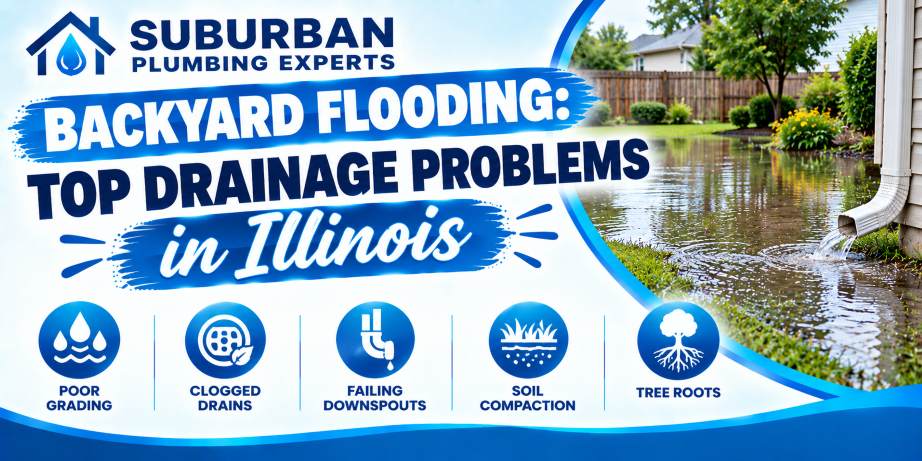
Illinois Yards Don’t Flood by Bad Luck. They Flood Because of What’s Actually Under Them
Most of northern and central Illinois sits on dense glacial till, clay-heavy soil compacted by ice sheets that covered the region repeatedly during the last several hundred thousand years and retreated for the final time roughly 12,000 years ago. The USDA’s own soil survey work confirms this directly: Illinois’ official state soil, Drummer silty clay loam, is formed from glacial till parent material and is explicitly classified as poorly drained. That’s not an incidental detail, it’s the state’s own representative soil type. That soil has had millennia to compact into something genuinely dense and slow-draining, not the loamy, quick-absorbing soil common in other parts of the country. Add in Illinois’ flat topography, which gives water nowhere to run downhill toward, and you have a state where backyard flooding is less a maintenance failure and more a predictable outcome of the ground itself. Understanding that is the first step toward fixing it correctly instead of guessing.
How Much Water Are We Actually Talking About
It’s easy to underestimate the volume involved. A 2,000-square-foot roof sheds roughly 1,200 gallons of water for every inch of rainfall, and a hard summer storm can drop an inch in well under an hour. All of that water has to go somewhere the moment it leaves the gutters, and on dense, slow-draining clay, it doesn’t soak in fast enough to keep up. That’s before accounting for runoff from the rest of the lot, driveways, patios, and any other impervious surface funneling additional water toward the same low points. A yard that seems to flood “out of nowhere” during a hard rain is usually just receiving more volume, all at once, than the soil underneath it can absorb in the time available.
Common Mistakes That Make It Worse
Piling mulch or soil against the foundation during landscaping projects often unintentionally reverses the grade right where it matters most, directing water toward the house instead of away from it.
Extending a downspout onto a neighbor’s property without their knowledge, even with good intentions, can create a dispute and, depending on volume, run into the same reasonable-use concerns covered below.
Letting gutters clog and overflow effectively turns your roof drainage system into an uncontrolled sheet of water pouring straight down at the foundation, defeating the purpose of having gutters and downspouts in the first place.
Adding a patio, shed, or driveway without adjusting drainage increases the impervious surface on a lot without giving the additional runoff anywhere new to go, which is exactly the kind of change municipal stormwater ordinances are often written to catch.
Is This a Yard Problem or a Plumbing Problem?
Before spending money on any fix, figure out which category you’re actually dealing with, since the wrong diagnosis means paying for a solution that was never going to work.
Standing water after every rain, spread across a low area of the lawn, usually points to grading, the ground simply doesn’t slope away from the collection point, and no pipe or drain is involved.
Water pooling specifically near the foundation points to grading immediately around the house or a downspout discharging too close to it, both fixable without touching any buried system.
Water that used to drain fine but now backs up around a specific pipe outlet or catch basin suggests an existing drainage system, a French drain, a catch basin, a discharge line, has developed a blockage or failure rather than the yard itself changing.
A sump pump running constantly with water still visible in the yard can mean the pump is working exactly as designed but the system feeding it, or the discharge line moving water away from the house, is undersized or blocked somewhere past the pump itself.
The Real Fix Options, Ranked by Cost and Scope
Start with grading and downspouts, the cheapest and most commonly overlooked fix. Soil should slope away from the house at a consistent grade, and downspouts should discharge at least four to six feet from the foundation, not dump directly beside it. A surprising share of “drainage problems” are actually just water being funneled to exactly the wrong spot by design, not by any system failure.
If regrading alone doesn’t solve a low spot in the yard, a French drain or drain tile system intercepts groundwater and channels it away before it can pool on the surface. Our French drain and drain tile installation service covers new installations, and if you already have a system that’s stopped performing, our guide on diagnosing and clearing a clogged drainage tile covers what’s actually involved in servicing one, since most buried systems have no accessible opening the way a kitchen drain does. If yours has genuinely never been serviced, our drain tile cleaning cost breakdown gives you a real number to plan around before committing to one.
For a yard that collects runoff from a larger area, a dry well or catch basin captures water at a specific low point and either disperses it slowly into surrounding soil or routes it to a storm connection, useful where a simple French drain doesn’t have enough capacity for the volume involved.
For water that’s already reaching the foundation or basement, the fix moves from yard-level to structural: a sump pump system, sometimes paired with an ejector pump or a backwater valve depending on what’s actually happening. Our comparison of French drains versus sump pumps versus backwater valves walks through exactly which situation calls for which system, since they solve genuinely different problems and installing the wrong one wastes real money.
The Legal Line Most Homeowners Don’t Know They’re Standing On
Here’s something worth understanding before you pick up a shovel: in most Illinois municipalities, you cannot legally solve your own flooding by regrading your yard to divert water onto a neighbor’s property or directly into the street in volumes beyond natural flow. Illinois generally follows the “reasonable use” doctrine for surface water, which allows a property owner to alter drainage on their own land but not in a way that unreasonably dumps concentrated water onto someone else’s. Many municipalities also have their own stormwater ordinances requiring detention or specific drainage provisions for additions, patios, or major grading work above a certain size, meaning your fix might need a permit you didn’t know to pull. Before undertaking any significant regrading project, a quick call to your local public works or building department confirms you’re not solving your own flooding by creating a legal problem with your neighbor’s.
When to Call a Professional
If grading and downspout adjustments haven’t resolved the problem, if you suspect an existing drainage system has failed rather than just aged, or if water is reaching your foundation rather than just pooling in the yard, that’s the point to bring in a professional assessment rather than keep guessing at fixes. A proper diagnosis identifies which of the categories above you’re actually dealing with before any money gets spent on a solution.
Quick Answers
Why does my yard flood when my neighbor’s doesn’t, even though we’re right next to each other?
Small differences in grading, soil compaction from past construction, and even which direction a downspout discharges can create very different drainage outcomes between two adjacent, otherwise similar lots.
Can I just dig a ditch to drain water toward the street myself?
Be careful. Depending on your municipality and how much water you’re redirecting, this can violate local stormwater ordinances or Illinois’ reasonable-use doctrine for surface water if it concentrates flow onto a neighbor’s property. Check with your local building department first.
How do I know if I need a French drain or just better grading?
If the problem is water pooling in a specific low spot with no way to naturally drain away, grading alone may not be enough and a French drain intercepts groundwater more directly. If water is simply flowing toward the wrong spot due to slope, grading is usually the right first step and the cheaper one.
Is backyard flooding actually connected to the broader stormwater system?
Indirectly, yes. Chicago-area stormwater infrastructure has a finite capacity, and a property that’s properly managing its own runoff through grading and drainage puts less strain on that shared system during heavy storms than one that isn’t.
How much water can actually come off my roof during one storm?
A 2,000-square-foot roof sheds roughly 1,200 gallons per inch of rainfall, and a hard storm can deliver that in under an hour. That volume is a big part of why a yard that drains fine most of the time can still flood during a genuinely heavy rain.
I just added a patio or shed. Could that be why my yard suddenly floods?
Very possibly. Any new impervious surface reduces how much of your lot can absorb rain naturally, sending more runoff toward the same low points that used to handle less volume.
Backyard Drainage Solutions in Chicagoland
Licensed, insured, and serving Illinois homeowners since 1978. French drains, sump pumps, and honest diagnosis before any digging starts. Call now or fill out the form.
Emergency: 708-518-7765 | Suburbs: 708-801-6530 | Chicago: 773-570-2191
—
Suburban Plumbing Sewer Line & Drain Cleaning Experts
Licensed & Insured | Open 24 Hours | Serving Chicago & the Suburbs Since 1978
📞 Suburbs: 708-801-6530 | 📞 Chicago: 773-570-2191 | 🚨 Emergency: 708-518-7765