Westmont Exists Because a Brick Maker Found Clay Deposits Thick Enough to Build a Company On, at the Highest Point West of Chicago Along the Railroad. That Same Clay Is Still Under Every Sewer Lateral in Town 150 Years Later, and It’s Exactly the Kind of Soil That Makes Hydro Jetting Matter More Here Than in a Lot of Nearby Suburbs.
Most hydro jetting articles explain the technology the same way regardless of which town’s name is in the title. This one starts somewhere more specific: why the ground under Westmont makes hydro jetting a genuinely better fit for this town than for a lot of its neighbors, not just a nice-to-have upgrade over cheaper methods.
Why Westmont’s Soil Isn’t Incidental to This Topic
Westmont exists because of clay. After the Great Chicago Fire of 1871, a brick maker named William Gregg traveled west along the Chicago, Burlington and Quincy Railroad looking for a site with two things: clay deposits thick enough to supply a brick company, and elevation high enough that loaded rail cars could coast downhill back toward the rebuilding city. He found both at what’s now Westmont, the highest point west of Chicago along that rail line, sitting on glacial clay deposits roughly 740 feet above sea level. The brick company is long gone, but the clay it was built on didn’t go anywhere.
Clay-heavy soil behaves differently than the sandy or loamy soil found in a lot of other Chicagoland suburbs. According to the USDA’s Natural Resources Conservation Service, this kind of soil’s “shrink/swell potential,” the relative change in volume as moisture content changes, is a well-documented hazard to foundations, roads, and other structures, driven by the amount and type of clay present. That same expansion and contraction puts real, repeated stress on anything buried in it, including a sewer lateral’s pipe joints. A joint that shifts slightly with every wet spring and dry summer is more prone to small gaps and misalignment than one sitting in soil that stays dimensionally stable year-round. Those gaps are exactly where buildup accumulates and where tree roots find their way in.
A Two-Season Stress Cycle, Not a One-Time Problem
The clay movement under Westmont isn’t a single, one-time settling event from decades ago, it’s a cycle that repeats every single year. Research from Missouri University of Science and Technology’s geological engineering program describes exactly this pattern: shallow pipes buried in the zone of seasonal moisture fluctuation are exposed to significant stress from shrinking and swelling soil, with the hazard being greatest precisely in regions with pronounced wet and dry seasons, since the annual wetting-and-drying cycle causes the surrounding soil to shrink and swell year after year. Spring rain and snowmelt saturate clay soil and cause it to swell, pushing against buried pipe from every direction at once. Summer and early fall dry spells do the opposite, causing the same clay to contract and pull away from the pipe, sometimes leaving small voids around sections of the lateral that were tightly packed just months earlier. A pipe joint under Westmont isn’t dealing with one slow shift over its lifetime, it’s absorbing a push-and-pull cycle twice a year, every year, for as long as it’s been in the ground. That repeated cycling is what turns a joint that was manufactured within normal tolerances into one with a measurable gap after enough seasons of expansion and contraction around it.
What Hydro Jetting Actually Is
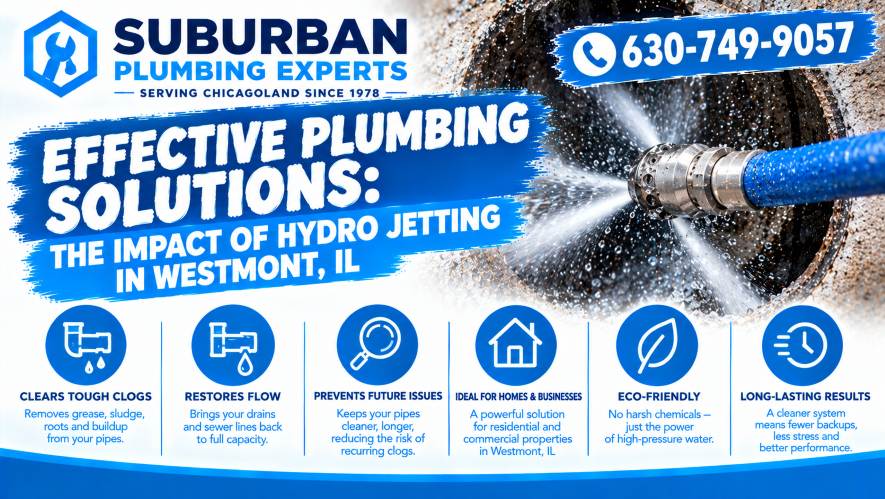
Our hydro jetting service uses a specialized nozzle, fed through the pipe on a flexible hose, that directs high-pressure water in multiple directions at once. Rather than relying on chemicals or a cutting blade, the water pressure itself scours debris, grease, mineral buildup, and root intrusion off the entire interior surface of the pipe, not just the center of the channel.
The nozzle itself matters here. A forward-jetting nozzle drives straight ahead to punch through heavier blockages first, while a rear-facing, rotating nozzle pulls itself through the pipe as it cleans, spraying backward and to the sides to scour the walls behind it. Professional units typically run in the 3,000 to 4,000 psi range, well beyond anything available to a homeowner, but the pressure actually used on a given line is adjusted down for older or more fragile pipe material rather than applied at a single fixed setting regardless of what the camera shows.
A proper hydro jetting job starts with a sewer camera inspection to identify exactly where buildup or intrusion sits and how severe it is. The jetting nozzle is then run through the line at a pressure matched to the pipe’s material and condition, and a follow-up camera pass confirms the line is actually clear rather than just assuming the job worked.
Why That Matters More for a Clay-Soil Town Specifically
Our sewer rodding service, the more common alternative, uses a rotating cutting head to punch a path through a blockage. It’s fast and effective for clearing an active clog, but it clears a channel through the middle of whatever’s blocking the pipe rather than scouring the full interior surface. On a lateral with joints that have shifted slightly from seasonal clay movement, that distinction matters: buildup and root growth concentrated at those shifted joints can survive a rodding pass largely intact, sitting at the edges of the pipe rather than in the center where the cutting head traveled, which is exactly why a line that was “just rodded” can clog again within months.
Hydro jetting’s full-surface scouring reaches that buildup at the joints, not just the material blocking the center of the pipe. For a Westmont lateral running through soil that’s been quietly stressing pipe joints for decades, that’s a meaningfully more complete clean than a method built around punching a hole through the middle of a clog.
Hydro Jetting vs. Rodding vs. Chemical Cleaners
Chemical drain cleaners dissolve the soft leading edge of a clog and stop there, without reaching embedded buildup or touching root intrusion at a joint. Repeated use also corrodes pipe material over time, which is a worse trade on a lateral whose joints are already under periodic mechanical stress from the clay around them. Rodding, as covered above, clears a path but can leave buildup at the pipe’s edges largely untouched. Hydro jetting is the only one of the three that addresses the entire interior surface at once, with no chemical corrosion risk added to joints that don’t need another source of stress.
Why This Also Means More Root Intrusion
A gap at a pipe joint doesn’t just invite buildup, it’s also the exact kind of opening tree roots are built to find. This connection isn’t speculative: an engineering geology review published through the UK’s Natural Environment Research Council identifies tree-induced soil movement as a significant contributor to the failure of old pipes specifically located in clay soils near deciduous trees. Our guide to root intrusion and how it affects sewer lines covers the biology in full, but the short version matters directly here: roots can’t force their way into a sound, intact pipe, they follow moisture escaping through an existing crack or gap. A joint that’s opened slightly from a few years of seasonal clay movement is exactly the kind of opening a nearby tree’s root system will exploit, which means Westmont’s soil isn’t just a buildup problem, it’s a contributing factor to root intrusion risk that has nothing to do with how close a specific tree happens to be.
Signs Your Westmont Home Could Benefit From Hydro Jetting
Frequent clogs that return within weeks of being cleared, slow drainage across more than one fixture at a time, gurgling sounds from drains after another fixture is used, and a sewer odor near a floor drain or basement fixture are all signs worth taking seriously, especially if a previous rodding service didn’t produce a lasting fix. On an older Westmont property, particularly one near the village’s original, more established neighborhoods, a lateral that’s never been camera-inspected is worth checking before assuming a quick rodding visit will hold.
Extending the Lifespan of Your Plumbing System
Buildup left in place doesn’t just restrict flow, it contributes to corrosion and pipe wall deterioration over time, and on joints already under periodic stress from clay soil movement, that combination accelerates wear faster than either factor alone would. Removing that buildup at the surface level, rather than just clearing a path through the center of it, protects the pipe’s structural condition in addition to restoring flow, which is the difference between a cleaning that buys a few months and one that meaningfully extends how long the line lasts before it needs repair.
Choosing a Hydro Jetting Provider in Westmont
The clay-soil dynamic above is exactly why a camera-first approach matters when choosing who does this work. A provider that runs a camera before and after jetting, rather than jetting blind and hoping for the best, can confirm both that the pressure used matched your specific pipe’s material and condition, and that the line is actually clear afterward rather than just assumed clear. Our Westmont plumbing team approaches hydro jetting this way as standard practice rather than an upsell, since guessing at pressure on a pipe with unknown joint condition is how you either under-clean the line or risk damaging an already-stressed section.
Cost-Effectiveness of Hydro Jetting
Hydro jetting typically costs more upfront than a basic rodding visit, and the comparison that actually matters isn’t the sticker price of one visit against another, it’s how often you’re paying for a return visit afterward. A rodding service that leaves buildup at shifted pipe joints, the pattern described above, tends to need repeating more often on a Westmont lateral than the same service would on a line in more stable soil. Jetting’s more complete clean, addressed once with a camera-verified result, is the comparison worth running before assuming the cheaper single visit is actually the cheaper option over a year or two.
Frequently Asked Questions
Why would Westmont’s soil specifically make a difference to drain cleaning?
Westmont sits on clay-heavy glacial soil, the same clay deposits the village was originally built around as a brick-making site. Clay expands and contracts with moisture, which puts repeated stress on buried pipe joints and makes small gaps and misalignment more likely than in more stable soil, which is exactly where buildup and root intrusion tend to concentrate.
Is hydro jetting better than sewer rodding?
They solve different problems. Rodding punches a path through an active clog quickly, which makes it the right first move for restoring flow fast. Hydro jetting scours the entire interior surface of the pipe, which matters more for buildup sitting at pipe joints rather than in the center of the channel, a pattern more common in a clay-soil town like Westmont.
How do I know if I need hydro jetting instead of a basic cleaning?
Clogs that return within weeks of being cleared, slow drainage across multiple fixtures, gurgling, and sewer odor are all signs worth a closer look, especially if a previous rodding visit didn’t produce a lasting fix. A camera inspection is the most reliable way to confirm which service actually matches what’s happening in your specific line.
Is hydro jetting safe for older pipes?
When pressure is matched to the pipe’s actual material and condition, yes. That’s exactly why a camera inspection before jetting matters: it lets the pressure be set appropriately for your specific line rather than applying a generic setting to a pipe of unknown condition.
Is hydro jetting worth the higher upfront cost compared to rodding?
Compare it over a year or two rather than one visit against another. A rodding service that leaves buildup at shifted joints often needs repeating sooner than a jetting service that cleans the full interior surface once, which changes the real cost comparison once repeat visits are factored in.
Does this clay movement happen once, or does it keep happening?
It repeats every year. Spring moisture swells the clay and pushes against buried pipe, while summer and fall dry spells cause it to contract and pull away, sometimes leaving small voids. That push-and-pull cycle happens twice a year, year after year, which is why joint gaps develop gradually over a pipe’s lifetime rather than from one single event.
Does Westmont’s soil also affect root intrusion risk?
Yes, indirectly but meaningfully. Tree roots can’t penetrate a sound, intact pipe on their own, they follow moisture escaping through an existing gap. A joint that’s opened slightly from years of seasonal clay movement is exactly the kind of opening a nearby root system will find and grow into, which means the soil itself contributes to root intrusion risk independent of how close any specific tree is.
Need Hydro Jetting in Westmont, IL?
Licensed, insured, and serving Westmont and the surrounding west suburbs since 1978. Camera-first diagnosis, hydro jetting matched to your pipe’s actual condition, and a post-service verification pass, every time.
Westmont: 630-749-9057 | Emergency: 708-518-7765 | Open 24/7
—
Suburban Plumbing Sewer Line & Drain Cleaning Experts
Licensed & Insured | Open 24 Hours | Serving Chicago & Chicagoland Since 1978
📞 Westmont: 630-749-9057 | 🚨 Emergency Hotline: 708-518-7765