
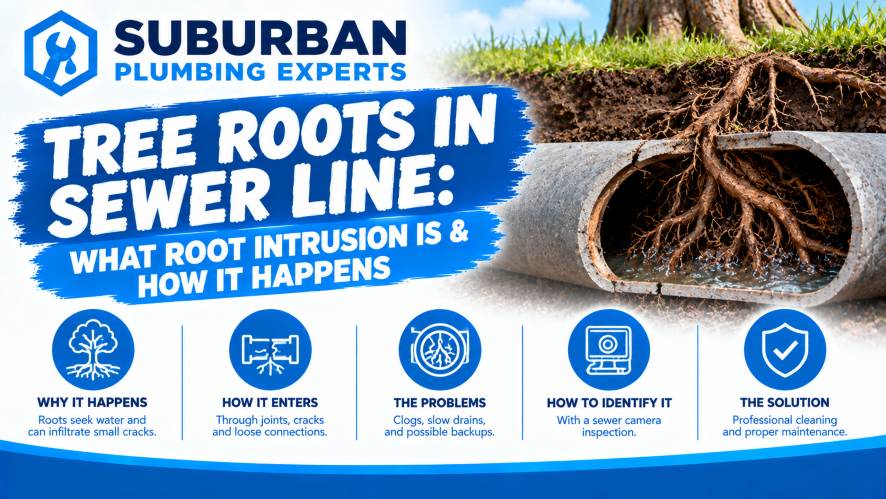
A Tree Doesn’t “Decide” to Invade Your Sewer Line. It’s Just Following a Moisture Trail, and a Hairline Crack in an Aging Pipe Is Exactly the Invitation It’s Looking For. Here’s the Actual Biology Behind Root Intrusion, How to Spot It Early, and What Actually Stops It.
A mature tree in the yard is one of the best things a property can have, until the exact conditions that make it thrive, a deep, spreading root system constantly hunting for water, turn a small crack in a decades-old sewer line into an open door. Tree roots in a sewer line are one of the most common causes of drain backups and blockages homeowners deal with, and it isn’t rare, and it isn’t a sign of bad luck. It’s a predictable, well-understood process, and understanding how it actually works is the difference between catching it early and discovering it after a full backup.
What Root Intrusion Actually Is
Tree roots don’t seek out sewer lines on purpose the way the word “intrusion” makes it sound. Roots grow toward moisture and nutrients through a biological response called hydrotropism, essentially following a gradient of dampness through the soil. A sewer line carrying wastewater is warm, constantly moist, and full of the organic nutrients that make plant roots grow faster and denser than they would anywhere else nearby.
None of that matters to a healthy, intact pipe. North Carolina State University’s Cooperative Extension puts it plainly: tree roots cannot create a crack in a sound sewer pipe on their own, they can only exploit one that’s already there. The problem starts at a joint, a hairline crack, or a spot where age has made the pipe brittle enough to let a small amount of moisture escape into the surrounding soil. That escaping moisture is the trail a root follows, and once a fine root hair finds its way through an opening as small as a few millimeters, it doesn’t stop there.
Why Drought and Dry Summers Make It Worse, Not Better
It seems backward at first: shouldn’t a wet season be when root intrusion is the bigger risk? In practice, prolonged dry spells and drought conditions often make the problem worse, not better. When the surrounding soil dries out, the constant, reliable moisture inside a leaking sewer line becomes an even more concentrated, more attractive target relative to everything else nearby, and tree roots respond by growing more aggressively toward that one remaining reliable source. A tree that’s coexisted peacefully with a minor pipe leak for years can suddenly intensify its root growth toward that leak during a hot, dry summer, turning a slow-developing problem into a faster one almost overnight.
How a Few Fine Roots Become a Blockage
What starts as a single thread-like root entering through a joint gap doesn’t stay small. Once inside, that root has found an environment with essentially unlimited water and nutrients, and it responds by growing rapidly and branching, filling more of the pipe’s interior with each passing season. Debris, grease, and waste catch on the growing root mass and build up around it, which accelerates blockage far faster than the root growth alone would.
Over time, the root system also works from the outside in, since larger roots continuing to expand in diameter exert real physical pressure against the pipe wall from within, which can widen the original crack or joint gap and eventually crack the pipe further. A problem that started as a barely visible entry point can progress to a fully blocked, structurally compromised section of pipe within a few years if it’s never addressed.
Which Trees Cause the Most Problems
Not all trees pose the same risk, and the species matters as much as the proximity. Willows, silver maples, poplars, cottonwoods, and elms are especially aggressive water-seekers with fast-growing, wide-spreading root systems, and they’re responsible for a disproportionate share of root intrusion cases. Slower-growing species with more contained root systems, like most oaks and many ornamental trees, pose meaningfully less risk at the same distance from a line. Distance still matters regardless of species, since a large, mature tree’s root system typically extends well beyond its canopy, often reaching two to three times the tree’s height in radius.
Warning Signs Worth Taking Seriously
Frequent clogs affecting more than one drain at the same time are one of the earliest reliable signs, since a localized fixture clog rarely explains problems showing up simultaneously across a house. Gurgling sounds from drains or toilets, especially right after another fixture is used, point to air being trapped by a partial obstruction further down the line.
A persistent sewer odor, indoors or in the yard, often means gases that should be venting normally are being redirected by a blockage. One sign almost nobody thinks to look for: an unusually green, lush strip of grass running across the yard in roughly a straight line, tracing the path of the sewer line underground. That section of soil is getting a steady, invisible dose of nutrient-rich moisture from a leak, which is exactly the condition drawing roots toward it in the first place.
Diagnosis Isn’t a Guess. It’s a Camera.
Every symptom above can also be explained by other causes, which is why a sewer camera inspection is the only way to actually confirm root intrusion rather than assume it. A camera run through the line shows exactly where roots have entered, how extensive the mass has become, and whether the surrounding pipe has already sustained structural damage, information that determines everything about the right next step.
Clearing the Roots: Rodding and Hydro Jetting
Once root intrusion is confirmed, professional root removal typically starts with one of two mechanical approaches. Sewer rodding uses a motorized cable with a cutting head to physically cut through a root mass and restore flow, and it’s an effective, fast first response for a confirmed blockage.
Hydro jetting uses high-pressure water rather than a cutting blade, which shears roots away while also scouring the buildup and debris that accumulated around them, leaving a cleaner pipe interior than cutting alone. Neither approach removes the root system growing outside the pipe, which is exactly why regrowth through the same entry point is common without addressing the underlying opening.
Chemical Root Treatments: What They Do and Don’t Fix
Foaming root-control treatments, applied directly into the line after cleaning, use a herbicide formulated to kill root growth inside the pipe without harming the tree itself above ground. These treatments can meaningfully slow regrowth for a period of months, and they’re a reasonable part of an ongoing maintenance plan for a line with a known recurring intrusion point. They don’t repair the crack or joint gap the roots are entering through, which means they manage the symptom rather than resolve the underlying vulnerability.
When Cutting Roots Isn’t Enough: Repair and Lining
A line with a single isolated crack or joint failure is often a strong candidate for a targeted spot repair rather than full replacement. For a longer section with multiple entry points or more extensive damage, trenchless pipe lining, an industry-standard rehabilitation method recognized by the National Association of Sewer Service Companies, creates a new, jointless interior surface inside the existing pipe, sealing off every point roots could otherwise re-enter without excavating the yard. When damage is too extensive for lining to be effective, typically a collapsed section or severe structural failure across a long run, full sewer line repair or replacement is the option that actually resolves the problem rather than managing it indefinitely.
Is Root Intrusion Covered by Homeowners Insurance?
Usually not, and it’s worth knowing that before assuming a repair will be reimbursed. Standard homeowners policies generally treat root intrusion as a gradual, foreseeable maintenance issue rather than a sudden, accidental event, which is the same category exclusion that applies to age-related wear on a roof or a water heater. The clearing or repair itself typically falls to the homeowner directly.
Where coverage can come into play is secondary damage: if a root-caused blockage leads to a sudden backup that floods a finished basement, that resulting water damage is sometimes covered even when the root intrusion that caused it isn’t, depending on the specific policy and whether a sewer backup endorsement is in place. Reading the actual policy language, or asking an agent directly before an incident happens, is worth far more than assuming either way.
Preventing the Next Intrusion
A physical root barrier installed between a tree and a sewer line, typically a rigid panel set 18 to 24 inches deep, redirects root growth away from the pipe without harming the tree. When planting new trees, choosing slower-growing, less aggressive species and keeping them well clear of the line’s path prevents the problem from developing in the first place rather than managing it later.
For an older property with mature trees already established near the line, a periodic camera inspection on a set schedule catches a new intrusion while it’s still a minor, inexpensive fix rather than after it’s progressed to a full blockage. If you’re located in the Chicago area specifically, our guide to tree roots and sewer lines for Chicago homeowners covers the local soil, climate, and tree species factors that make this an especially common issue throughout Chicagoland.
Frequently Asked Questions
How do tree roots actually get inside an intact sewer pipe?
They don’t enter intact pipe. Roots follow moisture escaping through an existing crack, gap, or deteriorated joint, meaning some level of pipe damage or age-related wear is already present before root intrusion can begin.
What are tree roots in a sewer line, exactly?
Tree roots in a sewer line are root growth that has entered the pipe through an existing crack, gap, or deteriorated joint, drawn in by the consistent moisture and nutrients inside a wastewater line. Roots cannot penetrate an intact, undamaged pipe on their own; some level of existing damage always comes first.
Is root intrusion covered by homeowners insurance?
Generally no, since most standard policies treat it as a gradual maintenance issue rather than a sudden covered event. Secondary damage from a resulting backup, such as flooding in a finished basement, is sometimes covered depending on the policy, but the root clearing or pipe repair itself typically isn’t.
Will removing the tree solve a root intrusion problem?
Not on its own. Removing the tree stops new root growth from that specific tree, but it doesn’t repair the crack or joint gap the roots entered through, and existing roots already inside the line won’t disappear on their own. The pipe damage still needs to be addressed directly.
How often does a sewer line need root removal once intrusion has started?
It depends on whether the underlying entry point has been sealed. Cutting roots without repairing or lining the damaged section typically means regrowth returns within months to a year or two, while a lined or properly repaired section removes the entry point entirely and stops the cycle.
Can chemical root treatments replace mechanical removal?
No. Chemical treatments slow future regrowth after a line has already been mechanically cleared; they aren’t strong enough to remove an existing, established root mass on their own and work best as an ongoing maintenance step rather than a first response to an active blockage.
—
Suburban Plumbing Sewer Line & Drain Cleaning Experts
Licensed & Insured | Open 24 Hours | Serving Chicago & Chicagoland Since 1978