
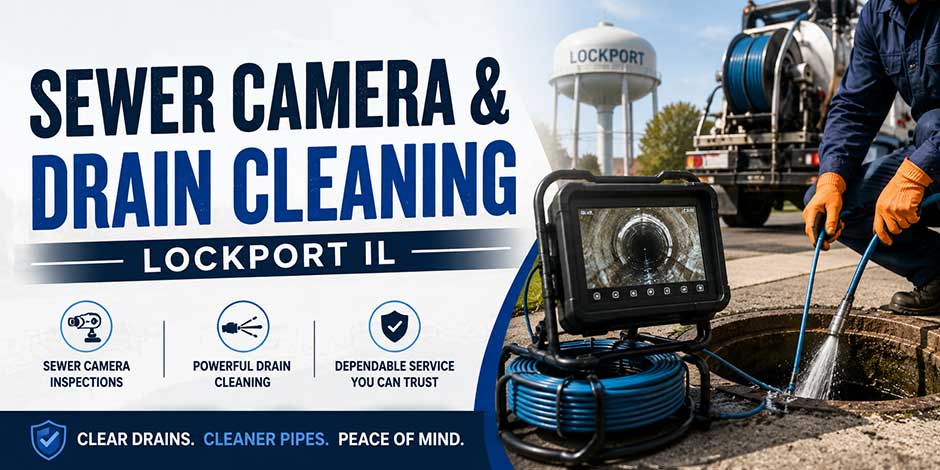
The Complete Sewer and Drain Guide for Lockport Homeowners Who Want to Understand What’s Happening Underground
Lockport has a relationship with water and sewage infrastructure that goes deeper than almost any other community in Illinois. This is, after all, the city where the Chicago Sanitary and Ship Canal’s control works are located — where the MWRD’s historic Lockport Powerhouse has managed the flow of Chicago’s waterway system since 1900, and where the Deep Tunnel’s Tunnel and Reservoir Plan ultimately routes the stormwater and sewage overflow captured from throughout the Chicago metropolitan area. The most historically significant water management infrastructure in North America is in Lockport. Water and sewage are not abstractions in this city — they’re part of its identity, its history, and its daily operational reality.
Against that backdrop, the City of Lockport has announced something that every Lockport homeowner should read carefully: a major infrastructure investment program running from 2025 through 2030, funded by rate increases, designed specifically to address the deterioration of existing water and sewer systems. The city’s own rate increase documentation states the purpose plainly — facility improvements to the water system and the expansion to the Division Street Treatment Facility are needed to stop deterioration and proactively ensure these systems are sustainable for the future of Lockport.
A city that’s spending significant public funds specifically to stop infrastructure deterioration is a city whose public works department has identified real, documented deterioration in its existing systems. That’s the public side. The private sewer lateral running from your home to the city’s mains — the underground pipe that’s the same age as the infrastructure the city is now upgrading — remains your responsibility entirely. And it’s worth knowing about before a backup event makes it urgent.
Lockport’s Sewer Infrastructure — What Makes It Different
A Separate Sewer System With Two Treatment Plants
Unlike Chicago and most inner-ring Cook County suburbs — where a combined sewer system carries both stormwater and sanitary waste in the same pipes — Lockport operates a separate sewer system. Storm and sanitary sewage run in separate underground infrastructure. The Sewer Division of the City’s Public Works and Engineering Department maintains the sewerage collection system and operates two separate wastewater treatment facilities: the Division Street Wastewater Treatment Plant and the Bonnie Brae Forest Manor Treatment Plant.
This separate sewer system means the combined sewer surcharge backup mechanism — where heavy rain overwhelms a shared storm-and-sanitary pipe, reversing pressure through residential floor drains — is largely absent in Lockport. When a Lockport sewer lateral backs up, the cause is almost always within the private lateral itself: root intrusion through aging pipe joints, structural failure from decades of freeze-thaw cycling, grease and debris accumulation, or pipe belly from soil settlement.
This is actually good news for the diagnosis: Lockport sewer problems are almost always solvable within the private lateral. Camera inspection identifies the specific condition. The appropriate service — rodding, hydro jetting, spot repair — addresses it.
The Historical MWRD Connection and What It Means for Lockport Homeowners
The MWRD’s Lockport Powerhouse isn’t just a historical landmark — it’s the active control point for the Chicago Sanitary and Ship Canal, which is the downstream recipient of sewage and stormwater from throughout the northeastern Illinois region. The private sewer laterals of Lockport homes connect to the city’s collection system, which connects to the treatment plants, which ultimately discharge to the waterway system that flows through Lockport’s control works.
Understanding this connection matters practically: the treatment capacity at Lockport’s two plants is sized for the collection system’s expected flow. A Lockport sewer lateral with multiple open root intrusion joints is a lateral that’s admitting groundwater into the sanitary collection system alongside household sewage — adding infiltration flow that wasn’t designed into the system’s capacity calculations. Individual homeowner maintenance of private laterals contributes to the collective performance of the treatment system that the city is actively investing in upgrading.
The City’s Acknowledged Discoloration Issue
The City of Lockport’s Public Works Department acknowledges directly on its website that due to pressure fluctuations in the system, residents may experience some discolored water — with sediment in the mains causing the discoloration. This is the city’s own public works department confirming that its water distribution infrastructure has sediment buildup consistent with aging pipes.
For Lockport homeowners who’ve noticed morning water discoloration — the brownish tint that clears after running the cold tap for 30 to 60 seconds — this is the city confirming that the condition exists at the public system level. For the full guide to what water discoloration means for private-side plumbing in older homes, see our complete guide to water line warning signs in Chicago suburbs.
The Sewer Lateral Picture in Lockport
What Lockport’s Housing History Means for Underground Pipe Conditions
Lockport’s housing stock spans a significant range of construction eras — from the historic downtown area near the Illinois and Michigan Canal corridor with older homes to the suburban subdivisions that developed throughout Will County from the 1970s through the 2000s. Each era has a different sewer lateral profile:
Pre-1970 Lockport homes: Clay tile laterals now 55 to 80+ years old. The cumulative freeze-thaw cycling, root pressure, and soil movement of that many Illinois winters has produced the joint displacement, root entry points, and structural conditions that camera inspection reveals in older Lockport laterals. These are the pipes most urgently in need of camera assessment.
1970s-1980s Lockport homes: A mix of clay tile (earlier decade) and early PVC (later decade). 1970s clay tile in Lockport is now approaching 50+ years with the same deterioration concerns as older housing. Early PVC from the 1980s is 35 to 45 years old — within service life but approaching the age where joint sealant and connection conditions warrant monitoring.
1990s-2000s Lockport homes: Modern PVC laterals in good condition relative to older pipe. These homes’ primary sewer concern is tree root pressure at connection points and any physical damage from nearby construction. First-time camera inspection on a reasonable schedule is appropriate preventive maintenance.
The Drainage Swale Responsibility
The City of Lockport’s Residential Draining & Flooding guidance is specific about homeowner obligations that directly affect both drain performance and sewer lateral health:
Sump pump discharge rules. The city specifically prohibits redirecting sump pumps to sanitary sewers — a water quality regulation with significant enforcement implications. Sump pump discharge must be directed away from the municipal storm sewer or connected to the public storm sewer with permit approval from the Building Department. Sump pump discharges must be at least 10 feet from the property line to avoid creating nuisance conditions for neighbors. A Lockport homeowner whose sump pump is discharging to the sanitary sewer is operating in violation of city requirements.
Drainage swale maintenance. Stormwater runoff from yards should flow via side and rear yard swales toward the city’s storm sewer and detention ponds — and those swales may continue through neighboring properties. The homeowner’s responsibility is to ensure water can flow unimpeded through their property. Blockages to drainage swales — from landscaping, structures, grade changes — can create flooding conditions for adjacent properties and violations of drainage easement requirements.
Soil settlement and low spots. The city specifically advises that areas of the yard that settle over time should be filled with clay below the topsoil layer to restore drainage grade. In Lockport’s clay-heavy Will County soil, differential settlement creates the same yard pooling conditions that affect every community we serve in this corridor.
The Complete Sewer Service Bundle for Lockport Homes
Service 1: Sewer Camera Inspection — The Foundation of Every Correct Decision
For any Lockport home that hasn’t had a camera inspection of the private lateral in the current ownership period — and especially for pre-1980 Lockport homes with clay tile laterals — camera inspection is the most valuable plumbing investment available.
The camera travels through the lateral from the house to the city main connection, providing real-time video of pipe interior condition. In Lockport’s housing stock, the findings that most commonly determine subsequent service decisions:
Root intrusion at joint gaps. Mature trees throughout Lockport’s established neighborhoods create the same root pressure on clay tile lateral joints that affects every Will County and Cook County community we serve. The specific findings — how many joints are affected, how dense the root mass, whether joint displacement has occurred — determine whether annual maintenance cleaning, targeted joint repair, or more comprehensive lateral work is the appropriate response.
Pipe belly from clay soil settlement. Will County’s expansive clay soil creates the differential settlement around buried pipes that produces the grade deficiencies — low points where waste pools rather than flowing. A pipe belly that camera inspection identifies as a recurring accumulation zone explains the recurring drain problems that rodding alone hasn’t resolved.
Structural condition of aging clay tile. A pre-1970 Lockport lateral that’s been through 55+ Illinois winters has accumulated the freeze-thaw stress that produces joint displacement, cracking, and in advanced cases, partial collapse. Camera inspection documents the specific conditions before any repair or replacement decision is made.
Our sewer camera inspection service is available throughout Lockport with same-day scheduling.
Service 2: Sewer Rodding — Emergency Clearing and Root Mass Reduction
When a Lockport lateral is actively backed up — multiple drains slow simultaneously, floor drain backing up, sewage odor in the basement — sewer rodding is the immediate response. Mechanical root cutting with a steel cable breaks through root masses and debris accumulation, restoring flow.
For Lockport homes where annual rodding has become the maintenance pattern — the lateral backs up every 10 to 14 months, gets rodded, works fine, backs up again — the rodding is managing the symptom of root intrusion at an open joint without addressing the joint itself. Camera inspection after clearing identifies the specific entry joints for targeted sealing — the step that breaks the annual rodding cycle.
Our sewer rodding service covers Lockport with same-day and 24/7 emergency response.
Service 3: Hydro Jetting — Complete Pipe Wall Cleaning
After root cutting with the rod, hydro jetting at 2,500 to 4,000 PSI flushes all cut root material from the pipe and scours the pipe walls of the biological deposit and scale that accumulates in aging clay tile and cast iron drain systems. Hydro jetting following rodding produces a genuinely clean pipe rather than a temporarily cleared one.
For Lockport’s interior drain lines — kitchen drains in older homes with cast iron drain branches — hot water hydro jetting removes the calcium-reinforced grease deposits that are the primary cause of recurring kitchen drain problems throughout Will County’s older housing stock. For the complete explanation of why kitchen drain clogs keep coming back and what hydro jetting does differently, see our complete guide to the #1 cause of drain clogs in Chicago homes.
Our hydro jetting service is available throughout Lockport.
What the City’s 2025-2030 Infrastructure Investment Means for Lockport Homeowners
The rate increase documentation is specific: construction will begin in 2025 and be completed by 2030. Facility improvements to the water system and the expansion to the Division Street Treatment Facility are needed to stop deterioration and proactively ensure these systems are sustainable.
The city is investing in the public infrastructure. The private sewer lateral connecting your home to that infrastructure is not part of the public project scope. It’s the homeowner’s maintenance obligation — and it’s the same age as the public infrastructure the city has determined needs investment to remain sustainable.
The homeowner who proactively camera-inspects their lateral, addresses root intrusion, and maintains their private drain system is the homeowner who benefits from the city’s public investment — because their private connection to the improved public system is as sound as the system it connects to. The homeowner who defers private-side maintenance is the homeowner whose backup event will be attributed to the private lateral regardless of what the city has invested in the mains.
For the complete framework on how Chicago-area homeowners can avoid the most expensive plumbing mistakes — including deferring sewer lateral assessment until an emergency forces it — see our guide to the 10 most expensive Chicago plumbing mistakes.
The Groundwater and Flooding Picture in Lockport
Lockport is a Will County community with the same clay-heavy soil and relatively flat terrain that creates groundwater flooding conditions throughout the southwestern Chicago suburban corridor. The Presidential Disaster Declaration for Will County following severe weather in July 2024 reflects the real and recurring flooding risk that this corridor experiences.
For Lockport homeowners whose basement flooding is from groundwater — water entering through the slab or wall-floor joint without sewage odor — the sump pump is the primary defense. Lockport’s separate sewer system means the combined sewer surcharge mechanism affecting Chicago and Cook County combined sewer communities is absent here. What remains is the groundwater pressure from Will County’s clay-heavy soil that every Lockport basement with a below-grade floor is subject to.
Battery backup is essential. The July 2024 severe weather event that triggered the Will County disaster declaration was the kind of storm that simultaneously produces peak groundwater pressure AND power outages. A sump pump without battery backup fails during exactly this scenario. Our sump pump services cover Lockport and Will County with same-day and 24/7 emergency response.
What Lockport Homeowners Should Do Right Now
If your home was built before 1980 and hasn’t had a sewer camera inspection: Schedule one. The city is investing in infrastructure improvements through 2030 specifically because of documented deterioration. Your private lateral is the same age as what they’re addressing.
If your kitchen drain has been rodded more than once in 18 months: The recurring cycle indicates wall deposits that rodding compresses but doesn’t remove. Hot water hydro jetting breaks the cycle.
If your sump pump is more than 7 years old: Have it assessed. Add battery backup if not present — Will County’s severe weather history makes battery backup a necessity, not an option.
If your sump pump currently discharges to the sanitary sewer: This violates Lockport’s requirements. Contact the Building Department to get permitted approval for an appropriate discharge connection.
If you’ve noticed morning water discoloration: The city has acknowledged this is a systemic condition from sediment in aging mains. For older Lockport homes, a plumber assessment of private-side supply line condition confirms whether the discoloration is coming from the public main or from aging private supply pipes inside the home.
Frequently Asked Questions: Sewer and Drain Service in Lockport
Lockport has a separate sewer system. Does that mean I don’t need a backwater valve? For most Lockport homeowners, the combined sewer surcharge backup mechanism that drives backwater valve installations in Chicago’s Cook County communities is absent — so a backwater valve is typically not the priority installation. The primary sewer concern in Lockport is the condition of the private lateral itself: root intrusion, structural deterioration, and pipe belly that cause backup conditions independent of the municipal sewer system type. Camera inspection of the private lateral is the right diagnostic first step.
The city says construction will begin in 2025. Will road or utility work affect my sewer lateral? Municipal infrastructure projects that require excavation near residential laterals can create vibration and occasionally pressure changes that stress aging lateral conditions — particularly at the connection point where the lateral meets the city main. If you’re in an area where city infrastructure work has recently occurred and you’ve started noticing drain symptoms you didn’t have before, a camera inspection of the lateral including the connection point is warranted.
My Lockport home’s yard has a drainage swale. Can I plant in it? Drainage easements that include swales have specific restrictions on building, planting, and grading — the city’s drainage guidance is specific about this. Any landscaping or grade work within a drainage easement requires checking the easement restrictions first. A swale that’s been planted over or graded flat loses its drainage function, creating pooling conditions for your property and potentially your neighbors’.
Need Sewer Camera Inspection, Drain Cleaning, or Sewer Service in Lockport? We’re Here.
Licensed, insured, and serving Lockport and Will County since 1978. We perform sewer camera inspections, rodding, hydro jetting, and complete sewer line assessment throughout Lockport — understanding both the city’s separate sewer system and what aging private laterals in Will County’s housing stock look like on camera. We also serve nearby Will County communities, including Romeoville, with the same sewer, drain, plumbing, and emergency services. Written quotes before we start, permits on every job, our own licensed plumbers in Lockport on every call. Send us a message and we’ll get back to you fast.
Or call us directly: 708-801-6530 | Open 24/7
—
Suburban Plumbing Sewer Line & Drain Cleaning Experts
Licensed & Insured | Open 24 Hours | Serving Lockport & Will County Since 1978
📞 Suburbs: 708-801-6530 | 📞 Chicago: 773-570-2191 | 🚨 Emergency: 708-518-7765