
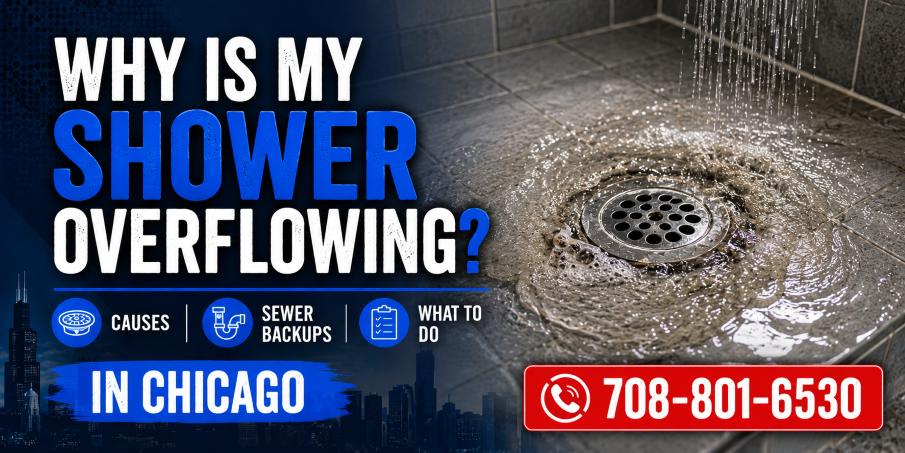
Water Coming Up Through a Shower Drain Instead of Going Down It Is Rarely About the Shower — It’s Almost Always a Sign of What’s Happening Further Down the Line. Here’s What Actually Causes It, How to Tell a Simple Clog From a Sewer Backup, and What to Do the Moment It Happens.
A shower that overflows is one of the more alarming plumbing problems a homeowner can run into, mostly because it doesn’t look like a normal clog. Instead of water draining slowly, it comes back up — sometimes clear, sometimes cloudy, sometimes carrying a smell that makes it obvious this isn’t just hair and soap scum. The shower drain is usually the lowest fixture opening in the house, which means it’s often the first place a bigger problem downstream makes itself known. This page walks through what actually causes a shower to overflow, how to tell a routine drain clog from a genuine sewer backup, and what to do immediately if it happens.
The Two Very Different Reasons a Shower Overflows
Broadly, a shower overflowing has one of two causes, and telling them apart matters because the fix is completely different. The first is a localized clog in the shower’s own drain line — hair, soap scum, and skin oils built up in the trap or the branch line close to the fixture, blocking water from draining normally while it backs up and eventually overflows the shower pan. The second, and the more serious of the two, is a blockage or overload further down the system — in the main sewer line or the combined sewer serving the block — that’s pushing wastewater backward through every low fixture connected to it, with the shower often being the first to show it simply because its drain sits lowest to the floor.
The clearest sign you’re dealing with the second scenario rather than the first: more than one fixture is affected at the same time. If your toilet gurgles, your basement floor drain backs up, or water rises in multiple fixtures while the shower overflows, that’s not a shower problem — that’s a main line or sewer backup, and it needs to be treated as one.
Local Shower Drain Clogs: What Causes Them
A shower drain clog close to the fixture is usually straightforward — hair combines with soap scum and skin oils to form a mass that narrows the pipe until water can no longer drain as fast as it enters, especially during a long shower. Older homes with narrower, corroded drain lines or a P-trap installed at an awkward angle are more prone to this kind of buildup collecting faster than it would in a newer, larger-diameter line. Our shower and tub plumbing service clears this kind of localized blockage directly at the source, and a drain cleaning service covering the full branch line is often worth pairing with it if the shower has been slow to drain for a while before the overflow happened, since a slow drain rarely fixes itself and tends to progress toward a full blockage.
When It’s a Sewer Backup, Not a Drain Clog
A true sewer backup happens when wastewater has nowhere else to go and is forced back up through the plumbing into your home, and in Chicago it has two common triggers. The first is a blockage in your own sewer lateral — most often tree roots intruding into an older clay or cast iron line, which is the single most common cause of sewer line failure in Chicago and the surrounding suburbs, growing slowly inside the pipe for years before a homeowner notices anything beyond a slow drain. A collapsed or offset section of older pipe can cause the same effect even without roots involved. The second trigger, more common during and after heavy storms, is the municipal system itself reaching capacity. Much of Chicago and its older suburbs run on a combined sewer system, meaning stormwater and sewage share the same pipe, and the Metropolitan Water Reclamation District’s own explanation of how the local sewer system works notes that when rainfall exceeds what the system’s tunnels and reservoirs can capture, sewers follow their original course and overflow — and that same overload is what pushes wastewater backward into homes at their lowest points, including shower and floor drains, before it ever reaches a waterway. A shower overflowing during or right after a heavy rain, especially alongside a gurgling toilet or a wet basement floor, is a strong sign this is what you’re dealing with rather than a local clog.
Our sewer backup services handle exactly this scenario — identifying whether the cause is a private lateral blockage, a general main line clog from grease and debris buildup, or a municipal system overload, clearing what needs to be cleared, and helping assess whether backflow protection makes sense going forward.
Stopping It From Happening Again: Backflow Prevention
If a shower overflow traces back to sewer surcharge rather than a one-time clog, cleaning the immediate mess doesn’t address why it happened, since the next heavy storm can push wastewater back up the same path. A backwater valve — a device installed on the sewer lateral that allows wastewater to flow out toward the street but closes automatically if it tries to flow back toward the house — is the most direct way to physically stop that from reaching your fixtures again. Our sewer backflow prevention service covers backwater valve installation and inspection, and it’s worth having assessed for any home that’s had even one backup, since a property that’s flooded once from sewer surcharge is statistically likely to see it again during the next major storm.
What to Do the Moment a Shower Overflows
If your shower starts overflowing and you suspect it’s connected to a wider backup rather than a simple clog, stop using every other water fixture in the house immediately — every flush, load of laundry, or dishwasher cycle adds more water to a system that’s already at capacity and can push the overflow further. If the water is cloudy, discolored, or has any odor suggesting sewage rather than clean water, avoid direct contact and keep children and pets away from the area, since contaminated wastewater carries genuine health risks and isn’t something to clean up casually. Turn off electrical power to the affected area if outlets or fixtures are near standing water and it’s safe to reach the breaker without contact. From there, a professional assessment is the fastest way to know whether you’re looking at a localized clog that clears in one visit or a backup that needs both cleanup and a look at what’s causing it further down the line.
Basements and Floor Drains: The Same Problem, Different Fixture
Everything driving a shower overflow can just as easily show up as a flooded basement instead, since floor drains and basement bathrooms typically sit at the lowest point in the plumbing system — often lower than a main-floor shower. If your property has experienced both a shower backup and basement moisture at different times, they’re worth treating as the same underlying issue rather than two separate problems, since a sewer surcharge or a lateral blockage doesn’t pick just one fixture to affect. Our basement flooding services cover the same diagnosis and cleanup process for basement floor drains and sump pits that this page covers for a shower — the entry point changes, but the cause and the fix generally don’t.
Preventing the Next One
Beyond a backwater valve, a handful of ongoing habits meaningfully reduce how often a home experiences a sewer backup in the first place. Avoiding grease, wipes, and other non-flushable material down any drain in the house keeps the main line clearer for longer, and a periodic camera inspection can catch tree root intrusion or pipe deterioration well before it causes a full blockage rather than after. Homes with mature trees near the sewer lateral — a common situation across older Chicago neighborhoods and inner-ring suburbs — benefit from having that line checked on a schedule rather than waiting for symptoms, since root intrusion by nature happens slowly and with almost no warning before it’s already serious.
Related Reading
If a shower overflow turns out to be part of a larger backup, our guide to sewer backups and insurance covers what’s typically covered and what documentation to gather for a claim. Our complete symptom guide to a failing Chicago sewer line goes deeper into reading gurgles, smells, and yard signs at every stage before a shower overflow ever happens. And if a toilet has been acting up alongside the shower, our guide to toilet drain cleaning in Chicago covers the same local-clog-versus-main-line distinction from the toilet’s side of the system.
Frequently Asked Questions
How do I know if my shower is overflowing from a clog or a sewer backup?
If only the shower is affected and it’s been draining slowly for a while beforehand, it’s most likely a local clog in the shower’s own drain line. If other fixtures are affected at the same time — a gurgling toilet, a backed-up floor drain, water in the basement — or if it happens during or right after a heavy storm, that points to a sewer backup rather than a shower-specific problem.
Is it safe to clean up an overflowed shower myself?
If the water is clean and the cause is a simple local clog, yes. If the water is discolored, has an odor, or you suspect it’s connected to a sewer backup, it should be treated as contaminated wastewater — avoid direct contact, keep children and pets away, and have it professionally assessed and cleaned rather than handling it as a routine spill.
Why does my shower only overflow during heavy rain?
That pattern is a strong sign of sewer surcharge — Chicago’s combined sewer system carries stormwater and sewage in the same pipe, and during heavy rain the system can reach capacity faster than it can drain, forcing wastewater back up through the lowest fixtures connected to it, which is often a shower or floor drain.
Will a backwater valve stop my shower from overflowing during storms?
A properly installed backwater valve prevents wastewater from flowing backward from the municipal sewer into your home’s private line, which is the mechanism behind most storm-related shower and floor drain backups. It doesn’t prevent a separate clog inside your own drain line, but for backups tied to municipal sewer surcharge, it’s the most direct physical fix available.
Shower Overflowing or Backing Up in Chicago?
Licensed, insured, and serving Chicago and Chicagoland since 1978. We handle shower and drain clearing, sewer backup response and cleanup, and backwater valve installation — residential, commercial, and multi-family properties alike.
Suburbs: 708-801-6530 | Chicago: 773-570-2191 | Open 24/7
—
Suburban Plumbing Sewer Line & Drain Cleaning Experts
Licensed & Insured | Open 24 Hours | Serving Chicago & Chicagoland Since 1978
📞 Suburbs: 708-801-6530 | 📞 Chicago: 773-570-2191